Posts

Showing posts with the label WIT August

August Reading: Sprint to the End of Summer, part I

Image
I've got some good reading going on!  Here are the two latest, including my WIT title. Summerbook #15: The Story of Hong Gildong :  This is a Korean classic of literature, and the author is unknown.  For a long time, Koreans were taught that this was the first story written in Hangul, the Korean script, and that it dated from the 17th century, but our translator argues that modern Korean scholarship has found that it dates from the late 19th century.  Anyway, Hong Gildong occupies approximately the same spot in Korean literature that Robin Hood does in English, that of a delightfully tricky noble robber who steals from rich and advocates for the poor, but Gildong has another dimension -- he rebels and argues against Korean laws that, back then, discriminated against illegitimate children.  Hong Gildong's father had a beautiful prophetic vision of having a brilliant son, but this son is born to a lowly concubine, and so despite his intelligence, prowess, and mast...
Summerbook #14: Pillars of Salt

Image
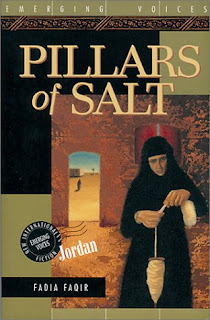
 Pillars of Salt, by Fadia Faqir I was saving this novel for August's Women in Translation event, and got halfway through before I looked at the copyright information and realized that Faqir, a Jordanian author, actually wrote this story in English.  So, oops.  Good thing I've got a Spanish mystery so I won't totally miss out on WIT! Two women are imprisoned in a mental asylum, and tell each other their stories.  Maha's life is told in the first person, in flashbacks.  Um Saad narrates her life to Maha each evening when the lights go out, since they aren't supposed to talk.  And a storyteller jumps in every so often to tell Maha's life through his own malicious and gossipy lens. Maha lives on a small farm with her father and no-good brother.  She is delighted to marry her husband, the Bedouin Harb, and they are deeply in love, but he spends most of the time off in the mountains, raiding English camps.  Despite this, the village is talking about Ma...

A few short stories in Urdu

Image
 Back in August, I got hold of a book of Urdu short stories translated into English.  It's a large book, so I wanted to read just the women authors for WIT, and that would still be a good amount.  August got away from me, and I only read one or two stories back then, but I've continued reading them since.  I've now finished all the short stories in the book that were written by women (luckily for me, there are short biographies in an appendix, since I could only tell from the name about half the time).  I'll just highlight a couple: "The Wagon," by Khalida Asghar, is a hallucinatory, apocalyptic story.  The narrator meets three strange men who are watching the evening sky and point out that it has become red.  No one had noticed until they said so, but the sky is now strangely red.  Then a smell arrives, so offensive and sickening that it causes real pain -- but only once it's pointed out.  And finally, a mysterious wagon, which may be the s...

20 Books of Summer Wrapup

Image
 Well, I'm going to call it good.  I've definitely read 20 books this summer, even if I didn't finish that exact list, and much of it has been very good reading!  The Popol Vuh was a highlight, and so was Piranesi .  I still have a couple of books to post about, too.   I only read one book for #WIT month, which is kind of disappointing.  I have another book of Urdu short stories, but so far I've only read one, so I can't exactly count it.  Oh well. In the fall, I'm very much looking forward to Witch Week , which will take place at Calmgrove this year, and I'll be doing a guest post. Plus RIP season is starting!  I have a couple of fun books for that, but mostly I want to focus on preparing for Witch Week.

Summer 2021: Another Riffle of Reviews!

Image
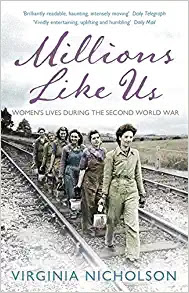
 I want to blog, I really do.  Everything has just been getting away from me so fast!  I'm gearing up to go back to work, which means lots of fun meetings beforehand.   I've officially changed some of my 20 Books of Summer list!  I just can't read it all, but that's OK.  And so, here is my second riffle of reviews... Summerbook #14: Millions Like Us: Women's Lives During the Second World War, by Virginia Nicholson.    The UK seems to have an even more endless and voracious appetite for books about WWII than we do here in the US, which is no surprise.  This book collects the stories of many different women; Nicholson is trying to give us a portrait of the incredible number of ways women lived and worked during the war.  So we have Wrens, WAAFs, land girls, decoders, housewives...Vera Lynn and Vera Brittain.  Nicholson also covers how women managed under wartime conditions -- not just drawing lines up the backs of their legs, bu...

There Once Lived a Woman Who Tried to Kill Her Neighbor's Baby

Image
  There Once Lived a Woman Who Tried to Kill Her Neighbor's Baby: Scary Fairy Tale s, by Ludmilla Petrushevskaya This is the second collection of Petrushevskaya's stories I have read, and she is a great writer, although her material is mostly raw misery, Russian style.  In the other post, I quoted a review blurb as saying, "nothing about it screams 'political' or 'dissident' or anything else.  It just screams."   That said, the 'fairy tale' genre works well.  It actually took me all summer to read this collection; since I often get tired of too many short stories at once, I eked it out over months.  Even so, I can recall first story in the book -- the one about the woman who tried to kill her neighbor's baby -- as though I read it yesterday.  Another story deals with a plague in the city and the family that tries to survive it.  Or there's a teenage girl who dies, and her father makes a deal to save her. Twin ballerinas run afoul of a ...

Summerbook#14: Seeing Red

Image
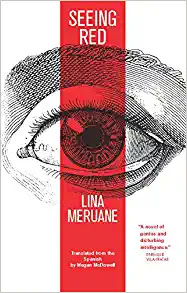
 Seeing Red, by Lina Meruane (Sangre in el ojo) I was quite interested in this Chilean novel, which I saw billed as "one of Chile's most exciting young writers" in her first work translated into English, which was about trauma and its effects.  I didn't quite expect what I got! Lina is a young Chilean grad student living in the US with her boyfriend, Ignacio, but she has to be extremely careful with her eyes, which have a bunch of extra veins growing in them, and they're brittle.  So the first thing that happens is that the veins burst and Lina becomes very nearly blind as one eye fills with blood and the other comes pretty close.* Immediately, her life becomes far more difficult, as she has to take a leave of absence and usually depends on Ignacio to get around.  The doctor wants to wait and see if the blood kind of goes away.  Her family back in Chile want her home immediately and for her to see a proper Chilean doctor; she and Ignacio do travel down, but Lina...

Summerbook #11: The Scapegoat

Image
The Scapegoat, by Sophia Nikolaidou In 1948, an over-eager American journalist reporting on the Greek civil war was pulled out of the bay, murdered.  The American government threatened to withdraw aid unless the killer was found immediately, and so the Greek police decided who did it.  Manolis Gris, a junior reporter, spent 12 years in jail. In 2010, Minas Georgiou is the smartest, and most disaffected, kid at his high school.  Everybody is preparing for the exams, but he doesn't want to go to university or ever take another exam again.  (After all, the Greek economy is in freefall, and there doesn't seem to be much point in anything.)  The maverick teacher at the school gives Minas an assignment: instead of exam prep, investigate the Gris case, and give a presentation on it. The story of the Gris case is presented in a mosaic made of testimonies from the people involved -- almost everyone, except Gris himself.  Blended with the old stories, we see Minas fi...

Summerbook #19: Purge

Image
Purge, by Sofi Oksanen This was a pretty harrowing novel, folks.  It was interesting, and well-written, but I don't think I'll be revisiting it and it should maybe come with a warning on the cover. Aliide Truu, an old woman, lives in her farmhouse on the edge of the Estonian forest.  It's 1992, and an unknown young woman shows up in front of her house.   Zara is running from the terrifying men who captured and trafficked her, but she also has a reason for searching out this particular house. Neither of the women want to tell their stories, but they each need to find out who the other is.  The reader, meanwhile, is given access to chapters of their histories; Aliide remembers successive waves of German and Soviet occupation, her sister's marriage to the man Aliide loved, and just what she did to survive , and to get what she wanted.  Zara grew up in Vladivostok, surrounded by her mother's and grandmother's memories and fears.  When she wanted to ...

Summerbook #18: Lais of Marie de France

Image
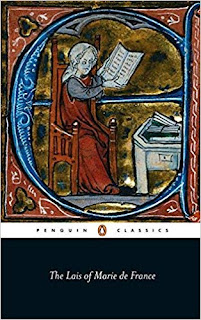
The Lais of Marie de France I didn't know anything about Marie de France, and I wanted to find out, so here we go.  Marie is the earliest French woman poet we know of, and she was writing in the late 1100s.  It seems that she was born in France and then moved to England, and we do not know her real name.  She just said (in Old French) "My name is Marie, and I am from France," and that's what we've got.  Scholars have looked at several Maries of the day, but there is no certain identification.   She was almost certainly known at the court of Henry II and Eleanor of Aquitaine, and her poems were popular in  aristocratic social circles. Marie wrote "lays," that is, narrative poems of a few hundred lines each, and they were based on Breton tales.  We have twelve of these stories.  The majority of them are about knights who fall in love with ladies, or vice-versa, and how they evade one or more spouses in order to carry on affairs.  One lay ...

Summerbook #17: Secondhand Time

Image
Secondhand Time: The Last of the Soviets: An Oral History, by Svetlana Alexievich Wow, this book is...an achievement.  Alexievich won the Nobel Prize in Literature, and it was well-deserved.  It's not a regular book of history; it's more like a monument, really. What Alexievitch does -- has been doing for well over twenty years -- is interview people and transcribe their stories.  Mostly just ordinary people, and the stories are not edited much.  They're just set down.  The result is very immediate; you can almost see the people as they speak. Many of the people in this book are elderly, and tell of long Soviet lives.  Others are quite young and may not even remember Soviet life. There's a former Soviet officer, who offers the rather stunning information that a good 70% of the Soviet economy was militarized, and in his opinion that was only correct.  They weren't about to convert tank factories into factories for toasters!  They had to be ...

Summerbook #15: Paradise of the Blind

Image
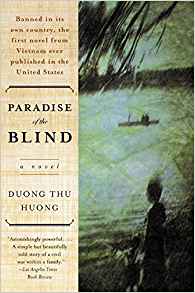
Paradise of the Blind, by Duong Thu Huong This is truly an amazing novel; beautifully written and hard to put down.  It was also banned in Vietnam and the author imprisoned for her writing, which was -- even in a time that was supposed to be welcoming to dissent -- too directly critical for the government's pleasure.  As a young woman, Duong was part of the North Vietnamese Communist Party (she was exactly the age to be a young enthusiast during the war), but became disillusioned and spent the 1980s writing and speaking about what she had witnessed.  She was expelled from the Party and imprisoned for a while, and then released and simply not allowed to travel for years.  In 2006 she moved to Paris, where she still lives today. Hang, a young woman living in Russia as an 'imported worker,' receives a telegram summoning her to Moscow to see her uncle, a cadre leader.  As she travels on the train, she ponders on her family's history in episodes that jump around ...

Summerbook #14: Kalpa Imperial

Image
Kalpa Imperial: The Greatest Empire That Never Was, by Angelica Gorodischer, trans. by Ursula K. Le Guin I'd really been looking forward to this, and it did not disappoint.  Angelica Gorodischer is an Argentinian writer, and has published quite a bit, but this is her first book to be published in English.  This book was originally published in two parts, in the early 1980s.  Each part is a collection of stories. Most of the time, the stories are told by an old storyteller -- but not always.  Some are different.  All purport to tell small parts of the extremely long history of the Empire, which has existed in various forms for thousands of years.  There are dark ages, many dynasties, and waxings and wanings of power. The first story actually tells of the complete destruction of the Empire in what you might call prehistoric times, since all knowledge was lost for quite some time.  People lived in a new stone age until one young man ventured further...

It's almost WIT Month!

Image
And I'm back, just in time! Every August, Meytal hosts Women in Translation Month at Bibliobio .  There is always tons of good information, stuff to think about, and great suggestions for books.  And this year there's a variety of images, too!  I like this one because I like purple and green together. I put three books aside on my 20 Books of Summer list for August.  Since I haven't read them yet, I've lifted the book descriptions: Purge by Sofi Oksanen : Oksanen is a Finnish-Estonian writer, and this novel is written in Finnish but set in Estonia (the languages are related).  It's all about Soviet-occupied Estonia and survival, and I'm really looking forward to it.  A disheveled girl arrives on an older woman's doorstep, and "as their stories come to light, they reveal a tragic family drama of rivalry, lust, and loss that played out during the worst years of Estonia’s Soviet occupation." Paradise of the Blind by Duong Thu Huong: ...

A Sister to Scheherazade -- WIT Month and Summer Book 20

Image
A Sister to Scheherazade, by Assia Djebar August is Women in Translation Month, the time of year when Meytal Radzinski at Bibliobio talks about books by women in translation -- mostly, but certainly not entirely, in the Anglosphere.  The fact is that despite plenty of interesting, intelligent literature written by women in every language, the stuff chosen for translation tends to be much more by men -- who, yes, also write interesting and intelligent literature, but the parity could easily be much better.  Radzinski has recommendations, statistics, and plenty of information available at Bibliobio, so go check it out!  I'm always interested to see what she has to say, and her recommendations are very helpful with my Reading All Around the World project (I have not really paid much attention to gender in choosing my books, but since my tastes do run more to women authors than men, I think I might start to some extent.  I'm finding that frequently, if I choose a boo...

The Story of My Teeth

Image
The Story of My Teeth , by Valeria Luiselli Gustavo Sánchez Sánchez, otherwise known as 'Highway,' has a career change in mid-life and becomes an auctioneer and collector.  Not just any auctioneer, but a legend and story-spinner, who can auction anything by using the auctioneering styles he has learned and invented: hyperbolic, parabolic, allegoric, and more.  Having bought Marilyn Monroe's teeth and implanted them in place of his own, he decides to auction off his original teeth as historical artifacts from famous people.  And then his estranged son steals his teeth and imprisons him in a room with scary video clowns... I am not even kidding about that last one.  This is a surreal novel that reminds me a lot of Mario Bellatin's Shiki Nagaoka .  Bellatin even makes an appearance here, along with many other literary figures, or sometimes just their names attached to other characters.  Highway has an uncle named Juan Pablo Sánchez Sartre. There are a lot ...

Post-summer riffle of reviews: part II

Image
Here is a whole set of books I've read from various countries in the last few weeks.  Most of them will show up in my Reading All Around the World list, and one I picked for August's Women in Translation event, which I nearly missed!  Most of these were also on my original 20 Books of Summer list (which currently stands at 17!  No way will I finish that list in the next week, but I read quite a few other books too). Lyrics Alley, by Leila Aboulela  (Sudan) : This novel of a wealthy and powerful family in 1950s Sudan is a tapestry of interwoven lives.  The patriarch, Mahmoud Bey, is a forward-looking man invested in bringing infrastructure and wealth to his country.  His son, Nur, is about to marry a cousin and they are very much in love, but a tragic accident leaves Nur paralyzed and depressed.  The family dynamics are complex and sometimes disastrous. Nur has to break through the weight of expectations and pity in order to forge a new life and id...

The First Wife

Image
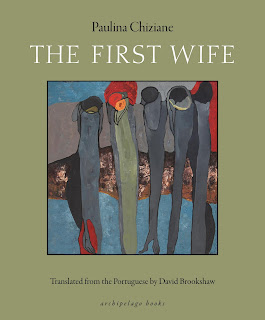
The First Wife: A Tale of Polygamy , by Paulina Chiziane I was intrigued as soon as I saw this novel.  It's the first published by a Mozambican woman, it's about polygamy, plus it's square, which is fun.  So here we go. Rami, the narrator, has been married for twenty years, and to a prominent man -- her husband Tony is the chief of police, so they should have plenty for their needs.  But Tony is not around all that much.  Rami finds out that he has another family; in fact he has four mistresses, and most of them have several children.  Rami alternates between rage and hurt, but as she gets to know the other women, they realize that together they might be able to make Tony live up to his obligations.  They maneuver Tony into a polygamous marriage and start to demand their rights, but it's not a straightforward business. Everything is told from Rami's point of view, and it's kind of stream-of-consciousness.  Rami has a tendency to discourse on t...

The Big Green Tent

Image
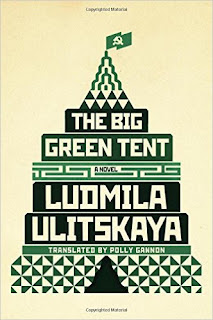
The Big Green Tent , by Ludmila Ulitskaya Phew, I wanted to get this very long novel finished in time for the end of Women in Translation month, and I did!  AND this is the second time I've written this post, because Blogger ate the first one.  I hope I can remember what I said. Three schoolboys become friends in post-Stalinist Russia; so do three girls, in a different class.  Their lives are the lattice for the intertwinings of many characters over four decades.  Many of them are involved with underground activities, the samizdat network or political advocacy.  The story moves around in time, following people through years or decades and then turning back again to other stories. Although the book cover's blurb focuses on the three boys, I really felt that Olga's story is the center of the novel; although she does not appear in the beginning or the end, she dominates half the book, to the point that parts of her story are told twice or even three times, wi...

Last Tales

Image
Last Tales, by Isak Dinesen/Karen Blixen I always enjoy reading Isak Dinesen, and I have just about everything on the bookshelf because I took a course in college that was almost nothing but Dinesen (I did a good bit of Scandinavian literature).  She was an odd duck in her day, and reading her now is almost surreal; the stories are so strange to our sensibilities, especially in this last collection.  She did her level best to write as though she lived in the 18th century, or possibly earlier, and nobody thought more of aristocracy, nobility, or the mysterious power of femininity than she did. I remember once my instructor showed us a photo of her standing on a stage with Betty Friedan.  Two more dissimilar women could hardly be imagined, and I have to wonder if they'd ever read each other's works (probably not) or if they could possibly have had anything to say to one another.  Karen Blixen was tall, slim, elderly, elegant and proud.  She'd probably put bel...