Posts

Showing posts with the label Feminist

Summerbook #12: Crossings
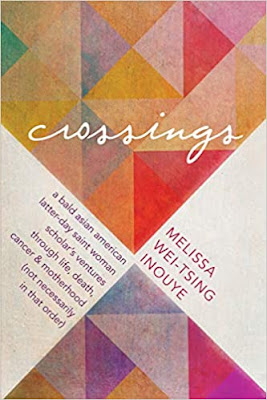
Image
Crossings: A Bald Asian-American Latter-day Saint Woman Scholar's Adventures Through Life, Death, Cancer & Motherhood (Not Necessarily in That Order), by Melissa Wei-Tsing Inouye This book is really a project put together for the author's four children, who are/were too young to read it yet.  But she was dealing with cancer, and wasn't sure she'd survive -- so she put together a collection of essays, letters, talks, and meditations for them to have one day.  (And if it was a published book, it couldn't get lost very easily!)  Lucky for us, the rest of us get to read it too.  I enjoyed this collection a lot, and it gave me some good things to think about.   (Note: I assumed the 'bald' part was due to the cancer, but nope; she had already lost her hair to alopecia in her 20s.) For one thing, she is just very fun to read, and has had an exciting life.  She and her husband/family have lived in Cambridge, Hong Kong, Taiwan, and now Auckland...
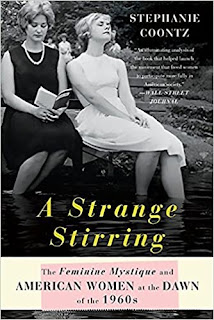
A Strange Stirring

Image
A S trange Sti rring: The Feminine Mystique and American Women at t he D a w n of the 1960s, b y St ephanie Coontz I've meant to read The Feminine Mystique for years, since it was so influential back in the day, but it's huge and I figured it would be boring.  When I spotted this analysis of the book, it took me a while to decide to read it without reading Feminine Mystique first.  But I'm pretty happy that I did, because Coontz is interesting and also not 800 pages long. Coontz offers up a capsule description of the book itself, the context it was written in, the impact it made, and the book's strong and weak points -- as well as some things Friedan wasn't necessarily entirely truthful about.  It makes for pretty good reading! She also tries to blow up some myths about Feminine Mystique .  People have often described it as a book that encouraged women to ignore husband, children, and home in favor of focusing on a full-time career, which apparently is not real...

Women Talking

Image
A remarkably hideous cover IMO Women Talking, by Miriam Toews Whoof, this is a difficult one, folks, so you have been warned.  First a very short background, then the novel, then some information about the reality. For a few years in the mid-2000s, women in a particular Old Order Mennonite colony in Bolivia suffered from mysterious night-time violence.  In 2009, nine men were arrested and charged with drugging entire households with an anesthetic spray in order to rape girls and women.  They were convicted in a mass trial and are in jail. Miriam Toews, who grew up in a more liberal Mennonite family in Canada, wrote Women Talking as a sort of novelistic response to the events in Bolivia.  I don't know that she's actually trying to portray the people and events; the characters are based on people she knew, and she doesn't seem to have gone to Bolivia.  I really get the feeling that she tidied everything up a lot for her narrative, which may have been n...

A Sister to Scheherazade -- WIT Month and Summer Book 20

Image
A Sister to Scheherazade, by Assia Djebar August is Women in Translation Month, the time of year when Meytal Radzinski at Bibliobio talks about books by women in translation -- mostly, but certainly not entirely, in the Anglosphere.  The fact is that despite plenty of interesting, intelligent literature written by women in every language, the stuff chosen for translation tends to be much more by men -- who, yes, also write interesting and intelligent literature, but the parity could easily be much better.  Radzinski has recommendations, statistics, and plenty of information available at Bibliobio, so go check it out!  I'm always interested to see what she has to say, and her recommendations are very helpful with my Reading All Around the World project (I have not really paid much attention to gender in choosing my books, but since my tastes do run more to women authors than men, I think I might start to some extent.  I'm finding that frequently, if I choose a boo...

Women and Appletrees

Image
Nobody in the novel is this well-dressed. Women and Appletrees, by Moa Martinson Moa Martinson (born Helga Maria Swarts) was a Swedish feminist writer who always worked on behalf of the working class.  Her whole life was given to her ideals, especially for working-class women.  (I seem to recall she was also in favor of free love, but that's left over from a long-ago class and may be somebody else.) Women and Appletrees starts with Mother Sofi and her best friend, Fredericka, and their lives in the 1840s.  They farm, and they shock the village with their scandalous habit of bathing once a week.  Sofi has many children, and two generations later... We follow Sally and Ellen, two of Sofi's descendants, through their lives up to about World War I (both are partial autobiographical portraits of Martinson herself, Sally more so).  Both grow up in slums, enduring hunger, violence, and trauma, and end up meeting in a tiny farming village.  Ellen has re...

Witch Week Readalong: The Bloody Chamber

Image
The Bloody Chamber , by Angela Carter   Well, I'm at least a week late with this blog post. Lory had a read along for Witch Week that featured this now-classic book of feminist retellings of fairy tales.  (I have my own ideas about the feminism of fairytales, and in fact just started reading a book...)  Anyway, this collection is from the late 1970s, and you can really tell.  There is a lot about sex, and blood.  More than I would prefer.  It's an OK book, I guess, but it's not really my kind of thing. I quite enjoyed some of the stories, though, or a good deal of them.  There is one about the last of the lady vampires that I enjoyed, and "Wolf-Alice."  "The Bloody Chamber" was mostly quite good, but I got hung up on a detail that about drove me mad; the narrator describes herself going to the opera in "a sinuous shift of white muslin tied with a silk string..."  Well, the sewist in me promptly objects, muslin is an evenweave cotton and...

Fantasia

Image
Fantasia: An Algerian Cavalcade , by Assia Djebar  (from the French L'amour, la fantasia ) In 1830, the French invaded Algeria, turning it into a colony.  Algerians have thus had a tricky dual heritage of Arabic culture and imposed French government and language, and Assia Djebar intertwines pieces of history with stories of the lives of women living within it.  This is a complex book that would keep a college literature class busy for weeks, so I can hardly do it justice here, but here are some themes: A 'fantasia,' to Arabs, is indeed what I might call a cavalcade: a procession of riders on horseback, showing off their skills at a gallop, and incidentally firing rifles and yelling.  In the Romance languages, it means a free-form musical composition that wanders around.  Both of these meanings are put into use, and sections of the book are named after sections of a musical composition as Djebar demonstrates her skills as a storyteller. Language, and cul...

The Joys of Motherhood

Image
The Joys of Motherhood, by Buchi Emecheta I've never read a Buchi Emecheta novel before.  It was recommended on Celestine's blog, Reading Pleasure, so I picked it up as part of my prospective summer reading. A young mother, mad with grief, runs away from her home to kill herself by jumping off a bridge... And then the story goes back 25 years to tell the story of Nnu Ego's life, starting with her mother's story.  Nnu Ego grows up as the favorite daughter of her eminent father, and he wants a good marriage for her, but she doesn't get pregnant and eventually her husband shoves her aside.  Nnu Ego is sent to the big city of Lagos to marry another man, who she desperately hopes will give her children.  Emecheta writes ambiguously, both defending and critiquing traditional Ibo ways.  Nnu Ego lives by them strictly, but comes to question her life and wonder if she will ever be free.  Everywhere she turns, she is chained by obligation, rules of status,...

Little Women

Image
Little Women , by Lousia May Alcott I'm going to be writing a bit about this book for the Feminist Classics Project, so this is just a quick post to say that I read Little Women over the past few days and enjoyed it thoroughly.  I always refused to read it when I was a kid--I avoided anything with the word 'classic' on it, especially anything American--and I missed out!  When the movie came out in the mid-90s, an old friend of mine found out that I had never read it.  She bought me a copy, and I have just re-read it again.

My brief moment in the spotlight is over

Image
With the end of March, the discussion at the Year of Feminist Classics blog on Christine de Pizan's Book of the City of Ladies is wrapping up . My problem with this book is that I like it too much and can't think of much to say about it except that. Head on over if you'd like to express an opinion, or just admire my lovely picture of the Virgin Mary being welcomed into the City of Ladies.

I've hit the big time

Image
That's right, I'm blogging a little bit over at A Year of Feminist Classics this year. I suggested Christine de Pizan's Book of the City of Ladies as a reading choice this year, it was selected as the book for March, and now it's my task to host the discussion. Let's hope I do a good job. Check out the introductory post! (It's a little bit embarrassing really, because I had never even heard of the book until JNCL put it in her Medieval Challenge and Eva commented that it was a response to the Romance of the Rose .)

2011 Challenges Wrap-Up

Image
I'm a few days early, but I'm going to wrap things up now. The Year of Feminist Classics Challenge: I read nearly all the selections, but opted out of God Dies by the Nile, The Second Sex , and the academic anthology (I looked at it!). I'm pretty satisfied with that even though I don't get to tick all the boxes, but the real point is that I got to read a lot of great books and enjoyed them very much. A Vindication of the Rights of Women by Mary Wollestonecraft So Long a Letter by Mariama Ba The Subjection of Women by John Stuart Mill and Harriet Taylor Mill A Doll’s House by Henrik Ibsen Herland by Charlotte Perkins Gilman A Room of One’s Own by Virginia Woolf God Dies by the Nile by Nawal Saadawi The Second Sex by Simone de Beauvoir The Woman Warrior by Maxine Hong Kingston The Beauty Myth by Naomi Wolf Ain’t I a Woman? by bell hooks Third World Women and the Politics of Feminism Anthology Gender Trouble by Judith Butler Sister Outsider by Audre Lorde Victo...

Feminist Classics: Sister Outsider

Image
Sister Outsider , by Audre Lorde This collection of essays, speeches, and other pieces by Audre Lorde was worth reading (and in my view better than the last one on our list!). The pieces that interested me most tended to be the ones that recounted Lorde's personal experiences: an essay about a visit to the USSR, excerpts from an interview, and "Eye to Eye." I don't know that I have a lot of amazing insight into the book, but it was an excellent addition to this year's list of feminist works. This book also wraps up the list! Stay tuned for a possible continuation of the project.

Feminist Classics: Gender Trouble

Image
Gender Trouble , by Judith Butler This book is famous for its impenetrability, and the reputation is deserved. Butler's prose will leave most people confused and frustrated, and that includes me. I am conceding defeat on this one; I got about halfway through it, and my ILL copy has to go back. A fairly easy sentence taken at random from page 7 reads, "As a result, gender is not to culture as sex is to nature; gender is also the discursive/cultural means by which "sexed nature" or "a natural sex" is produced and established as "prediscursive," prior to culture, a politically neutral surface on which culture acts." The liberal use of quotation marks is a consistent feature of the book, since Butler is trying to question the meaning of all the words. To me it read as a more opaque version of the kind of academic prose that seeks to impress readers through jargon. I'm not sure I buy the necessity of that kind of language. Too often it s...

Feminist Classics: Ain't I a Woman?

Image
Ain't I a Woman?: Black Women and Feminism , by bell hooks This month we read bell hooks' 1981 book Ain't I a Woman , which chronicles the massive injustices black women have endured in America, from colonial days right up to the time the book was written. I completely agree with hooks' main premise that black women have suffered from a double bind of racism and sexism. It's hard to argue with that! It was both fascinating and painful to read; I had to take it fairly slowly. I did feel like she made more generalizations and used more stereotypes than she maybe should have. It's possible that in 1980, academics hadn't yet gotten obsessed with making those distinctions in the way that we do now, but I would have expected a lot more language along the lines of " many black women..." or most white women..." and so on. Or, in the first section on Colonial history, she does seem to use a lot of stereotypes about religion at the time and I thi...

Feminist Classics: The Beauty Myth

Image
The Beauty Myth: How Images of Beauty are Used Against Women, by Naomi Wolf When Naomi Wolf published her diatribe against ridiculously unrealistic standards of beauty in 1991, doing such a thing was kind of new (at least, after the 80's). The Beauty Myth has had a lot of influence over the past 20 years. Thanks partly to Wolf, books denouncing the objectification and commercialization of women are now pretty common. Many more people are aware that our ideals of beauty are unrealistic and unattainable, and our ideas about beauty have expanded a bit to include some variation. At the same time, the standards have only gotten less realistic; Photoshop means that every image in every publication is fixed up to reflect something that no one could attain, and there is no such thing as being too gaunt. Look back at some 80's models and marvel at their curves! So this was an important book. But I didn't enjoy reading it, and I didn't finish it. Wolf makes some really gr...

Feminist Challenge: The Woman Warrior

Image
The Woman Warrior , by Maxine Hong Kingston This was a really famous and somewhat controversial book when I read it in college. I'm glad I got the chance to read it again now and absorb it better. The Woman Warrior is a collection of sort-of-personal-memoir, sort-of-fictional pieces with the common theme of a Chinese-American immigrant (or children of immigrants) experience, especially for women, with a lot of folk belief, imagination, and insanity thrown in. It's a very readable book with lots to think about, and would make a good book club selection. I also just like the look of Maxine Hong Kingston, and think she would be an interesting person to see in real life.

Feminist Challenge: A Room of One's Own

Image
A Room of One's Own , by Virginia Woolf This is the May title for the Feminist Classics Reading Challenge, and I enjoyed reading it. I read it once before in college and remember several parts, but it was very nice to get the whole picture. I was really not in a mood to be patient with Virginia Woolf, but her assertions in this essay are difficult to argue with. Woolf points out that the reason that women in the past never did much writing was for the simple reason that they were almost never allowed to do so. No matter how much talent a woman might have had, she was kept much too busy serving her family; education and personal leisure time were not considered in the least necessary for women, and most likely bad for them. Woolf concludes that the only way for a woman to be able to become a writer is for her to have an income of 500 pounds a year without having to work for it (quite a nice income, which would allow for a flat and a servant or so) and a "room of her own...

Week 20: Reading Women

Image
Reading Women : How the Great Books of Feminism Changed my Life, by Stephanie Staal The Feminist Literature Challenge I'm participating in gave away a copy of this book, which seemed nicely thematic. I didn't win, so I went and found a copy for myself. Stephanie Staal is your average 30-something New York writer--very intelligent, went to a fancy college (Barnard), lived in New York City, high-powered career, got married to a nice guy and then had a baby girl. Motherhood and the usual attending difficulties--dividing time between work and family, less time for husband, too much housework and no time or help--threw her for quite a loop, and she decided to try to take some time to find herself and audit the same Feminist Literature courses she loved as a 19-year-old undergraduate. So this is part personal memoir and part reaction to feminist classics. At first I was quite annoyed by Staal, who has a very nice life--which, at least, she freely admits--and is kind of unhappy ab...

Feminist Challenge: Herland

Image
Herland , by Charlotte Perkins Gilman Charlotte Gilman Perkins was a Victorian feminist writer, most famous for her rather creepy short novella The Yellow Wallpaper . Herland was published serially in her magazine, The Forerunner, and was Gilman's attempt to show that only feminism and socialism could produce a just and peaceful society. Three men on an exploring trip find a long-lost civilization where, amazingly, there are no men. (The men were killed off 2000 years ago, and the women are miraculously parthenogenic, all descended from the single woman who developed that trait.) This women-only society is the most peaceful and advanced ever seen. Without the constant pressure of sex roles, the women have banded together and planned their society. After over 1500 years of work, they have accomplished much. Motherhood is the focus of their society, which is centered around the children, and everything is done collectively. Working together, the women have eradicated disease...