Posts

Showing posts with the label Eastern European literature

Finishing all those books in November

Image
 I'm working on that pile!  Here are three of my pile books, plus two quick reads I stuck in around the edges. Junk Film: Why Bad Movies Matter , by Katharine Coldiron -- This book was just a delight to me, but then it was written by somebody who likes many of the same terrible movies I do but is much more knowledgeable than I am.  The first third of the book is dedicated to a monograph of Plan 9 From Outer Space and what makes it so interesting as a terrible movie.  Wonderful!  She talks about a failed TV show called Cop Rock in which somebody mashed a serious procedural cop show with a musical -- "I promise this is true."  Coldiron gets into literature and compares Irene Iddesleigh with Sean Penn's novels.  She explains why a low-budget 70s horror film called Death Bed is actually pretty good.  I loved it. If you like bad movies, this is a great book for you.  Others possibly not so much.     How Democracies Die , by Steven L...
Three Apples Fell From the Sky

Image
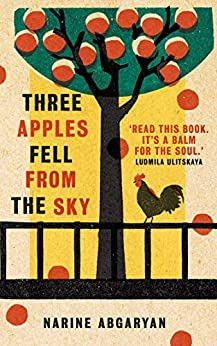
 Three Apples Fell From the Sky, by Narine Abgaryan This novel is advertised as a Russian best-seller, but that seems to mean that it was a big hit in Russia, not that it is a Russian novel, because it isn't.  Narine Abgaryan is Armenian, and her story is set in Armenia, completely suffused with an Armenian atmosphere (I conclude, never having been there myself).   Anatolia has spent her life in Maran, a tiny village clinging to the side of a great mountain.  These days, Maran is inhabited only by the old; after the disasters of past decades (an earthquake that swallowed part of the village, the war, the famine that killed so many), what few young people who were left had to go.  Anatolia and her neighbors live as they have always done, but they are the last, and now Anatolia is dying. At least, she believes herself to be dying, and gets everything ready so that her best friend will find her properly.  As she lays down and prepares for death, something...

Summer 2021: Another Riffle of Reviews!

Image
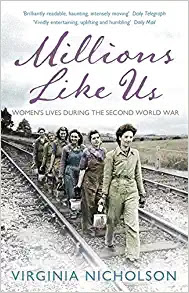
 I want to blog, I really do.  Everything has just been getting away from me so fast!  I'm gearing up to go back to work, which means lots of fun meetings beforehand.   I've officially changed some of my 20 Books of Summer list!  I just can't read it all, but that's OK.  And so, here is my second riffle of reviews... Summerbook #14: Millions Like Us: Women's Lives During the Second World War, by Virginia Nicholson.    The UK seems to have an even more endless and voracious appetite for books about WWII than we do here in the US, which is no surprise.  This book collects the stories of many different women; Nicholson is trying to give us a portrait of the incredible number of ways women lived and worked during the war.  So we have Wrens, WAAFs, land girls, decoders, housewives...Vera Lynn and Vera Brittain.  Nicholson also covers how women managed under wartime conditions -- not just drawing lines up the backs of their legs, bu...

The Traditional Summer Riffle of Reviews

Image
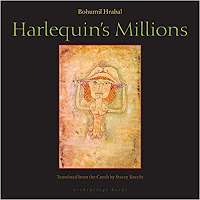
 Well, I got busy with...stuff...and didn't write any posts for a couple of weeks, and now I have a pile of books, but no more energy than I started with.  So let's just catch up with a riffle of reviews, yes? I'm doing well with the Popol Vuh (which is FASCINATING) and only OK with my 20 Books of Summer.  I mean, I'm currently reading books 14, 15, and 16 -- and one is a WIT title, with another upcoming -- but I have serious doubts that I can read the entire Ring of Bright Water trilogy by the end of the month, especially since I have three or four library books that are crying out for attention...so I'll probably change my list a bit.  And now: Summerbook #11: Harlequin's Millions, by Bohumil Hrabal.   Hrabal's later novel is all about growing old.  In a town "where time stands still," the local castle has been converted into an old folks' home.  Our narrator, a woman who remains unnamed, wanders around the grounds and, in her mind, throug...

For Two Thousand Years

Image
I love this cover, I do  For Two Thousand Years, by Mihail Sebastian  I only heard of this novel/writer in the last couple of years, and it should be better known!  This is an amazing book, and also sort of semi-biographical.  Sebastian had this charismatic professor who is portrayed in the novel, and he asked him to write the foreword, which he did; but the foreword was a vicious polemic.  Sebastian published it anyway.  And it's not included here, presumably because of the 'vicious polemic' part. This is a diary that covers about ten years (1923 - 33), and the narrator remains unnamed.  He starts as a Jewish university student in Bucharest, and the university houses other students who make it a point to bar Jewish students from classes and beat them up.  Getting to class is an impossible daily ordeal.  Some Jewish students enjoy the street battles and fistfights, and in their dingy dormitory, they discuss Zionism and Communism and so on....

Summerbook #18: White Guard

Image
 White Guard, by Mikhail Bulgakov This is Mikhail Bulgakov's first novel, written in 1921 and published serially -- except that the magazine shut down and the last part of the novel was not published at the time.  Instead, it was turned into a play, The Days of the Turbins, and the play was such a smash hit that the novel was kind of ignored.  Bulgakov didn't finish it for several years. It is 1918, and the Turbins of Kiev are a family of three siblings: Elena, whose husband has been working for the German hetman, Alexei, a doctor with the Russian (White) army, and Nikolka, just 17.  They belong to the Russian-based urban/military class.  Ukraine has been pulled nearly to pieces in the complicated war; at the start of the novel, the Germans had installed a hetman to run the country for them, but now they are pulling out.  Elena's husband heads out with them.  Now there are three sides to the war: the Russian military trying to restore the Empire, Petly...

Summerbook #15: Black Renaissance

Image
 Black Renaissance, by Miklós Szentkuthy  Miklós Szentkuthy, Hungarian and cosmopolitan (that is, he was in favor of pan-Europeanism rather than nationalism), wrote a sort-of-fictional synthesis of European history and culture, seen through his own very strange lens, and narrated by "St. Orpheus."  The ten volumes of St. Orpheus' Breviary span decades of work and centuries of history, and swirl around the 'marriage of Athens and Jerusalem' -- the contradictions, fractures, and cruelties that make up European history -- but nothing about this is straightforward or anything most people would recognize as history, or logic, or even narrative.  Black Renaissance was written in 1939 (but the title doesn't seem to have anything to do with contemporaneous events).  Also, I love the cover so much, I can't even tell you.  This is a fantastic cover. Now, obviously a work like that is going to be way over my head.  I won't claim to have understood this book....

The Zelmenyaners

Image
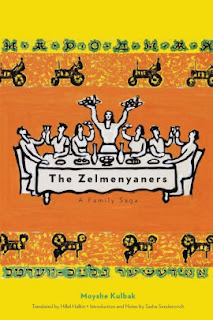
The Zelmenyaners, by Moyshe Kulbak A couple of years ago, I read Outwitting History, about saving Yiddish literature from the dumpster of history.  IT was one of my favorite books of the year, and it put some Yiddish titles on my wishlist.  This was one of them, and I finally picked it up! The Zelmenyaners appeared in a serial format in a Yiddish monthly magazine called Shtern (the Star), published in the Soviet Union.  It was actually two series; the first one ran in 1929 - 1930, and the second 1933 - 1935.  It became a comic family saga, about a Jewish family in Minsk. None of the Zelmanyaners are actually named that.  Their father, Reb Zelmele, has been dead for a while now, but it's still his courtyard, with his descendants all living around in a big house, and little houses, and stables.  Bubbe Bashe is their matriarch, and she's so old she's like a little hen.  The four sons now have children and grandchildren, and so there are Zelmenyan...

Everything Happens As It Does

Image
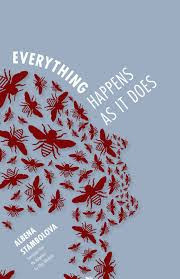
Everything Happens As It Does , by Albena Stambolova, trans. by Olga Nikolova Published in 2002, in English in 2013, winner of 2013 Contemporary Bulgarian Writers Contest Now that Bulgarian Literature Month is almost over at GLLI , I can publish my post here.  Head on over to see what's been going on before it's all done!   Thomas has been doing a great job. Albena Stambolova, originally from Sofia, is a psychoanalyst and writer.  She lived and taught in Paris for some years in the 1990s, but returned to Bulgaria and won recognition with this, her first novel.  Since then, she has published two more novels, as well as essays and short stories. Everything Happens As It Does is something of a mosaic whose pieces, some not visibly related, eventually go to make up a complete and satisfying pattern.  We follow characters who then disappear for a while as others take the stage without warning, and we are left to draw connections between them.  Every...

Bulgarian Literature Month, or, Jean writes a guest post

Image
June is Bulgarian Literature Month!  Thomas of My Two Stotinki has hosted events in June before, and this year he is hosting an entire month of posts at the Global Literature in Libraries Initiativ e, which is an organization encouraging....global literature in libraries!  I've been following them for quite some time, so when Thomas put out a call for people to review Bulgarian books, I was both excited and very intimidated.  I took a deep breath and volunteered to read and review Everything Happens As It Does. Take a look and read the other articles too!  There's a lot of neat stuff happening over there this month. My post went live over a week ago, but I've been overwhelmed with the end of school.  It turns out that getting a freshman and a senior through finals (and graduated!) is way more work than I was expecting, and WAY more work than homeschooling them.  Massive final projects, frazzled nerves (theirs and mine), and endless ceremonies and ga...

The Dawning

Image
The Dawning, by Milka Bajic-Poderegin I now have a pile of books that is really pretty daunting; there are nine sitting here waiting for me.  But I have an interesting reason; I've been working on a guest post and it's taking up most of my blogging time.  It's for a much more professional kind of blog, and I'm quite nervous about the whole thing.  Stay tuned! I think I mentioned that my husband and I spent a weekend at Tahoe recently, and the long drive back and forth gave me some fabulous reading time.  I spent much of it immersed in this lovely novel.  I found it at my library and thought it would make a good pick for my reading around the world project; the back cover copy said it was set in Bosnia.  Well, it turned out to be a good deal more complex than that once I really got started! The Dawning was written in Serbo-Croatian about (mostly) ethnic Serbs, set in what was then Bosnia and Herzegovina, and is now Montenegro.  I finally decide...

Pan Tadeusz

Image
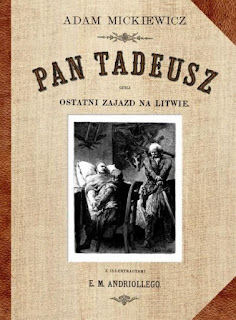
 Pan Tadeusz: The Last Foray in Lithuania, by Adam Mickiewicz It's the Polish national epic poem!  Also the last great European epic poem, if you believe the comments.  I guess there weren't a lot of epic poems written after 1834, so it's probably fair enough.  It's twelve books long and was written in Polish alexandrines, but my translation is just prose.  It ends up reading like a rather odd novel.  Adam Mickiewicz was a poet and philosopher, and he was living in exile in Paris when he wrote this; otherwise the Russians would never have allowed it to be published.  At the time of writing, Poland had been partitioned into three pieces and shared out between Russia, Prussia, and Austria, but the story takes place at a time when Napoleon had interrupted that partition and established a Duchy of Warsaw.  Note, though, that the geographic area in the story is always called Lithuania.  It's the name of the region, not of the country, and not...

The Faithful River

Image
The Faithful River, by Stefan Å»eromski  A badly wounded soldier, near death, stumbles into a mostly-deserted manor house.  The only people there are Salomea, a young woman whose father is off fighting, and an elderly cook.  They take the soldier in and hide him during his long, slow recovery. The novel, published in 1912, is set during the Polish uprising of 1863 and 1864, when Polish volunteers fought the Russian occupation of the eastern part of the country.  Poland didn't technically exist at this time, having been carved up and shared out between Austria-Hungary, Russia, and Prussia.  The novel is set in what is now south-central Poland, the Kielce region, and I think the river must be the Vistula.  The reader doesn't need to know a lot of this background, but a little bit is helpful. Josef Odrowaz is a dashing young nobleman -- or he was, before the Russian troops slaughtered every wounded man on the battlefield.  Now he is only barely al...

Alamut

Image
Alamut , by Vladimir Bartol This book has so much backstory and explanation involved that I feel like I'm going to bore you stiff -- except that it's all so interesting! In the 1930s, Vladimir Bartol wrote this novel, which was a pretty weird novel by the standards of his day and thoroughly annoyed his fellow writers.  Bartol was Slovenian, and the fashion was to write realistic portrayals of the struggles of Slovenians.  It certainly was not to write long, elaborate, highly-researched historical novels set in 11th-century Persia that were in fact kind of allegorical meditations on the rise of fascism across Europe.  But that is what Bartol did, and then he wanted to dedicate his book to Mussolini; but his publisher talked him out of doing such a dangerous thing.  Although nobody quite knew what to do with Alamut at the time, it became a beloved classic to Yugoslavians and then to the rest of Europe, but was only translated into English in 2004.  It even ...

Bai Ganyo

Image
Bai Ganyo: Incredible Tales of a Modern Bulgarian, by Aleko Konstantinov Everybody's doing 2017 halfway posts!  And that sounds like a really fun thing to do, but I'm going out of town for a few days, and rushing around getting ready, so perhaps I'll manage one when I get back.  Meanwhile, imagine me on a beach, and enjoy the single post I'm able to write before I go. Aleko Konstantinov was a Bulgarian political journalist, and he wrote this comic novel around 1895 (two years before he was assassinated).  As far as I can tell, Bai Ganyo became an instant popular classic and has been a favorite ever since.   It's a collection of stories about Ganyo Balkanski, a seller of rose-oil. Bai Ganyo is everybody's embarrassing uncle.  He blusters and barges in where he isn't wanted.  He is a master at mooching off anyone and everyone.  He pinches respectable shopgirls and propositions honorable matrons.  He needs to bathe more often, and he's vocal ...

The Widow Killer

Image
The Widow Killer, by Pavel Kohout I've been reading this book forever, or at least that's what it feels like!  Despite being a quite exciting murder mystery/thriller set in Prague at the end of World War II, I had a hard time getting into the story and was very slow about reading it.  It was good, though. We follow three men: Jan Morava, young Czech detective in occupied Prague, Erwin Buback, disillusioned Gestapo agent, and the murderer himself, who is a serial killer insanely obsessed with widows.  Over the months it takes for the case to unfold, the Russians move ever closer to the city and both Jan and Buback find love.  The killer just finds new victims and drives poor Jan mad with frustration. It's a long, intricate story and I was glad I read it, slowly though I went.  I partly grabbed the book because of the author; Kohout was a Czech Communist who became a dissident -- a leader of the 1968 Prague Spring, expelled from the Party and the country,...

Girl at War

Image
Girl at War , by Sara Nović In 1991, Ana is a happy, rough-and-tumble girl of ten.  She and her best friend Luka get up to all sorts of things in their beloved city of Zagreb.  When the Yugoslavian civil war breaks out, things slowly deteriorate until Ana's family is caught up directly into the war. Ten years later, Ana is a college student in New York with a lot of secrets.  She hasn't told anyone about her past, but she finds that she can't leave it behind her, so on a whim, she goes back to Croatia and hopes to find her old friend.  There, she tries to figure out how to confront and absorb the things that happened to her -- which we only discover as she re-lives them. This is a really absorbing YA novel that is part historical fiction (for an actual YA -- to me it feels immediate) and part coming-of-age, even though Ana is actually an adult.  Having been through what she has been, she had to grow up fast, but is also a bit stuck. Her story, for the mo...

9 Rabbits

Image
Mystery cover explained below Nine Rabbits , by Virginia Zaharieva Waaaaay back in the spring, Thomas at My Two Stotinki hosted a giveaway of two Bulgarian novels.  To my delight, I won this copy of 9 Rabbits , and he sent it off.  It showed up at my house about four months later, having been through a postal odyssey, and I had about given up hope--but it did arrive!  And so I read it. I honestly can't quite tell whether this is a novel, a memoir, or--I'm pretty sure--a mix of both.  It reads like a memoir, sort of, and quite a bit of it seems to be from Zaharieva's own life.  It's all in little vignette chapters. The first part of the book is about childhood; little Manda lives with her grandmother, in the country, and every so often her grandfather or her mother shows up.  There are cousins and uncles, adventures on the shore, and a lot of gardening.  Grandmother is no kindly nurturer.  She's an unstable despot most of the time, angry ...

King Stakh's Wild Hunt

Image
King Stakh's Wild Hunt , by Uladzimir Karatkevich I have no real idea of where I heard of this title.  It's been on my wishlist for a while and when I went on an ILL binge, I included it.  My copy came all the way from Florida!  It's a really nice copy, too, a hardback printed in 2012 by Glagoslav , a publishing outfit that specializes in Slavic books. Uladzimir Karatkevich was a Belarussian author, a pretty famous one, and he published this novel in 1974.  It's supposed to be something of a modern classic, or so they say.  I liked it.  It's very Gothic!  Appropriate to the fall season, and it could have been an RIP title if I had joined RIP this year, which I forgot to do. Belaretsky is an ethnographer who travels around his beloved Belarus, collecting old folktales and songs.  Upon arrival in a remote country district, he meets a girl--Nadzeya Yanovsky, the last of her line, living in a near-derelict manor, who expects to die under the f...