Posts

Showing posts with the label books everyone should read

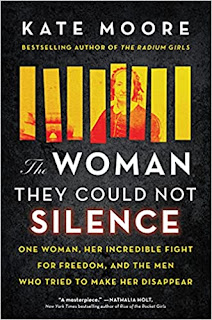
The Woman They Could Not Silence
Image
 The Woman They Could Not Silence: One Woman, Her Incredible Fight for Freedom, and the Men Who Tried to Make Her Disappear, by Kate Moore  It's hard to say anything about this book besides --- wowzers, this is a fantastic, amazing story, and everyone should read it.  Including you. This is the life story of Elizabeth Packard, a completely ordinary woman, wife, and mother of six in Illinois.  In 1860, as the United States was headed towards war, Elizabeth and her husband were in disagreement about religion.  Theophilus was a Presbyterian minister, and while Elizabeth had been joyfully discovering new ideas about women's rights, he was under pressure to guide his congregation into a stricter, more conservative theology (which, among other things, was neutral about slavery, in contrast to the church's previous anti-slavery position).  Elizabeth's insistence on her right to read widely, have her own ideas, and argue them in public grated on Theophilus, and he ...

Twilight of Democracy

Image
Twilight of Democracy: The Seductive Lure of Authoritarianism, by Anne Appleb aum I admire Anne Applebaum a lot!  So I actually bought this.  Be impressed.  It's a short, and very personal, book that meditates on recent history and the dangers of authoritarianism.  Why is it attractive to so many?  How long can you hold on to a relationship when the other person espouses beliefs you can't agree with? Applebaum starts with an engaging story -- a New Year's Eve party, 1999, in Poland -- a gathering of writers, thinkers, and dissidents.  Communism is defeated, and surely liberal democracy is the future.  But now, 20 years later, the group of former friends is split.  Many are involved in Poland's new authoritarian government. A large part of the book is dedicated to how Poland got where it is now -- a history that includes conspiracy theory used as a tool by the power-hungry, and which uses the same old familiar weapons of nationalism, violence, fea...

Love Your Enemies

Image
Love Your Enemies: How Decent People Can Save America From the Culture of Contempt, by Arthur C. Brooks It is now too long since I read this (very fascinating) treatise for me to be able to write a good post about it.  So I hope that even a fairly mediocre post will convince you that this is a good title to go out and read as soon as possible.  Also, it's not a very long book, only a couple of hundred pages, so there's no reason to put it off. Brooks asks: are you sick of fighting yet?  Of screaming at people who don't listen and only scream right back?  Maybe it's time we tried something a little different.  He figures the only way to get anything done -- to improve civic life, bring people together, look for some unity even when we disagree -- is to "practice warm-heartedness."  (He asked the Dalai Lama.)  Listen to others with an open heart, engage with love, will the good of others, and disagree with respect. ...there is a practical, albeit ...

Alienated America

Image
Alienated America: Why Some Places Thrive While Others Collapse, by Timothy P. Carney After the 2016 election, we all saw a lot of people trying to figure out just how and why Trump won.  There's been a lot of blame going around, but I've never really seen an explanation that I thought really hit the nail on the head, until I ran into this book.  Carney focused in on the original, core Trump fan base -- not the people who eventually voted for him because he was the Republican nominee, but the people who really cottoned on to his campaign from the beginning -- and looked for the common denominator. Carney's thesis was that certain segments of the population really resonated with Trump's declaration that the American dream is dead.  A lot of people didn't agree with that at all, but that's because this is all geographically based.  There are plenty of places in the US where the American dream is dead, and those are the places that produced Trump's core. ...

Black Earth

Image
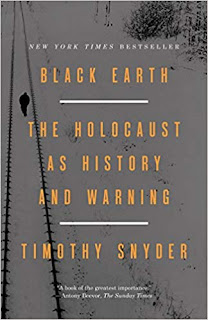
Black Earth: the Holocaust as History and Warning, by Timothy Snyder This is a truly great work of history, one I would highly recommend.  It's also quite a dense and difficult read, which is why it took me something like 3 months to get through.  It took some concentration to read -- something I don't always have in large supply! -- and it was one of those books where it's very easy to read two pages and then realize you have no idea what those pages said.  It was very worth it, though; this is an important work. An interesting thing about this book is that it barely touches on the usual focus of the Holocaust: Auschwitz and other famous concentration camps.  Most of this book is about the political background and development of the Holocaust, the beginnings, who cooperated and how.  There is much more about death squads in Eastern Europe. Snyder gives the most lucid and practical explication of Hitler's philosophy -- if such it can be called -- that I ...

How to Think

Image
How to Think, by Alan Jacobs  I'm going to make a judgement here, and that is that every college student and adult ought to read this book.  It's short and painless, so entirely doable!  I heard about this, by the way, from a favorite podcast I didn't mention before (because it's not literary), No Dumb Questions with Destin and Matt.  Destin does the Smarter Every Day channel on Youtube , and all of us are big fans.  Matt is a smart dude too, and they just talk and it's hugely entertaining.  They have kind of a book club, and they discussed this one a while ago.  I'm not current on their podcast, so I have yet to read a book along with them.  Anyway... Alan Jacobs teaches at a college, and he wants us all to learn to think a bit better -- especially on Twitter.  Really thinking is not easy; it's uncomfortable, and kind of hard work, so our brains don't like to do it.  So in short chapters, Jacobs tackles various aspects of thinkin...

Factfulness

Image
Factfulness: Ten Reasons We're Wrong About the World -- and Why Things Are Better Than You Think, by Hans Rosling This book has been making something of a splash in non-fiction and especially tech circles.  Bill Gates endorsed it, so that's probably making an impression in a lot of places.  It's the sort of book I really like, but I wasn't in a big hurry, so I put my name on the hold list at the public library and then didn't actually read the book until 4 days before it was due back.  I thought maybe I'd skim and get it later, but instead I was instantly grabbed, and read the whole thing in less than 24 hours.  (Although it's a thickish book, it's quite fast to read.)  Now I'm pushing it to the top of my blogging pile, since I have to return it right away! Hans Rosling was a doctor, expert in international health, speaker, and adviser to WHO and UNICEF.  His TED talks are popular, he helped co-found Doctors Without Borders in his native Sweden...

The Upside of Stress

Image
The Upside of Stress: Why Stress is Good For You, and How to Get Good At It, by Kelly McGonigal Well, you have to read a book by Professor McGonigal.  This was actually recommended to me, and now I'm going to recommend it to all of you, even every member of my family, because I plan to make them read it too.  It's just a really interesting book that contains some fascinating research into the nature of stress, how we deal with it, and how we can deal with it a lot better by tweaking a few thoughts. One weird element of modern society is that people tell us to avoid stress in such a way that just makes most people laugh hopelessly.  We're convinced that stress makes us sick and unhappy, and yet most of us cannot avoid difficult workplaces, illness in the family, financial worries, and lots of other stressful things.  BUT!  It turns out that stress is far more complex than we thought, and humans are in fact great at dealing with it.  This makes intuitive...

On Tyranny

Image
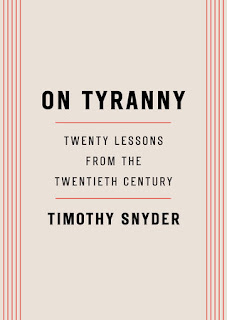
On Tyranny: Twenty Lessons From the Twentieth Century, by Timothy Snyder A couple of years ago, I read Timothy Snyder's excellent account of Eastern Europe in the 20th century, Bloodlands .  It was a fantastic book, though one of the grimmest I've ever read.  But Snyder knows what he's talking about, and so when he writes a little teeny book about tyranny that takes its lessons from his historical knowledge, I think it's a good idea to read it. I do mean it's teeny.  This is not a scholarly or heavy work; it's more like a short tutorial for Americans.  It has 20 sections, each just a few pages long, illustrating a rule: 1) Do not obey in advance.  3) Beware the one-party state.  5) Remember professional ethics.  12) Make eye contact and small talk.  14) Establish a private life.  19) Be a patriot. As such, it's a pretty quick read and one that most people can read with interest.  Most of the examples are taken from World War II, s...

Voices From Chernobyl

Image
Voices From Chernobyl: the Oral History of a Nuclear Disaster, by Svetlana Alexievich Svetlana Alexievich is a major presence on my mental TBR shelf, and I was really sorry I didn't think to put this on my 20 Books of Summer list.  I wanted to start here and then move on to Secondhand Time and her newly published (in English) Unwomanly Face of War.   This is not her entire output; there is also Zinky Boys , about Soviet soldiers in Afghanistan, so there's plenty to read. Alexievich is a Belarussian journalist who has made it her life's work to collect testimonies and oral histories of the USSR.  She arranges them in a collage sort of form to communicate the emotional history and impact of the events described.  She's been doing this kind of thing since the early 1980s, but much of it was repressed under the Soviet government, and then Lukashenko's Belarussian government persecuted her as well, so that she had to leave from 2000 - 2011. In 2015, she was award...

Getting to Green

Image
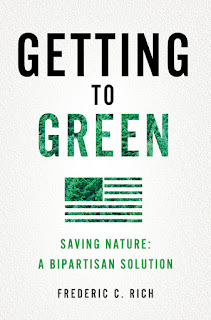
Getting to Green: Saving Nature: A Bipartisan Solution , by Frederic C. Rich I really liked this book!  It has a hopeful tone and is all about the massive common ground we really have in the US about environmental issues.  I also read it right before the inauguration, which made it read a little differently than it sounded when Rich wrote it (it was published in 2016, so I'm assuming he wrote it in 2015).  After that it became a weirdly ironic book as the last couple of weeks have unfolded.  Thus my delay in writing about it... Rich's premise is that the trend of hyperpartisanism we've had for the past few administrations has really hurt our ability to get anything real done.  The last really effective piece of federal environmental legislation passed was in 1990, when Bush signed the Clean Air Act that called for a reduction in emissions that produced acid rain.  That bipartisan-designed legislation was a huge success; atmospheric acids were sharply ...

Up From Slavery

Image
Up From Slavery , by Booker T. Washington A few years ago I read W. E. B. DuBois' The Souls of Black Folk  as part of my Classics Club list and realized that really, I should have read Up From Slavery first, since DuBois was responding to Washington in his book, although DuBois was writing analytical and historical essays on several topics, while Washington was mostly writing a memoir in which he also talked about his ideas.  But then I didn't get a copy for a long time, until a friend of mine traded my DuBois for his Washington.  Once I got started, I didn't put it down and devoured the whole thing as fast as I could. Washington recounts his early life in slavery, and young manhood in freedom.  He wanted desperately to go to school, and mostly persevered despite the difficulties poverty threw in his way.  At last he conceived an ambition to attend a black technical school that he heard would allow students to work for their board.  His determination ...

The Screwtape Letters

Image
The Screwtape Letters , by C. S. Lewis As long as I was reading about suffering and the meaning of life and all with Viktor Frankl, I picked up the Screwtape Letters again as well.  I'm pretty sure we should all be reading this book every couple of years, regardless of religion, because Lewis is just so good at understanding human nature.  I run into myself every couple of pages. Since it's one of the most famous books around, it probably doesn't need me to explain it, but....Lewis writes a comedic and sharply insightful set of letters analyzing human nature--from the point of view of a devil in the business of tempting.  One very nice element is the image of Hell; as a member of the century that saw the rise of organized, bureaucratic genocide, Lewis paints Hell as a massive bureaucracy, with the office workers all quietly scheming to do each other down. Every letter from Screwtape to the lesser demon Wormwood discusses some point about humanity--and very frequent...

Beverly Cleary Turns 100

Image
Today I have a guest post!  It is Beverly Cleary's 100th birthday today, and my mom--Cleary fan and children's librarian extraordinaire--very kindly wrote a post for me in honor of the day.  I hope you will enjoy a Beverly Cleary book today! Here’s a big Happy 100th Birthday to Beverly Cleary, beloved author of dozens of children’s books and two memoirs. As someone who grew up in the 1950s, I am part of the baby-boomer generation, but that also makes me a member of the Beverly Cleary generation. Her stories of Henry Huggins, Beezus and Ramona, and Ellen Tebbits are the stories I grew up on. By the ‘60s I had grown beyond reading Beverly Cleary, so I never read The Mouse and the Motorcycle , or her later Ramona books, or her Newbery Medal-winning Dear Mr. Henshaw , until I became a children’s librarian (like Beverly Cleary) myself. I met Beverly Cleary once, at a library conference when I was living in Bakersfield in the early 1970s. I asked her to sign my...

Man's Search for Meaning

Image
Man's Search for Meaning , by Viktor Frankl I've been wanting to re-read this for a while.  I think it qualifies as one of the important books of the 20th century, a must-read, though I'm not sure how Frankl's ideas about psychotherapy are viewed now. The first half of the book is Frankl's personal account of his time in Nazi concentration camps.   It's not chronological and exact; it's more a series of stories and impressions, and his views on how he and his fellow prisoners kept going--or not--under such horrific conditions.  Frankl's assertion is that the way to find meaning in life, under any circumstance, is to turn the question around: .. .it did not really matter what we expected from life, but rather what life expected from us.  We needed to stop asking about the meaning of life, and instead to think of ourselves as those who were being questioned by life--daily and hourly.  Our answer must consist, not in talk and meditation, but in rig...

The Gulag Archipelago

Image
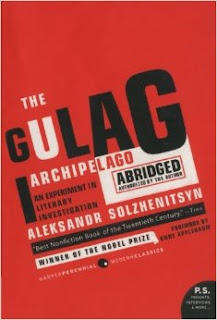
The Gulag Archipelago: an Experiment in Literary Investigation, Abridged Edition , by Aleksandr Solzhenitsyn A while ago I said that Bloodlands was the most unremittingly grim and tragic book I'd ever read, but now I have to say that the Gulag Archipelago is just as grim--and I only read the abridged edition.  This is also a completely amazing book, when you know about how Solzhenitsyn did it.  He was himself a zek (as you know already), and during his time in the gulag he talked with many other people and remembered their cases.  This gigantic three-volume work is a history of the gulag, compiled from these first-hand narratives and from things people wrote to him.  He could not do much other research, of course, and his writing had to be completely secret.  In fact, he mentions once or twice that he never really expects anyone else to see his book at all. In the foreword, Anne Applebaum (author of Iron Curtain , which is also on my pile) says that So...

Kindly Inquisitors

Image
Kindly Inquisitors: the New Attacks on Free Thought, by Jonathan Rauch OK, people, this is it.  THIS is the best book I have read so far this year (in the non-fiction category, but way above most of the fiction too, I just don't want to dis DWJ here).  And everybody should read it who plans to be a citizen of a country.  Or ruler of their own one-person country, it would be important then too.  You wouldn't want to oppress anyone, now would you? In 1993, Rauch published this treatise about the importance of free speech, free thought, and the whole system he calls "liberal science."  He used the then-current case of the fatwa against Salman Rushdie for writing The Satanic Verses as a special example of the importance of free speech.  It was a timely book, what with the quick rise of political correctness on college campuses and all.  Nobody paid a lick of attention, so in 2013 Rauch wrote another chapter and re-published the book.   Rauch e...