Posts

Showing posts with the label Japanese literature

More Uketsu: Strange things!

Image
Strange Pictures , by Uketsu This is a prose novel, not a graphic novel, but it still revolves around pictures.  We have four short stories, each of which involves a mystery about one or more hand-drawn pictures -- some by children, some by adult artists.  In the end, the narratives fit together to solve a larger mystery about a very quiet serial killer -- a story that has lasted decades.  It was a good read, on the fast and easy side. We start with an abandoned blog discovered by two students who think there's a puzzle involved.  The writer starts off happy and excited that his wife is going to have a baby, and is then grief-stricken when she dies during childbirth.  Three years later, he erases most of the entries, posts a cryptic note, and the blog ends.  Who is the note addressed to?  What of this little family?  Through three more seemingly unrelated stories, the solution eventually comes out.        The Strange House, vo...

The Strange House

Image
 The Strange House, vols 1 and 2, by Uketsu  This is at least a trilogy, but so far only the first two have been published.  Uketsu is an odd Japanese artist/ Youtuber /author, whose videos and books have made something of a splash.  As far as I can tell, no one admits to knowing who Uketsu actually is -- the artist is always masked. The unnamed narrator is asked to investigate an unusual floor plan for a house that previously belonged to a married couple with a child.  This doesn't seem like something she knows much about, so she asks an architect friend who is into the occult; maybe he can come up with something.  Kurihara studies the floor plans, notes its oddities, and spins the craziest, most macabre theories you've ever heard.   Then they connect this house to the inhabitants' previous home, which also seems odd.  And a woman claiming to be the wife of a murder victim shows up, asking for help.  Everything just gets more complex i...

The Strange Library

Image
 The Strange Library, by Haruki Murakami This is a funky little story -- at just 72 pages long, with a lot of artwork, it's a short story, not a novel.  It's a bit like somebody let Tim Holz illustrate it, but in fact the marbled papers and illustrations come from books found in the London Library (which I am still bitter about not being allowed to visit). Our narrator, an unnamed boy, just wants to return his library books and ask for a new one.  He's directed to room 107, in the cellar, and soon he is imprisoned and on a strange adventure.  Assisted by a mysterious girl and a sheep man, he meets all sorts of dangers; will he ever get home to his mother? An intriguing read, sometimes hard on the eyes (pale grey ink on magenta, whose idea was that?), and worth the time, which isn't much. 

Playing Catch-Up With Autumn

Image
Well, the world is on fire and I'm deeply upset about it, but this is not a blog about world events and politics, so let's escape for a bit with some books for the younger crowd....    Temple Alley Summer, by Sachiko Kashiwaba : This is a charming middle-grade novel translated from the Japanese.  Kazu lives in a big old house in an old neighborhood, and one night he sees a girl in a white kimono walk through.  The next day she is in his class -- and she has always been there.  Everyone but Kazu has known her for years.  And then he learns that his street used to be called Kimyo Temple Street, which implies that people can be brought back to life.  This is going to be a summer of adventure for Kazu and Akari, as they become friends and figure out what's going on. This is an unusual story, and I enjoyed it a lot.  It won the Batchelder award for translated literature.   The Last Cuentista, by Donna Barba Higuera : Petra Peña lives in New Mexico...

In May I truly think it best...

Image
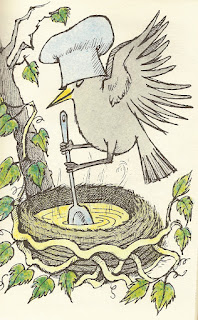
 ...to read lots of books?  That doesn't rhyme.  I have to do it right. ...to be a robin lightly dressed, concocting soup inside my nest! Mix it once, mix it twice, mix that chicken soup with rice! No, actually, I'm not making soup, I'm reading books.  Quite a few books, so here at the halfway point I'm doing a post.  The Marquis' Secret, by George MacDonald:   I'm a bit of a sucker for these sort-of translated 1980s Bethany House versions of George MacDonald's very Victorian Scottish romances.  This one was originally The Marquis of Lossie , a sequel to Malcolm.  Malcolm, a poor fisher-boy, is the true heir to the estate of Lossie, but his half-sister Florimel (a definite Faerie Queene reference!) thinks she is, and so he becomes her groom in hopes of finding a way to break the news to her without ruining her life.  Confusion and hijinks ensue; Malcolm despairs of influencing his sister for good; and also he falls in love.  Can this ...

Summerbook #2: The Honjin Murders

Image
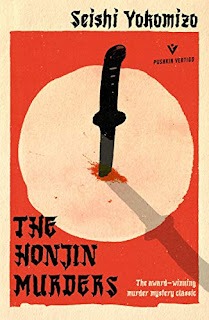
 The Honjin Murders, by Seishi Yokomoto Winter 1937: in a small village, the well-off and proud Ichiyanagi family is preparing for a wedding.  The eldest son of the house, Kenzo, is finally getting married to a lovely girl, but the family is disapproving, because of her ordinary family background.  The Ichiyanagi family is intensely proud of their family history; they once owned a honjin, an inn for officials.  The day before the wedding, a strange man, wearing a mask over part of his face (much like a modern covid mask!), has been asking questions. The newlywed couple is spending their wedding night in a small annexe house, away from the main family compound.  In the middle of the night, strange sounds and screams are heard -- and then silence.  The house is locked up tight, and the family has to break down a shutter to get it, but then they find husband and wife, gruesomely murdered.  Outside, a blood-covered katana sword stands, point-down in the sn...

Amrita

Image
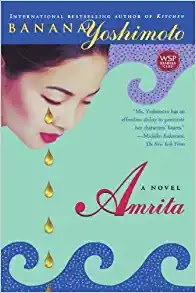
Amrita, by Banana Yoshimoto Banana Yoshimoto is just so darn famous that I'd really been meaning to read one of her works, so I've had Amrita sitting around the house for a while.  And I did it!  I liked this novel, but I'm finding it hard to describe. Sakumi is just a 90s girl in Tokyo, a young adult.  Her sister, Mayu, was a famous movie star whose life ended in a tragic suicide, and Sakumi herself is recovering from a severe accidental head injury; she's lost large chunks of her memory.  Through the novel, she takes her younger brother (who has some sort of ESP) and her sister's former boyfriend along on her journey through her dreams, thoughts, and grief, making some new friends along the way. This is not a novel that is packed with action.  Things happen, and they are carefully savored.  Other people -- their appearances, reactions, and feelings -- are described at length.  Memories and emotions are noticed and saved for later.  Much of...

Plans for 2020

Image
The New Year is fast approaching, and I haven't done any wrap-ups or sign-ups or anything.  I've gotta get moving!  So I'm going to take a page from other posts I've seen and cram a few things in together. Every year I think about cutting back on challenges, and every year challenges pop up that are irresistible to my very greedy book-loving heart.  However, all the challenges I want to join are in line with my existing goals, which are: Continue to work on Reading ALL Around the World and my Classics Club list ; Read as much history as I can cram into my brain (favorite things: UK and Russia/Eastern Europe); Also and at the same time, read whatever I want.  Totally doable, right?  So, here are two events coming up soon, and two of the challenges that I plan to sign up for (but not all, because I'm still hoping some favorites will appear): My favorite way to kick off a new year, the Vintage Sci-Fi Not-a-Challenge, is hosted by Little Red .  I've ...

Kappa

Image
Kappa, by Akutagawa Ryonosuke The poet Akutagawa, who suffered from mental illness or depression for most of his life, wrote this novella in 1927 at top speed, in just a couple of weeks.  He did this right after his sister's husband committed suicide, leaving him to straighten out a terrible financial mess.  The story was written out of his disgust with life, the world, and most of all with himself. This is the narrative of patient #23 in a mental hospital: he met a kappa one day and chased it, falling into Kappaland.  He had to join Kappa society, learn to speak, and make friends.  After a year or so, he became disenchanted with Kappa life and found a way back home, but now he wants only to return, and he describes his friends and Kappa society to anyone who will listen. When a Kappa is about to be born, the father yells in to it and asks if it really wants to be born and exist, warning it to think carefully.  The child in the story answers:  "I do ...

The Kojiki

Image
The Kojiki: an Account of Ancient Matters, by ÅŒ no Yasumaro Here we have Japan's earliest chronicle, giving the descent of the Yamato dynasty.  It dates from the 8th century, and was written by a courtier at the request of the Empress Gemmei.   The chronicle is in three parts, and roughly they are myth, legend, and history.  The first section deals with the creation of the world and with kami --translated here as 'spirits.'  These are the stories that became part of the Shinto religion.  (It's very much like Hesiod's Theogony , being a genealogy of divinities.)  The story of Amaterasu is found here, and the ancient beginnings of the Yamato line. The second, legendary part sounds a lot like the first, except that we've mostly moved into the world of people by now.  It becomes a kingship chronicle, with interesting legends attached.  These kings, however, are too far back to be able to confirm much about their existence.  And the thi...

The Makioka Sisters

Image
The Makioka Sisters , by Junichiro Tanizaki The Classics Spin wouldn't help me out, so I finally got around to reading it on my own.  The back copy says that The Makioka Sisters "is arguably the greatest Japanese novel of the twentieth century," so wow!  I did in fact really enjoy it. This is a long and deceptively quiet novel.  We have four sisters of a once-prominent Osaka family: Tsuruko, the oldest, married with several children, she and her husband are the head branch of the family Sachiko, also married, usually hosts her younger sisters and is the most active in their future plans, Yukiko, elegant and quiet, "a real old-fashioned Osaka lady," but getting worryingly old for marriage arrangements, Taeko, lively, modern, and independent, she has her plans already laid out. In years past, the family has been too picky about marriage proposals for Yukiko and now they are not so frequent.  Getting Yukiko married to a good man is the spine of the story...

Colorless Tsukuru Tazaki and His Years of Pilgrimage

Image
The US cover without jacket, which is how I got it Colorless Tsukuru Tazaki and His Years of Pilgrimage , by Haruki Murakami I must confess that I have not had a ton of luck with Murakami in the past.  I liked After the Quake pretty well, but gave up on IQ84 after about 8 pages.  I wasn't too sure I wanted to read Colorless Tsukuru , but the cover is pretty hard to resist and I thought I'd give it a try and I could always quit if I didn't like it.  I was pleasantly surprised to find that I enjoyed it quite a bit, and in fact I think I finished it in just one day. Tsukuru Tazaki has never had a high opinion of himself.  He thinks of himself as lacking personality, "an empty vessel" with nothing much to offer.  In high school, he belonged to a close-knit group of 5 friends, and even then he wasn't sure he was worthy, but then they kicked him out of the group with no explanation; just "we never want to see you again."  At age 35, he looks rea...

The Sound of the Mountain

Image
The Sound of the Mountain , by Yasunari Kawabata Kawabata first became famous in the West for his short stories and two short novels.  He won the 1968 Nobel Prize for literature.  This novel was published in 1949, but not in English until after the Nobel Prize.  My book blurb lauds it as "one of his most important works--both longer and more complex" than his other novels.  The Sound of the Mountain describes the inner life of an elderly businessman named Shingo, who observes his dysfunctional family and his own old age.  His childrens' marriages are foundering, he is more fond of his daughter-in-law than of his own daughter, he is distant from his wife, and his most intense feelings seem to be reserved for flowers and art. I honestly did not care about this book, or the people in it, or anything much.  I planned to like it.  I expected to like it.  At the beginning I was rather tickled to see that Shingo lives in Kamakura, where my mom liv...