Posts

Showing posts with the label Translation Challenge

The Absolute at Large

Image
The Absolute at Large, by Karel Č apek It's Karel Č apek's first novel!  Printed in 1922, two years after the play R. U. R ., this is another science-fiction premise, and--at least at first--it's a bit comedic. It a futuristic 1943, an engineer comes up with a machine (the Karburator) that produces power by annihilating matter completely; the energy contained in each atom is liberated and consumed, thus providing practically infinite power from tiny amounts of fuel.  Unfortunately, it turns out that matter has two parts.  There is the physical part, which produces the atomic energy, and there is also the spiritual component, which, when destroyed, releases the Absolute into the air.  If you conceive of God being present in all matter, well, now it's free and floating around.  Anyone who gets near a Karburator experiences religious ecstasy.  They perform miracles and healings, or give away all their goods to the poor, or start preaching, or perhaps...

Chaka

Image
Chaka,  by Thomas Mofolo I have here on my desk a pile of seven books to post about.  With most of them, I want to discuss things and talk at length!  But, with everything going on, I might have to do a mini-review roundup.  We shall see.  But for the moment, let us talk about Chaka . Chaka was written in the Sesotho language in 1909, but not published until 1925 (with some revisions).  It was translated into English in 1931.  It is a fictionalized account of the life of Chaka, the chieftain that united the Zulu tribes through conquest, and then went on to conquer quite a bit of South Africa, in the early 19th century.  Despite the more adulatory legends around his name, Chaka was a brutal warlord who killed an awful lot of people, his own as well as those he conquered, and he was pretty good at the whole thought-policing thing too.  Mofolo writes a story about Chaka that brings in quite a lot of...not symbolism...more like he puts elem...

The Travels of Marco Polo

Image
The Travels of Marco Polo In 1271, a young Marco Polo traveled to China with his father and uncle, and he spent almost the next twenty years traveling around the East--China, India, Indonesia, even Zanzibar.  He is said to have worked for Kubilai Khan as a diplomat.  He returned to the West in 1295 and some time later was captured as a prisoner of war.  In prison, he met Rustichello of Pisa, who wrote down his stories, and together they produced The Travels , written in Old French with quite a bit of Italian mixed in.  It was a massive popular success even during Polo's lifetime, though right from the beginning people questioned Polo's veracity.  Even now it makes for exciting reading. Polo starts off by describing the route to China, skipping most of the places already well-known to Westerners, so that he spends a limited amount of time in the Middle East.  When he gets to Persia, he describes Parsi believers, saying that the Magi were from here and id...

Women and Appletrees

Image
Nobody in the novel is this well-dressed. Women and Appletrees, by Moa Martinson Moa Martinson (born Helga Maria Swarts) was a Swedish feminist writer who always worked on behalf of the working class.  Her whole life was given to her ideals, especially for working-class women.  (I seem to recall she was also in favor of free love, but that's left over from a long-ago class and may be somebody else.) Women and Appletrees starts with Mother Sofi and her best friend, Fredericka, and their lives in the 1840s.  They farm, and they shock the village with their scandalous habit of bathing once a week.  Sofi has many children, and two generations later... We follow Sally and Ellen, two of Sofi's descendants, through their lives up to about World War I (both are partial autobiographical portraits of Martinson herself, Sally more so).  Both grow up in slums, enduring hunger, violence, and trauma, and end up meeting in a tiny farming village.  Ellen has re...

The Brothers Karamazov

Image
The Brothers Karamazov , by Fyodor Dostoevsky I've been working on this novel for a couple of months.  Now I'm not sure what to say about it.  What is there for me to say about one of the great masterworks of the 19th century and of Russian literature?  It is beautiful, and I loved most of it.  I wasn't too hot on the trial and the long lawyers' speeches.  I thought the translation was pretty great.  Not that I know a lot about translating Russian literature, but I liked the feel and I could tell it was Dostoevsky and not Gogol or Tolstoy.  I read the Pevear/Volokhonsky translation, and it came with a good tip: Karamazov is pronounced with a regular old Z, not a ZT sort of sound like Mozart.  Who knew? This is a pretty hopeless post really but hey everybody, read The Brothers Karamazov if you can!  It's a great work of literature and a great experience too.

The Ancrene Riwle

Image
The Ancrene Riwle: A Rule for Religious Women, trans. by M. B. Salu  I'm still making an effort not to type, so here we go with another dictated post.  (Note after finishing: voice software mostly does not get the word "anchoresses," but it sure does make some creative stabs at interpretation!)     While I was reading The Fellowship , it mentioned that Tolkien had taken on a project of translating a rule for anchoresses written in Anglo-Saxon. It took him ages to finish, of course. I don't think he managed to publish until the 1960s, or even later. But I instantly needed to read the book. It turns out that Miss Salu got in ahead of him, and this translation from the 1950's is the most readily available. Tolkien put in a nice introduction, which I must say was gracious of him.   This rulebook of instruction was written in a Western dialect of Anglo-Saxon in the 14th century, by an unknown author who was addressing three women - they seem to be sisters...

The Hand of a Great Master

Image
The Hand of a Great Master , by Konstanineh Gamsakhardia When I was reading Eight Pieces of Empire a little while ago, the author mentioned that Georgians place a great value on their literature. He mentioned one of their favorite national authors, Konstanineh Gamsakhurdia, and I thought I would like to read one of his books. The particular book I was looking for doesn't seem to be available in English. In fact, I could only find one book that had been translated into English at all. And so I read that. I got it through InterLibrary Loan, and it came all the way from Kansas. It was kind of a cool book, since it was printed in Moscow in 1962. As far as I can tell, it's the only time Gamsakhurdia has been printed in English.        Svetitskhoveli Cathedral The Hand of a Great Master is historical fiction, set an 11th century Georgia. It deals with the construction of the great Svetitskhoveli Cathedral, which still exists today. Although the st...

Three Plays by Karel Čapek

Image
Three Plays by Karel Č apek I read R. U. R. a while back, and I wanted to read the other three plays in the book, but I didn't get around to it for quite a while.  Silly, because they are pretty neat. The Insect Pla y: an entomologist observes several different kinds of insects, who illustrate types of humanity.  Butterflies are flirtatious Bright Young Things with just one thing on their minds; dung-beetles only think about gathering wealth, while crickets are all about family, and ants have a fascist war-machine going. The Makropulos Case : a lovely singer captivates everyone she meets.  Men all want her; women all want to be her, but she is incredibly cold and unfeeling.  It's about mortality and the necessity of death. The White Plague : a new illness, which looks like leprosy but only attacks those over fifty, is becoming an epidemic.  No-one can escape, and it's always fatal.  A young slum-clinic doctor develops a cure, but he will only gi...

The True Deceiver

Image
The True Deceiver, by Tove Jansson Tove Jansson is always worth reading, and this is an intriguing short novel that I think is also her darkest. In a remote village that is nearly cut off by winter snows, Katri Kling is an outsider.  She lives with her simple brother Mats and her menacing, unnamed dog, and she's been planning for a long time.  Mats' security is her goal; her method will be to take over the life of Anna Aemelin, an artist.  I enjoy Jansson's prose a lot, with its extreme particularity and focus on certain things.  I think a lot of her own thoughts about art and questions about what obligations the artist has to the audience show up in Anna's character, which is neat.  The main theme, though, is deception: what constitutes honesty or deception?  Each woman considers herself to be honest, but that doesn't mean that they always tell the truth. Excellent short novel--pick it up if you can.

Tevye the Dairyman

Image
This new edition has two books Tevye the Dairyman, by Sholem Aleichem I was excited to read these Yiddish short stories, published over 20 years (1895 - 1915), by the great Jewish writer and humorist Sholem Aleichem.  (That's a funny pseudonym that means, pretty much, "hello how are you" -- his real name was Sholem Rabinovitch.)  These are the stories that Fiddler on the Roof is based on.  So, excitement!  Except then I realized that Fiddler on the Roof always makes me cry.  And the stories, of course, are more realistic and rougher and more tragic and do not have fun songs.  They are still done in this humorous Tevye style, but oh boy.  So--be prepared. The musical writers did stick fairly close to the main events over several stories, so you'll see a lot of familiar points.  Tevye's "dream" really is in the Tzeitl story, so that made me happy.  The stories give us two more daughters (Tevye says he has seven, but one or two disa...

The Gulag Archipelago

Image
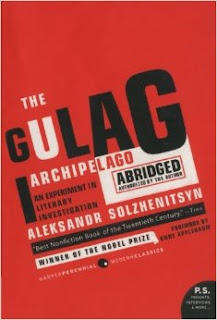
The Gulag Archipelago: an Experiment in Literary Investigation, Abridged Edition , by Aleksandr Solzhenitsyn A while ago I said that Bloodlands was the most unremittingly grim and tragic book I'd ever read, but now I have to say that the Gulag Archipelago is just as grim--and I only read the abridged edition.  This is also a completely amazing book, when you know about how Solzhenitsyn did it.  He was himself a zek (as you know already), and during his time in the gulag he talked with many other people and remembered their cases.  This gigantic three-volume work is a history of the gulag, compiled from these first-hand narratives and from things people wrote to him.  He could not do much other research, of course, and his writing had to be completely secret.  In fact, he mentions once or twice that he never really expects anyone else to see his book at all. In the foreword, Anne Applebaum (author of Iron Curtain , which is also on my pile) says that So...

Ecclesiastical History of the English People

Image
Ecclesiastical History of the English People, by the Venerable Bede Woohoo, my Anglo-Saxon mood wound up with the entire Ecclesiastical History!  It was neat stuff. Bede was a monk at the monastery of Jarrow in the kingdom of Northumbria.  He entered the monastery as a child for his education and stayed, becoming a respected writer and historian.  Jarrow had contacts with the prominent people of the day and Bede sent an early copy of his work to the king. The History is divided into five books.  Book I gives a historical background of Britain and information about the Roman era.  It kind of skims over early Christian history in England which is treated in much more detail in the other books.  II lauds Pope Gregory and shows a lot of missionary work in England as kings and their peoples are converted.   III is a lot of fun.  Here we learn about the lives of Bishop Aidan and King Oswald, and all the miracles attributed to them.  ...

The Cloud Messenger

Image
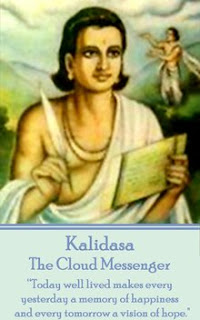
Meghadutam, or, The Cloud Messenger, by Kalidasa I must say, the Classics Club has been good for me. When I first compiled the list, I added a bunch of titles that I didn't actually know what they were.  Surprise is good, right?  Several of the surprise titles were ancient or medieval texts from Asian sources.  So, I have Kojiki (Japanese) and Muqaddimah (Arabic) on my list, and I'm tracking those down.  And I had The Cloud Messenger , by Kalidasa, who lived about 1500 years ago and wrote in Sanskrit.  Kalidasa wrote plays and poetry, and the web page where I read the poem says that he "created a new genre in Sanskrit literature" with The Cloud Messenger .  Instead of an epic or a hymn, this is a poem about love and longing.  It's too long to be called a lyric, but the website describes it as elegiac, which is pretty good. In the poem, a young Yaksha--an attendant on Kubera, the god of wealth--has committed some fault and has been exiled from t...

An African in Greenland

Image
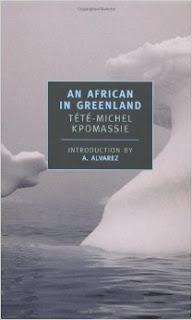
An African in Greenland, by Tete-Michel Kpomassie Resist this fabulous memoir if you can ( which you can't ).  In the later 1950s, Michel is your average 16-year-old in Togoland, living your average life, until he sees a book about Greenland.  The idea of a place so completely opposite to his home--cold and frozen all the time, with no trees, and with a culture that listens to children--intrigued him so much that he decided he ought to go there.  And so he did.  (It helped that his father had just promised him to the python cult, to be trained as a priest.)  Michel left home and worked his way north.  It took six years to get out of Africa, and another two to work his way up to Denmark, where he could embark for Greenland.  All the while, he was studying through correspondence courses, and picked up several new languages. Most of the book covers Michel's 16 months in Greenland itself, though.  He starts off in the south, and stays for a while...

The Song of the Volsungs

Image
The Song of the Volsungs After the Beowulf readalong, I went on quite the Anglo-Saxon/early medieval kick.  Beowulf mentioned Sigurd, so I wanted to read his story.  I read some little texts from the British Museum about the Lewis Chessmen and the Sutton Hoo helmet; those were great. Then I started the Venerable Bede's Ecclesiastical History , but I'm not finished with that yet; still about 100 pages to go there.  Anyway, for Sigurd's story I picked up this fancy new Penguin edition, featuring the 1990 translation by Jesse L. Byock. The saga traces the history of the Volsung clan, starting with Sigi and going down through lots of murders and power struggles and incest (!) and people murdering their own children (!) until we get to Sigurd, who kills the dragon Fafnir.  Fafnir has not always been a dragon; he is the brother of Regin and was once human.  Regin gets Sigurd to agree to kill Fafnir by promising him the dragon's massive hoard of gold. This was...

Beowulf Readalong: Week IV and Wrapup

Image
I'm saying goodbye to Beowulf.  This last section of the poem skims over 50 years of Beowulf's rule as a good and righteous king to tell the story of his last days.  An escaped slave wandered into a barrow and woke up the dragon sleeping there (I really like this bit actually, as it explains that the barrow is a very ancient one built by a people now long gone.  The dragon found the treasure inside and has been guarding it for 300 years.), and now the dragon is terrorizing the Geats and looking for his lost gold cup.  Only Beowulf can face the dragon! So King Beowulf--who is at least 70--puts on his trusty armor and vows not to leave the barrow until he has killed the monster inside.  Only one of his thanes is brave enough to follow him in and assist--his young kinsman Wiglaf.  Beowulf battles the dragon, and Wiglaf gets in a thrust that weakens the monster enough that Beowulf can deliver a killing blow.  Dying from blood loss and dragon venom, he ...

My Uncle Napoleon

Image
Fabulous cover! My Uncle Napoleon , by Iraj Pezeshkzad A large Iranian family lives in a compound of houses surrounding a garden, and they're ruled over by the patriarch, Dear Uncle.  He has so much admiration for Napoleon, and so much conviction that his own life mirrors that of the French general, that the kids call him Dear Uncle Napoleon.  In fact he is narrow, paranoid, and blustering; he's convinced himself that he was a great warrior against the English in his youth, and the whole family revolves around his tyrannical bad temper. And the narrator, a young boy who is never named, falls in love with Dear Uncle's daughter Layli. Unfortunately, the boy's father has a bit of a feud going with Dear Uncle, and spends most of the novel encouraging his paranoia about the English.  Boy's only confidant is his Uncle Asadollah, who is sympathetic, but also has a one-track mind.  His solution is always the same--"a little trip to San Francisco," which ...

Falling in Love

Image
Falling in Love: Stories from Ming China , trans. by Patrick Hanan Chinese society during the Ming era was highly restrictive when it came to marriage.  Girls were kept secluded, away from possible temptation, and marriages were arranged between families.  Naturally therefore, romantic stories were hugely popular (much like Bollywood movies in India, but more so!).  In most of these stories, the characters fall in love by seeing each other--after all, there was no chance that anyone would be talking and getting to know one another.  They then find some kind of strategem for meeting and quickly get to the physical stuff; there is no time for lots of dialogue or anything like that. The seven stories in this collection show a wide variety of plots and moral approaches to the material.  The writers' sympathies are with the lovers, but only some really approve of the action.  Others enjoy the story but warn readers that this kind of stuff can only end in tra...

Galileo

Image
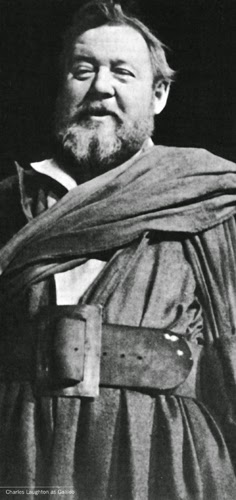
Galileo, by Bertolt Brecht Hey, everybody--I've been reading a good bit, but blogging has been just about impossible lately.  Still, I've got plenty to tell you and I'm determined to have my say for Elizabeth Goudge Week (starts today!) and Trollope's birthday month (go enter the giveaway!) before it's over. And now, to Bertolt Brecht's famous play, Galileo ... I've figured it out.  It's all Brecht's fault.  I blame him.  Or at least partly.  It's Brecht's fault that everybody thinks that medieval people were anti-science and all that.  Because he wrote this play, which shows Galileo kind of knuckling under to the evil Catholic Church because of cowardice, and we've all seen that scene acted out....  But!  Brecht wasn't the least bit interested in showing a historically accurate Galileo.  In fact, he happily gets a whole lot about Galileo's actual life quite wrong.  What Brecht was interested in was using the Galilean ...

Sanaaq

Image
Sanaaq , by Mitiarjuk Nappaaluk This book is one of the perks of my job.  Now that I get to buy literature, I can spend time searching for books from all over the world, and I can find neat stuff like this! Sanaaq is an Inuit novel, the first written in the language.  It started off as a vocabulary exercise.  In the early 1950s, a priest studying Inuttitut asked 22-year-old Mitiarjuk Nappaaluk, a respected member of the community, to write down some phrases for him to learn.  Instead of making a vocabulary list, Mitiarjuk starting writing little vignettes about Inuit life.  She invented characters, gave them a story, and over a period of years wrote an entire novel--without ever having read a novel in her life.  She re-invented the novel, in fact. This is the story of the young widow Sanaaq, her young daughter Qumaq, and the people around them.  They go about their everyday lives, hunting, building, and producing just about everything they use....