Posts

Showing posts with the label read around the world

August Reading, Part II: 20? Books of Summer
Image
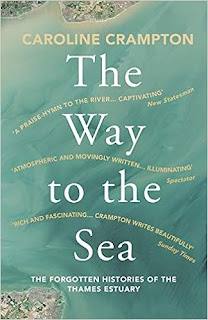
 Did I do it?  Did I hit my goal of 20 books by September 1st?  I did, and also I've been very busy and unable to finish this post.  So here we go... Summerbook #17: The Way to the Sea , by Caroline Crampton:   Crampton does a podcast I listen to ( Shedunnit ), so when she wrote this book I wanted to find a copy, but it was only published in the UK.  It's all about the Thames estuary - the bit between London and the sea -- which is where Crampton grew up, on a boat half the time.  She actually starts at the source of the Thames, but covers from there to Tower Bridge in the first chapter.  After that she gets down to business and covers history, the state of the river, ecology, and throws in bits of her own memory.  People have tended to ignore the estuary or use it as a place to dump things they don't want to look at, from actual garbage to sewage treatment and power stations.  These days the shipping is there too; an absolutely massive...
In May I truly think it best...

Image
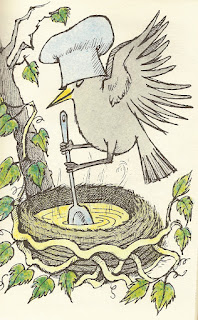
 ...to read lots of books?  That doesn't rhyme.  I have to do it right. ...to be a robin lightly dressed, concocting soup inside my nest! Mix it once, mix it twice, mix that chicken soup with rice! No, actually, I'm not making soup, I'm reading books.  Quite a few books, so here at the halfway point I'm doing a post.  The Marquis' Secret, by George MacDonald:   I'm a bit of a sucker for these sort-of translated 1980s Bethany House versions of George MacDonald's very Victorian Scottish romances.  This one was originally The Marquis of Lossie , a sequel to Malcolm.  Malcolm, a poor fisher-boy, is the true heir to the estate of Lossie, but his half-sister Florimel (a definite Faerie Queene reference!) thinks she is, and so he becomes her groom in hopes of finding a way to break the news to her without ruining her life.  Confusion and hijinks ensue; Malcolm despairs of influencing his sister for good; and also he falls in love.  Can this ...

April Reading

Image
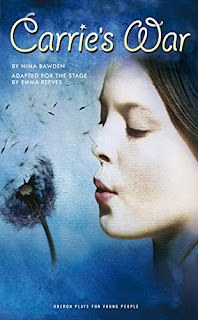
Here we have a good chunk of my April reading, except the CC Spin title which will be out in a few days, and the long-term, slow books I'm reading, like Red Famine and Les Miserables.  So I do have some more serious titles, but also I get so sleepy these days when I'm reading!  I know we all have this problem...  Carrie's War , by Nina Bawlden : I'd heard this middle-grade novel described with high praise, and a copy had been sitting on my tablet for a while.  And yep, it's really good!  12-year-old Carrie and her brother Nick are evacuated from London and sent to rural Wales (which means there's very little of the outside war in the story; it's all about Carrie figuring out her life).  They live with Mr. Evans, the village shopkeeper, and his sister.  Mr. Evans is fanatically frugal and bullies everyone around him, though he seems to be totally unaware of the effects; he's surprised when people don't like him.  "Auntie Lou" is kind but ...

A January Riffle of Reviews

Image
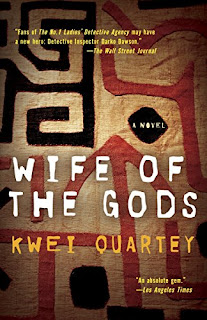
I've been having a good reading month!  Here are some of the more notable books I read in January.  I've also joined a daily chapter of Les Miserables , which I'm really liking so far, and I'm reading Letters From Russia , the record of a Frenchman's 1839 tour.  It's fascinating, and also nearly 700 pages long, so it will take me a while.  The Wife of the Gods , by Kwei Quartey -- the first in a series, or at least a pair, of detective stories from Ghana.  Darko Dawson is a CID man in Accra, and he's called to his mother's ancestral village (now a town) to investigate the murder of a young medical student.  As Darko wends his way through a maze of local politics, traditional beliefs, and family history, he is also wrestling with some of his own demons.  It's a good, solid mystery with great characters and lots of cultural detail, so I really enjoyed it. The plot hinges on adinkra cloth, which this cloth is not North to Paradise , by Ousman Umar -- t...

CC Spin #31: The Gray Earth

Image
  The Gray Earth, by Galsan Tschinag I finished my 31st Spin title!  This poor book has been waiting around for a while.  It's the second book in an autobiographical trilogy (though considered novels, so somewhat fictionalized) which was written in German.  I read The Blue Sky a few years ago, and am quite upset that the third book, The White Mountain, never actually got published in English.  That was supposed to happen in 2018. Galsan Tschinag is Mongolian, of the Tuvan culture, which was ravaged by Soviet dictates.  In this trilogy, he tells the story of his life; the first volume was his early childhood on the steppes, and now he is 8 years old and taken to a Soviet boarding school.  Instead of his childhood name of   Dshurukuwaa, he is now known as Galdan. Galdan's oldest brother is the principal of the school and his other sister and brother already live there, so he is fortunate in that he has family there, but he's also under pressure n...

The Silence of the White City

Image
  The Silence of the White City, by Eva Garcia Saenz It's a mystery novel set in Basque country!  This was my second WIT month title, but obviously I wasn't able to finish it in August.  At least it is actually a translated book, though!   Twenty years ago, a series of bizarre, ritualistic murders terrified the city of Vitoria.  The culprit turned out to be a charismatic TV host, and he was turned in by his own twin brother.  Now, the murders have started again, but with the original suspect still in prison, who could be committing them?  Inspector Unai Ayala and his partner are on the case, but clues are few.  Ayala thinks it has something to do with a medieval church in the country, San Vicentejo, which has a symbolic carving portraying the "alchemical marriage."  Ayala must dig into the past to find his quarry before more people are killed. This is a very long mystery, and it took m a while to get into it.  Flashback chapters tel...

Summerbook #14: Pillars of Salt

Image
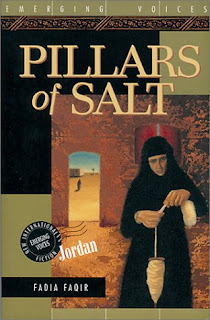
 Pillars of Salt, by Fadia Faqir I was saving this novel for August's Women in Translation event, and got halfway through before I looked at the copyright information and realized that Faqir, a Jordanian author, actually wrote this story in English.  So, oops.  Good thing I've got a Spanish mystery so I won't totally miss out on WIT! Two women are imprisoned in a mental asylum, and tell each other their stories.  Maha's life is told in the first person, in flashbacks.  Um Saad narrates her life to Maha each evening when the lights go out, since they aren't supposed to talk.  And a storyteller jumps in every so often to tell Maha's life through his own malicious and gossipy lens. Maha lives on a small farm with her father and no-good brother.  She is delighted to marry her husband, the Bedouin Harb, and they are deeply in love, but he spends most of the time off in the mountains, raiding English camps.  Despite this, the village is talking about Ma...

Tunnels

Image
Two sets of siblings, two ethnicities  Tunnels, by Ruth Modan, trans. by Ishai Mishory I was intrigued by the descriptions of this graphic novel, and I was not disappointed; it's a complex and fascinating read set on the fraught borders between Israel and Palestine. Nili is an unemployed archaeologist, single mom, resident of Jerusalem.  As a child, she helped her dad in his pursuit of his dream; he was convinced that he knew where the Ark of the Covenant was hidden, but the dig was canceled.  The spot is right under an Arab village, that village is behind a huge wall, and no Jewish archaeologists can get anywhere near it.  Now, with Nili's dad lost in dementia, and her brother working for a rival academic, she is determined to find a way to continue the project. Nili winds up with a strangely assorted crew of workers -- Jews, Palestinians, her brother, her son (whose name, inexplicably, is Doctor -- he's 6 or 7 and worryingly addicted to phone games).  As they ...

A Spring Riffle of Reviews

Image
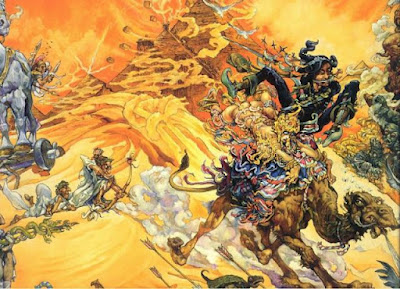
 I'm going to give in and admit that I have more books to post about than time to post in.  Besides, it's a beautiful spring outside!  So here we go: I continued my March Magics reading with Pyramids by Terry Pratchett , which I haven't read in many years.  It's an early one, about #7, and comes after Wyrd Sisters .  Pteppic, only son of the king of the narrow desert/river land Djelibeybi*, spends his youth in Ankh-Morpork, training as an assassin, but right after he survives his final exam, his father dies and he becomes king himself.  His ideas about bringing Djelibeybi into modern times are not welcomed; here, everything is done exactly as it has always been done, and head priest Dios is present to make sure of that. This is such a fun story, absolutely packed with mayhem, humor, and satirical insight.  I really enjoyed revisiting it. *A pun Americans may not get, since we don't have the British candy jelly babies -- which are basically gummy bears...

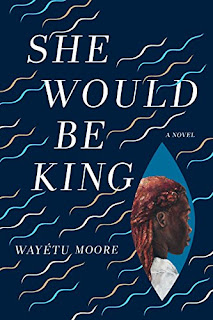
She Would Be King

Image
It's not a boat.  She Would Be King, by Wayétu Moore This was such an intriguing novel!  It takes a little while to figure out the overall structure, but since each individual story is also compelling, that is not a drawback at all.  Taken together, the various pieces form a mosaic imagining the establishment of Liberia in the first half of the 19th century -- and how it could have gone better. There are three protagonists: Gbessa (pronounced Bessa), a native African woman whose village pronounced her cursed at birth; June Dey, who escaped slavery and ended up on a ship to Liberia by accident; and Norman Aragon, a Maroon of Jamaica whose enslaved mother had just one dream -- to get to Freetown in Africa.  Their stories are narrated by a ghost.  Each of the three has a special gift, and each of them eventually uses the gift to help the helpless, communicate between the native Africans and the African-American settlers, and help to make Liberia a place where all ...

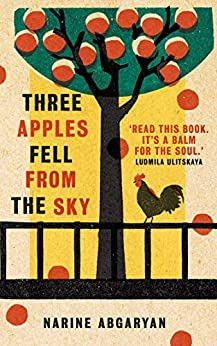
Three Apples Fell From the Sky

Image
 Three Apples Fell From the Sky, by Narine Abgaryan This novel is advertised as a Russian best-seller, but that seems to mean that it was a big hit in Russia, not that it is a Russian novel, because it isn't.  Narine Abgaryan is Armenian, and her story is set in Armenia, completely suffused with an Armenian atmosphere (I conclude, never having been there myself).   Anatolia has spent her life in Maran, a tiny village clinging to the side of a great mountain.  These days, Maran is inhabited only by the old; after the disasters of past decades (an earthquake that swallowed part of the village, the war, the famine that killed so many), what few young people who were left had to go.  Anatolia and her neighbors live as they have always done, but they are the last, and now Anatolia is dying. At least, she believes herself to be dying, and gets everything ready so that her best friend will find her properly.  As she lays down and prepares for death, something...

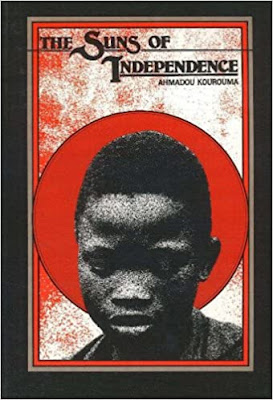
Suns of Independence

Image
 Suns of Independence, by Ahmadou Kourouma  Ahmadou Kourouma was an Ivorian novelist who wrote in French, so this first novel was published in 1968 but not translated into English until 1981.  Kourouma has gotten lots of awards -- this novel won the Grand prix littéraire d'Afrique noire -- but hasn't attracted much attention in English.  He was the son of a highly-regarded Malinke family, and that Malinke heritage (descendants of the Mali Empire, also known as Mandinka) forms a large element of his writing.  Kourouma's main focus, however, was disappointment in the newly independent West African governments, which he saw betraying African ideals and descending into corruption.  He was therefore imprisoned a time or two, but consistently stood against nationalism, wars, and corruption. 'Suns of Independence' is a literal translation of the Malinke phrase that we would say as 'days of independence.'  Fama, the last descendant of the princely Dumbuya fami...

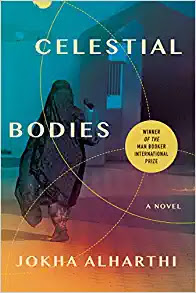
Celestial Bodies

Image
 Celestial Bodies, by Jokha Alharthi This novel has racked up the firsts.  Jokha Alharthi is the first Omani woman to have a novel translated into English, where it then won the Man Booker International Prize for 2019.  It's the first book translated from the Arabic to win that prize.  So, quite a book! This is a generational family novel, all taking place in one tiny Omani village.  And while my experience with multi-generational family sagas is pretty minimal, I think this one is a little different from the norm.  It bounces back and forth in time in a truly disconcerting manner; there are many short chapters focusing on various family members.  The thread that runs through it is a stream-of-consciousness narrative from Abdallah, the son, husband, and father who otherwise barely makes an appearance.  Yet he is a linchpin for the whole thing, right in the middle generation, a connection between families, and more openly emotionally raw than anyon...

Guest House for Young Widows

Image
  Guest House for Young Widows: Among the Women of ISIS, by Azadeh Moaveni It's almost ten years ago now that ISIS became known on the world stage, amid such complex circumstances in Syria and the surrounding areas that I can't possibly sum them up here.  They included Syria's civil war, the disappointed Arab spring, and the war in Iraq.  And young, often educated Muslims started leaving their homes to join up with ISIS and the proclaimed caliphate.  Why?  In particular, why the girls?  Azadeh Moaveni, who has spent years embedded in these conflicts, wanted to get to know them and understand their stories.  Her book contains thirteen young women (out of quite a few more) from many different circumstances, and she narrates their stories with understanding.  Early on, the young people who joined up tended to be idealistic.  They heard about atrocities in Syria and wanted to stand against injustice and violence against their fellow Muslims....

A few short stories in Urdu

Image
 Back in August, I got hold of a book of Urdu short stories translated into English.  It's a large book, so I wanted to read just the women authors for WIT, and that would still be a good amount.  August got away from me, and I only read one or two stories back then, but I've continued reading them since.  I've now finished all the short stories in the book that were written by women (luckily for me, there are short biographies in an appendix, since I could only tell from the name about half the time).  I'll just highlight a couple: "The Wagon," by Khalida Asghar, is a hallucinatory, apocalyptic story.  The narrator meets three strange men who are watching the evening sky and point out that it has become red.  No one had noticed until they said so, but the sky is now strangely red.  Then a smell arrives, so offensive and sickening that it causes real pain -- but only once it's pointed out.  And finally, a mysterious wagon, which may be the s...