Posts

Showing posts with the label arty books

Playing Catch-Up With Autumn

Image
Well, the world is on fire and I'm deeply upset about it, but this is not a blog about world events and politics, so let's escape for a bit with some books for the younger crowd....    Temple Alley Summer, by Sachiko Kashiwaba : This is a charming middle-grade novel translated from the Japanese.  Kazu lives in a big old house in an old neighborhood, and one night he sees a girl in a white kimono walk through.  The next day she is in his class -- and she has always been there.  Everyone but Kazu has known her for years.  And then he learns that his street used to be called Kimyo Temple Street, which implies that people can be brought back to life.  This is going to be a summer of adventure for Kazu and Akari, as they become friends and figure out what's going on. This is an unusual story, and I enjoyed it a lot.  It won the Batchelder award for translated literature.   The Last Cuentista, by Donna Barba Higuera : Petra Peña lives in New Mexico...
A January Riffle of Reviews

Image
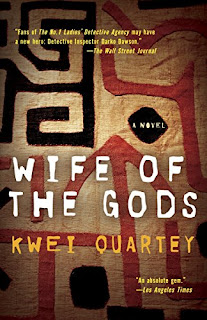
I've been having a good reading month!  Here are some of the more notable books I read in January.  I've also joined a daily chapter of Les Miserables , which I'm really liking so far, and I'm reading Letters From Russia , the record of a Frenchman's 1839 tour.  It's fascinating, and also nearly 700 pages long, so it will take me a while.  The Wife of the Gods , by Kwei Quartey -- the first in a series, or at least a pair, of detective stories from Ghana.  Darko Dawson is a CID man in Accra, and he's called to his mother's ancestral village (now a town) to investigate the murder of a young medical student.  As Darko wends his way through a maze of local politics, traditional beliefs, and family history, he is also wrestling with some of his own demons.  It's a good, solid mystery with great characters and lots of cultural detail, so I really enjoyed it. The plot hinges on adinkra cloth, which this cloth is not North to Paradise , by Ousman Umar -- t...

Books about making books!

Image
Cover to Cover: Creative Techniques for Making Beautiful Books, Journals & Albums, by Shereen LaPlantz Innovative Bookbinding: Secret Compartments and Hidden Messages, by Shereen LaPlantz Bound: Over 20 Artful Handmade Books, by Erica Ekrem I've been getting a little bit into bookmaking, which has been so much fun.   I've tried out several books on the subject, and here are three I looked at recently. Cover to Cover is full of great ideas.  It's a very good general book about making books, and covers a lot of the basics.  Shereen LaPlantz seems to have specialized in taking simple ideas and coming up with a zillion ways to implement them in cool ways.  This would be an excellent purchase for somebody like me who wants to try out different things and is not yet very knowledgeable.  (Several of the books I've looked at in the past have turned out not to be very good, so this is a serious recommendation.)  There is also a lot of variety here...

Soviet Ghosts

Image
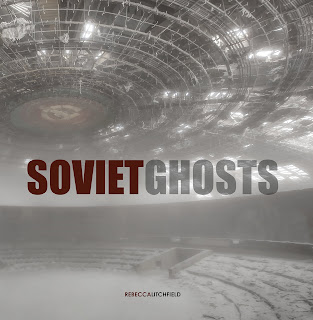
Soviet Ghosts , by Rebecca Litchfield Is there anything more fascinating than photos of decaying Soviet buildings?  I think we all know the answer is no .  Rebecca Litchfield took a bunch of photos in old buildings from all over the former USSR, and East Germany as well.  They're arranged in thematic chapters, almost like a social studies textbook: daily life, military, education, health, sport...and so on.  Each chapter has a little introductory essay, but the photos are the important bit. Random thoughts about these photos: Wow, there is a remarkable amount of robin's egg blue paint.  Many of the photos look like people just walked away, like maybe there was not a lot of official closing down and clearing out.  There's not just furniture, there are mattresses, medicine/chemical bottles, school equipment -- things you would think would be wanted elsewhere even if the institution closed.  There is one empty swimming pool with the lane-divi...

Never Use Futura

Image
Never Use Futura , by Douglas Thomas This title really caught my eye; a book entirely about the Futura font!  Thomas starts off by commenting that in design school, they always tell you never to use Futura -- and yet, all the giants do, so what's up with that?  Let's talk about this massively influential font. Thomas has a lot of fun talking about the development of Futura -- at first it was really quite avant-garde and had some features that many found kind of extreme (although attractive).  Soon it got a bit toned down for more general use, and it hit the big time, spawning a zillion imitators.  For one thing, Futura was a German font and you know nobody wanted to support that during World War II, so Americans came up with a home-grown version that was virtually identical. Futura is so familiar that even a total ignoramus like me can recognize it.  It has a lot of flavors, though, so I did not at first know that the blocky capitals on the cover are in t...

Adventures in Bookbinding

Image
My mom and I went to San Francisco, and we even drove there.  Which is insane.  I dislike going to SF, and I even more dislike driving there -- I can get very whiny about it.  I am an East Bay kind of girl.  But this worked out okay.  For one thing, it was on a Sunday, and also our destination was pretty close to the bridge and freeway, but south of it so that it was easy to park.  I did not believe the website's claim about "ample street parking" but it turned out to be true . We actually arrived somewhat early, so we explored the neighborhood a bit.  We found an old, but apparently thriving, brewery. We found a very interesting church!  I mean, it's like a mission style Orthodox church, two styles I never expected to see together, but in fact it's Episcopalian.  We were taking pictures of the outside and this guy invited us in, where a service was going on.  You enter into a large clear area with an altar in the middle,...

Two Books by Nick Bantock

Image
No good image of this exists online The Pharos Gate, by Nick Bantock The Egyptian Jukebox, by Nick Bantock A while ago I re-read the Griffin and Sabine trilogy, and  then I read the second trilogy , which had come out while I wasn't looking.  I found that second set to be a bit confusing.  Then, just recently, I discovered that a new book had come out upon Griffin and Sabine's 25th anniversary, and it purported to tell the outcome of the story.  I requested that and ILLed this other, intriguingly titled Bantock book at the same time.  So... The Egyptian Jukebox is a puzzle book, published in 1993.  It reminded me of nothing so much as the I Spy books for kids that my daughter loved so much when she was younger; it's just much more elaborate.  There is this jukebox with ten drawers, each of which plays a recording of a story.  Your job is to read the story, study the matching drawer, and follow the clues.  Each drawer yields a let...

Bibliocraft

Image
Bibliocraft: A Modern Crafter's Guide to Using Library Resources to Jumpstart Creative Projects , by Jessica Pigza Talk about a fun book!  Jessica Pigza is a rare book librarian and crafty blogger at the New York Public Library.  She keeps dropping the names of my favorite designers, like Heather Ross, Gretchen Hirsch, and Mary Corbet.  I would like her job, please. Library collections, especially collections of older books full of public-domain images and patterns, are wonderful sources of inspiration if you're an artistic type.  Pigza spends the first half of the book showing the reader how to access all this wonderful stuff, and the second half has various small projects by popular designers, along with their inspirations.  The projects weren't really my favorite, but then I am not actually much of a crafter; I do sewing, mostly of quilts or other particular things. The library information is wonderful.  Pigza explains the different types of libr...

Edward Gorey: His Book Cover Art and Design

Image
Edward Gorey: His Book Cover Art and Design , with essay  by Steven Heller Oh, this was a fun book!  It's a lovely collection of many of Edward Gorey's book covers, with particular emphasis on his early work at Anchor.  This is by no means a complete collection of all the covers Gorey ever did, even of the Anchor titles; it's just a nice sampling.  And there's a rather interesting essay to go along with the covers--again, mostly but not entirely about the Anchor period.  My favorite bit: Gorey was given certain authors to illustrate as a matter of course.  He recalled, "I became very well known for my Henry James covers.  I hate him more than anybody else in the world except for Picasso....I've read everything by Henry James, some of it twice, and every time I do it I think, 'Why am I doing this again?  Why am I torturing myself?  I know how I feel. Why can't I just accept that?'...Everybody thought, 'Oh, how sensitive you are to Henry Ja...

S. / Ship of Theseus

Image
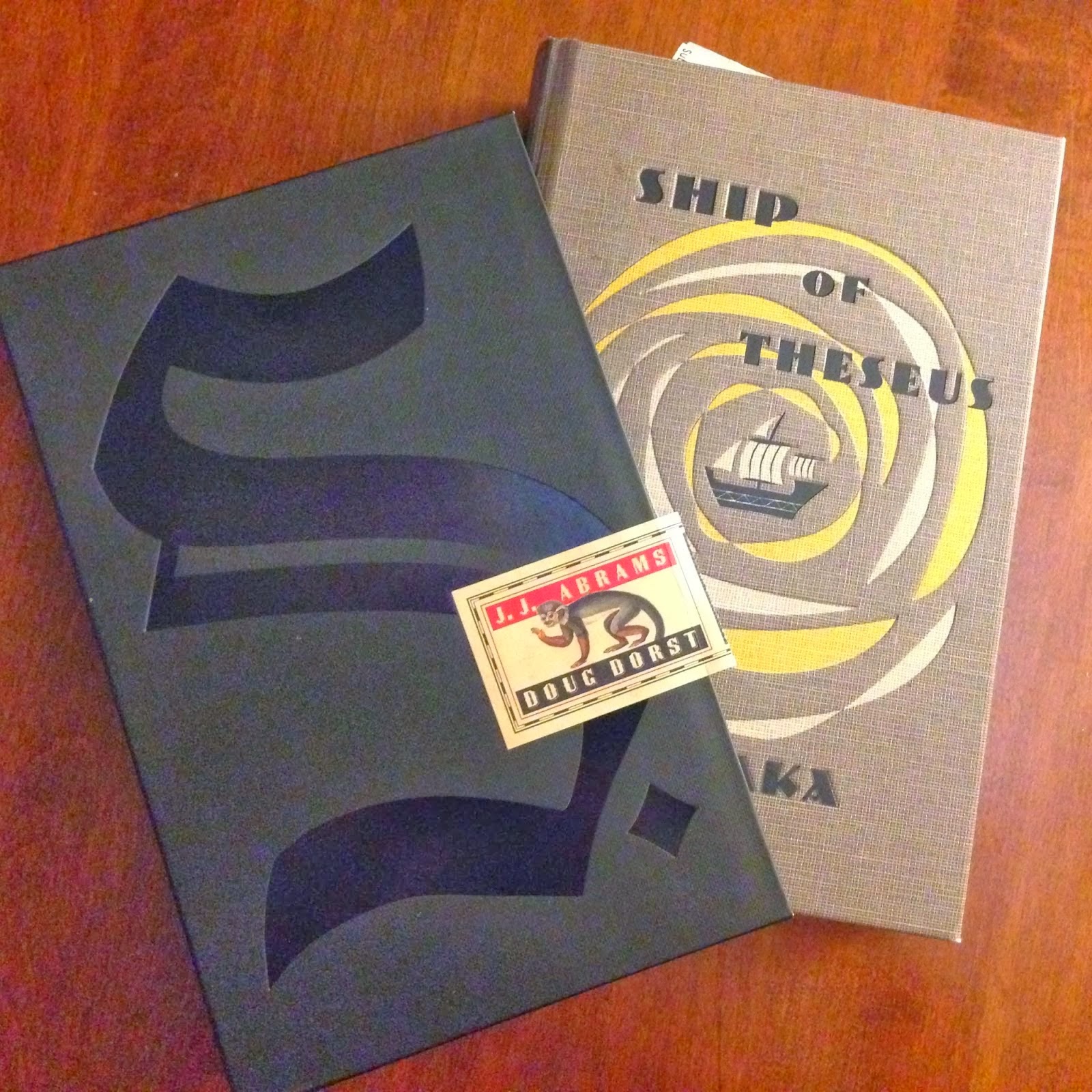
S. / Ship of Theseus , by Doug Dorst and J. J. Abrams I did not know WHAT to think when I ran across this book...thing.  What I noticed first was that it was stuffed full of ephemera, kind of like Griffin and Sabine on steroids.  I thought it must be a big gimmick.  And I got curious, so I read it. The idea is that it's a nested story.  You have a book that looks like a novel printed in the late 1940s, complete with library sticker* and stamps.  The book is a real, complete novel.  Then, two people have written notes all over the margins of the novel, and those notes tell a story too.  As you read, you find another novel and at least one other story of two people who communicated more through books than they did directly.  AND there are codes.  And shadowy bad guys, maybe.  And a secret symbol, and a jerk of a professor, and a mystery about the author's identity. I read the novel-- Ship of Theseus --first.  It purports to hav...

Griffin and Sabine, Part II

Image
The Gryphon , Alexandria , and The Morning Star , by Nick Bantock A couple of weeks ago I re-read the Griffin and Sabine trilogy, and found out that there is a second trilogy that I had never known about.  I got them from the library and read them too; they are pretty strange. The first trilogy left off in a mysterious, but satisfying way.  Now the story is reopened with Matthew and Isabella, a pair of separated lovers.  Griffin and Sabine write letters to both of them, but in Sabine's ink and handwriting.  The letters come from Paolo, a place not found on any map.  It all gets very mythological, with dark angels and symbolic visions and Egyptian artifacts.  Again we wonder if Sabine is a real person or...what, I don't even know.  Isabella and Matthew have to defeat the powers of darkness and it ends confusingly. I have to say, although I enjoyed the artwork again, I'm sort of disappointed with the storyline and (sort of) resolution.  It's p...

Griffin and Sabine

Image
Griffin & Sabine trilogy , by Nick Bantock Just the other day Amira posted about Griffin & Sabine .  I had completely forgotten about the existence of these books, and I was really happy to be reminded because they are really neat.  I liked them when they came out and spent a lot of time looking at my roommate's copies.  They especially appealed to me because I love stamps. (I have a stamp collection, even.  And in library school my reference work project was on stamps.  For reals.)  So I put the whole trilogy on hold at the library, and they showed up the same day!  I got to read them all at once.  It was fun, because I remembered all the artwork really well, but not until I actually saw it again. Anyway.  Griffin is a London artist and lonelier than he realizes.  Sabine designs stamps for a tiny archipelago of Pacific islands, and--mysteriously--she can see Griffin's art.  They start a correspondence, but is Sabine rea...