Posts

Showing posts with the label Re-Reading Challenge

The Neverending Story
Image
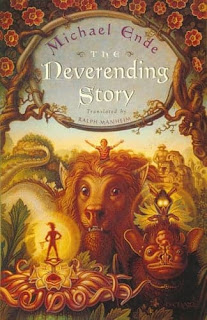
The Neverending Story , by Michael Ende A couple of months ago, I took my kids to see The Neverending Story at the movie theater for the 30th anniversary.  We had a lot of fun -- there was a little documentary first about the filming of the movie, and about a kerfuffle with Michael Ende (he hated the ending) -- and the movie was beautiful to see on the big screen.  Naturally, I promptly wanted to re-read the book, but I wanted my 13yo daughter to read it first.  It's one of her favorite movies, and so I've seen it several times over the years, but I haven't read the novel since the mid-1990s. My kid still hasn't gotten around to reading it my battered old paperback, but a couple of weeks ago at work I was going through the children's literature/YA section and moving a bunch of things down to the reading lounge, where they will get more use.  There was a mystery book with black tape on the spine and no title on the cover, but when I opened it up it turned out to...

Something Wicked This Way Comes

Image
Never actually seen this movie Something Wicked This Way Comes , by Ray Bradbury Witch Week culminates in our readalong of what might be the quintessential American fantasy novel about Halloween.  I first read Something Wicked This Way Comes about 25 years ago as a teen in Denmark, when I found the small English-language section of the local library and read my way through most of it.  I was nowhere close to being able to read well in Danish yet, and I was dying for books!  Something Wicked This Way Comes was the first one I read, and I only remember one other book from that section ( Evil Under the Sun , by Agatha Christie--I'd never really read Christie before).  Anyway, I loved it.  I'd always liked Bradbury's short stories, but I think this was the first time I read one of his novels. Is there anyone who writes like Bradbury?  I don't think so.  In my opinion he's pretty amazing.  That's not to say that his exuberant, sensory-overloa...

The Two Bouquets

Image
The Two Bouquets , by Eleanor Farjeon This is a sweet little novelette based on an operetta (!) by Eleanor and her brother, Herbert.  The musical ran in London for 9 months in 1936, and for six weeks on Broadway.  It was revived in 1952 and has probably never been seen since, but it is a fun, fluffy little story and I'd love to see it performed; I bet it's very enjoyable.  The music is all Victorian songs, because the story is set in 1876. Kate and Laura are cousins, and each is in love with a young man.  Both fellows are coming to the ball that Kate's mother is hosting tonight, but they're a bit worried about how their suits will be received, and so they each buy a bouquet that will do the talking for them.  But Kate's brother has been up to a few shenanigans of his own, and he mixes up the bouquets, with interesting results.  Everyone is at cross purposes, which get crosser and crosser until Regatta Day is rained out. A Bollywood director could pr...

Brat Farrar

Image
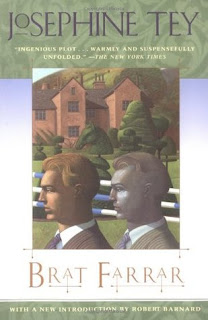
Brat Farrar, by Josephine Tey After the UK trip, I went looking for my copy of The Daughter of Time to give to my kid, who was curious about the Richard III question.  I couldn't find it, but I did find Brat Farrar , so I decided to read that myself.  Tey wrote unusual mysteries--not the usual kind of formula--and they're good to revisit.  This one is odd in that we know from the first that there's an impersonation going on...so what is the mystery? Brat Farrar is going to pose as the long-lost (thought dead) Patrick, heir to the Ashby estate.  He's well-coached, he looks just right, and he's going to arrive just as Patrick's twin, Simon, is about to come of age.  Brat immediately feels at home with the Ashbys--in fact, he feels that he's doing this for Patrick in a way.  As he becomes ever more comfortable in his new role, he also starts to suspect that Patrick did not commit suicide eight years ago.  One of the neat things about this story...

The Fair of St. James

Image
The Fair of St. James , by Eleanor Farjeon It's hard for me to describe exactly what it was that Eleanor Farjeon did.  She's a little odd.  She wrote fairy tales, really; mostly for children, but sometimes for grownups.  And they're fairy tales with a particular light and airy quality; usually English, but with a French flair.  A few times, she mentions Watteau in her stories, and I think that's a clue--she wrote stories that could be painted by Watteau.  She also loves to put stories within stories, and sometimes will produce a book structured like the Decameron or Canterbury Tales . Pilgrimage to Cythera, 1717, by Watteau The Fair of St. James is certainly a fairy tale for grownups.  Laura and her husband Jimmy are touring France, and they stop in an enchanting country town.  A nearby deserted field has a gate that says "Foire St. Jacques," and that evening, Laura enters the Fair -- which hasn't existed for years -- and also searches for Ja...

Northanger Abbey

Image
Northanger Abbey , by Jane Austen I did almost no reading at all on our trip, because I was running around all the time.  I also drove a rental car for a week--successfully--and I have to say, British drivers must all have nerves of steel, especially the bus drivers.  None of us could relax and read; all four of us had our eyes on the road the whole time.  Since we were going to Bath, of course I had to re-read Northanger Abbey , and my 15-year-old daughter read it too. You know the story, probably--17-year-old Catherine, of middling looks, unremarkable parentage, and small fortune, is taken to Bath by friends and has her adventures.  She's a Gothic novel fan and tends to take them a bit too seriously... This was such a fun read.  I love Catherine.  She is so naive that she could never exist today (Austen is poking a little fun at her innocence anyway).  She just doesn't have the tools, at first, to know how to take the Thorpe siblings...but the...

More Company Novels!

Image
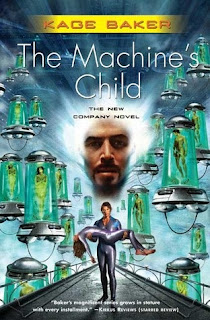
The Life of the World to Come, by Kage Baker The Children of the Company The Machine's Child Gods and Pawns The Sons of Heaven Phew, I have read a whole lot of Company novels!  I'm a little tired, so I think I won't read the last two I have --The Empress of Mars and Not Less Than Gods --for a little while.  Still not very good covers. The only problem with talking about these books is that the plot gets so complex and out-there that it becomes hard to describe to anyone who hasn't already read some of them.  I'll just do my best here... The Life of the World to Come : the life story of Alec Checkerfield, Seventh Earl of Finsbury, ridiculously wealthy 24th-century playboy.  But Alec is an unusual little boy, with some odd talents, who bears a remarkable resemblance to Mendoza's two former loves... The Children of the Company : meet Executive Facilitator Labienus, one of the most powerful immortals in Dr. Zeus.  Over the centuries, he has put toge...

Neverwhere

Image
My copy Neverwhere , by Neil Gaiman As long as I'm going to London, I need to brush up on my London geography, right?  Well, how about my fictional London Below geography?  It's a long time since I read Neverwhere. Richard Mayhew is your average British schlub guy, much like Arthur Dent, but the thing about Richard is that he is kind.  When he trips over an injured girl while on his way to a socially important occasion with his fiancée, he chooses to help the girl--and soon finds that his ordinary life has evaporated.  He's now an unwilling, bewildered denizen of London Below, where all the forgotten things fall and monsters lurk in the dark. This was Neil Gaiman's first novel, and it didn't start off as a novel at all.  First, it was a BBC mini-series on TV, and aired in 1996.  I've seen it, but it's been a very long time, and now I want to watch it again.  Gaiman then turned it into a novel, which has been through a few different incarnatio...

A lot of Company novels

Image
In the Garden of Iden , by Kage Baker Sky Coyote , Mendoza in Hollywood The Graveyard Game Black Projects, White Knights As you know from my earlier post, I fell down on the Faerie Queene project last weekend when I was kind of under the weather.  The universe handed me a make-up gift, though, when my ILL of the second Company novel arrived at just the same time, and I zipped through 4 books in 3 days.  I hadn't yet gotten to post about the first one, so I'll just put them ALL here.... First, the setup.  In the 24th century, some people figure out how to make immortals, but there's a catch.  It takes massive surgery and augmentation, and only works on tiny children who fit the physical profile.  Not very useful for rich old people who want to keep living.  They also figure out time travel...but you can only go backward, and you can't change recorded history.  So they form Dr. Zeus, a company that exploits these two technologies by taking orpha...

In the Garden of Iden

Image
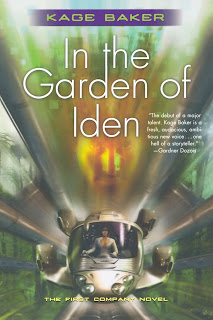
In the Garden of Iden, by Kage Baker I had a lot of fun with the Company series by Kage Baker a couple of years ago, and when somebody mentioned it recently I decided to do a re-read.  This time I'm going to try to spot the giant, overarching plot elements when they appear early on, which of course I couldn't do last time--it's a perk of re-reading! What happens if people in the future figure out time travel...but then it turns out you can't change history or visit a time after your own?  And those same people figure out immortality....but it only works on small children with suitable characteristics?   Well, they decide to go back in time and set up Doctor Zeus, Inc., which trains up immortal operatives who then collect samples and commission works which will just happen to pop up centuries in the future, bringing in wealth untold.  Obviously. And so Mendoza, who begins life as a dirt-poor Spanish peasant in the 1540s, becomes an immortal Company opera...

The Screwtape Letters

Image
The Screwtape Letters , by C. S. Lewis As long as I was reading about suffering and the meaning of life and all with Viktor Frankl, I picked up the Screwtape Letters again as well.  I'm pretty sure we should all be reading this book every couple of years, regardless of religion, because Lewis is just so good at understanding human nature.  I run into myself every couple of pages. Since it's one of the most famous books around, it probably doesn't need me to explain it, but....Lewis writes a comedic and sharply insightful set of letters analyzing human nature--from the point of view of a devil in the business of tempting.  One very nice element is the image of Hell; as a member of the century that saw the rise of organized, bureaucratic genocide, Lewis paints Hell as a massive bureaucracy, with the office workers all quietly scheming to do each other down. Every letter from Screwtape to the lesser demon Wormwood discusses some point about humanity--and very frequent...

Man's Search for Meaning

Image
Man's Search for Meaning , by Viktor Frankl I've been wanting to re-read this for a while.  I think it qualifies as one of the important books of the 20th century, a must-read, though I'm not sure how Frankl's ideas about psychotherapy are viewed now. The first half of the book is Frankl's personal account of his time in Nazi concentration camps.   It's not chronological and exact; it's more a series of stories and impressions, and his views on how he and his fellow prisoners kept going--or not--under such horrific conditions.  Frankl's assertion is that the way to find meaning in life, under any circumstance, is to turn the question around: .. .it did not really matter what we expected from life, but rather what life expected from us.  We needed to stop asking about the meaning of life, and instead to think of ourselves as those who were being questioned by life--daily and hourly.  Our answer must consist, not in talk and meditation, but in rig...

Spenser's Images of Life

Image
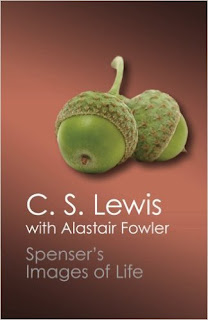
Spenser's Images of Life, by C. S. Lewis and Alastair Fowler This is my final preparation for the Faerie Queene Readalong next month!  Once upon a time, C. S. Lewis left Magdalen College at Oxford and took a chair in Medieval and Renaissance Literature at Magdalene College at Cambridge, where he lectured in English literature for the last years of his life.  (He commuted by train and went back to the Kilns on weekends.)  Lewis had meant to make a book out of his Cambridge lectures on Spenser, but died before he could do so.  His colleague Alastair Fowler took on the job of creating a book out of the lecture notes, and he succeeded well enough that Lewis' own voice still shows throughout.  I first read this book several years ago, before Cambridge brought it back into print, and it made me want to read the Faerie Queene and enjoy it.  I promptly failed, but this time I'm going to do it!  (With the help of o and Cleo and a lot of footnotes.) Lewis...

MarchMagics: Reading Catch-Up

Image
I guess I've slacked off a little bit on the MarchMagics posting, but that's because I really have no shipping ideas.  That's not really how my brain works. But!  Since I last posted about DWJ and Pterry, I've read a couple more things. Obviously I had to follow Dark Lord of Derkholm with a re-read of Year of the Griffin .  That is such a fun book.  I love the portrayal of a group of college friends, and how each of them copes with their various problems.  I also really like how the world is a mess, and the university has become completely incompetent, and it all needs fixing up--which is exactly what would really happen, only unfortunately we don't have magic to fix our problems up with. This is another really terrible cover.  It's a scene from the novel, but a very confusing one and the cover makes no sense at all.  Also, you can't see any human faces, and the whole thing comes off as badly drawn.  Elda is the only reasonable thing on thi...

The Allegory of Love

Image
The Allegory of Love, by C. S. Lewis I first read this, Lewis' first book of literary criticism, at least 10 years ago.  Last year after reading that book about the Inklings I thought I'd like to read it again, but when I took my copy (really my mother's, which I stole) down from the shelf, it seemed practically unreadable; it had tiny type in a 60s era paperback.  So I splurged a little and bought a new copy.  Then when Cleo mentioned it in connection with the Faerie Queene , I realized I really ought to read it before the readalong, not after, so I got going.  It was really nice to revisit, especially since I have now actually read the Romance of the Rose and understand a lot more of what he's talking about. Lewis starts off by explaining that allegory was how early medieval people first started to express psychological ideas, especially conflict.  Much as a cartoon might show an inner moral conflict by means of an angel and a devil on each shoulder, th...

Metamorphoses

Image
Metamorphoses , by Ovid I've been doing a readalong of this, sort of, with Cleo at Classical Carousel and o at Behold the Stars , before a more ambitious readalong of The Faerie Queene , which is set to start in April.  They have been much better at it, though, with weekly update posts discussing each book, whereas I just read the thing and didn't do anything else.  So you should check out their posts, because this is going to be on the minimal side in comparison. I actually wasn't at all sure if I had read all of the Metamorphoses before, because I know I read at least some in college, but how much?  Who knows by now (not me).  I got out my old copy--which is a Penguin prose edition old enough to be priced at seven shillings and sixpence!--and found a note used as a bookmark, scribbled with phone numbers and arcane things. There are fifteen books, each a nice length to read on its own.  They are not terribly separate, really; in each book, Ovid goes thr...

Kaleidoscope

Image
Kaleidoscope , by Eleanor Farjeon I just love Eleanor Farjeon.  She mostly wrote short fairy-tale-like tales for children, and novels and tales for adults as well, and quite a lot of poetry too.  She also produced a children's version of the Canterbury Tales .  But I love her stories.  They are light and rather sweet and have insights anyway.  And they are nearly always illustrated by Edward Ardizzone, who I also love. Kaleidoscope is a book of vignettes about a little boy's childhood--little pieces of life that mix and are held like a kaleidoscope.  Anthony lives next to a lovely old mill-pond, and Farjeon tells of his childhood experiences and then touches them with magic.  It is all extremely English countryside and a literary vacation. Anthony was a real person, though that was not his name.  In the book, Farjeon simply calls him by his childhood nickname of Pod and doesn't identify him, but elsewhere I found out that Anthony was George...

My Childhood

Image
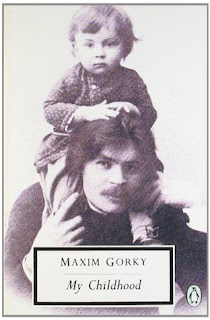
My Childhood, by Maxim Gorky I've always meant to read Gorky's autobiographical trilogy.  I have all three, and I did read My Childhood once years and years ago, but I stopped there and had forgotten all.  So one goal of mine this year is to read all three. Maxim Gorky's real name was Alexei Maximovich Peshkov.  He called himself Maxim after his father, and gorky means bitter , which he was.  Born in 1868, he had a lifelong concern for the plight of the Russian working class poor.  He got into Marxism, but he also founded a socialist publication that attacked Kerensky and Lenin (while living outside Russia; he spent time in the US and Europe).  Upon returning to Russia in 1928, he became an enthusiastic Soviet, and died in 1936--rumor had it that he was poisoned by political enemies. My Childhood starts at age 5, at the death of little Alexei's father.  His mother goes home to her parents, but spends less and less time there, until she kind of...

Roadside Picnic

Image
Roadside Picnic , by Arkady and Boris Strugatsky I first read this book a few years ago when Ekaterina recommended it on her blog. But the edition I read was the old translation from the 70's, and I wanted to read the newer translation from a couple of years ago. It said it fixed some errors and put in more material, and it also had an afterword explaining the history of the novel's publication in Russia (which is pretty fascinating all on its own). Red Schuhart is your average schmo. He's a stalker-- he ventures into the Zone to retrieve artifacts. It's a very dangerous occupation; the Zone is an area filled with random alien objects. There are five of them on the earth,  rather as though somebody had thrown some trash out of the car window on their way to somewhere else. The purposes of the different artifacts are unknown, and they are often extremely dangerous. Those who venture into the Zone and survive are somehow changed; their children are not quite human. ...

Brit-Think, Ameri-Think

Image
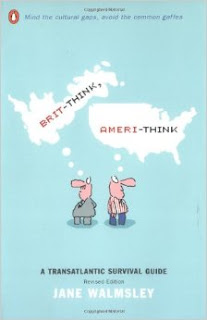
Brit-Think, Ameri-Think: A Transatlantic Survival Guide, by Jane Walmsley Jane Walmsley is an American who moved to the UK in the 70s and married a British person there.  As such, she is well-placed to write this little book that pokes fun at the cultural differences between the US and the UK, and which purports to explain us to each other.  It probably does no such thing, but it's fun to read. What both sides really fail to understand are the basics--the cultural themes, the habits of mind which determine the way the other guys behave.  In order that I may never again have to explain why Brits form orderly queues, or why Yanks insist that you 'have a nice day' whether you want one or not, I have written Brit-think, Ameri-think. There are the usual sections on food, TV, children, homes, and so on.  It's all fun and lighthearted, and since my edition dates from 2003, a bit outdated.  The world has changed quickly!