Posts

Showing posts with the label folklore

June reading, part II
Image
 Happy July!  I had an unexpectedly busy week so I'm a couple of days late but who cares.  One thing I did was spend an afternoon at the county board of supervisors' budget meeting, lobbying for them not to cut the library budget (which they already did last year).  It would have brought the largest branches in the system down to three days a week.  To our great surprise, it actually worked and the board decided not to enact the cuts -- but only for one year.   We also held an unexpected early birthday party, due to various factors such as the presence of the person involved and another friend being present from out of town.  So I spent a lot of time thinking about food -- a thing I don't do a lot any more now that I'm an empty nester.  And now, on to the books!  Actually, I have been too lazy.  There are too many books here for just one post.  I'm going to put my Books of Summer here, and do another post on the books I've read...
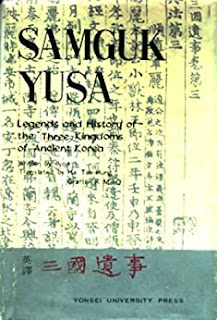
Samguk Yusa

Image
 Samguk Yusa: Legends and History of the Three Kingdoms of Ancient Korea, by Ilyon the monk, trans. Ha Tae-Hung In the 1200s, a Buddhist monk by the name of Ilyon, from the Kim family, set down the history and legends of the three early Korean kingdoms of Silla, Paekje, and Koguryo -- with a strong emphasis on Silla.  He seems to have written these stories down privately, for his own amusement, and the book was not subjected to official restrictions.  It was probably not printed until after his death, and the book was nearly lost, as the carved wooden plates used for printing were found to be unusable.  Fortunately, a nobleman of the 16th century was able to find an original copy of the book, and had a new edition prepared in 1512, thus ensuring its survival.  Since very little is known about early Korean history, this is an invaluable text. The book is written in Chinese, because at this time, Korean had no writing system.  Koreans borrowed the script of t...

Mules and Men

Image
 Mules and Men, by Zora Neale Hurston I particularly wanted to read Mules and Men this month as part of Erica's Zora Neale Hurston reading project.   That was the title that I most wanted to read; published in 1935, it represents her anthropological work, in which she collected African-American folktales, legends, and practices. There are ten chapters of folktales, in which Hurston narrates her trip and experiences as well as the stories she collected.  She starts in her hometown of Eatonville, where she is known, and has to convince people to tell her "lies" -- which, while entertaining, are not considered worthwhile.  Once the local fellows are in on the project, they take her to parties and dances, and she moves ever further out, visiting a logging camp and a gambling club, among other places.  Hurston collects songs, most especially "John Henry," which must have become a staple folksong in schools somewhat later; it was the sort of song we were all taught wh...

The Man Who Sold a Ghost

Image
  The Man Who Sold a Ghost: Chinese Tales of the 3rd - 6th Centuries, translated by Yang Hsien-Yi and Gladys Yang One of the fun things about working at a college library, even one as small as mine, is the interesting things you run into on the shelf.  I found this in the Chinese literature section, and the book itself is ten years older than the college is, so it must have been donated when the library was started.  It was printed in the PRC and is clearly part of a Chinese classics series meant for export and education.   This book is not rare, however, and you can easily find it used or in ebook format. This is just a small book of tales gathered from several historical sources, so the contents are highly varied.  There are anecdotes of the doings of various emperors and sages, moral folktales about kindness to animals, honesty, and so on, ghost stories and tales of marvels.  A lot of people die and come back to life, and sometimes they tell about ...

Old Testament Legends

Image
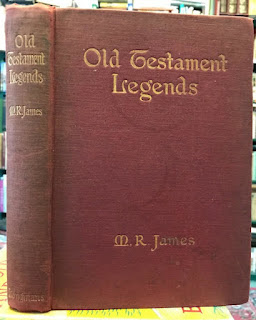
 Old Testament Legends: Being Stories Out of Some of the Less-Known Apocryphal Books of the Old Testament, by M. R. James Remember a little while ago I read the Apocalypse of Abraham ?  It's this very fun legendary story about Abraham figuring out that idols are just wood or stone.  Well, M. R. James (of spooky ghost story fame) thought it was a neat story too, so he put it into a book for children, along with other spurious legends about Old Testament characters. ...Perhaps I have now said enough to show of what sort the tales are that are told in this book -- some of them told for the first time in English.  They are not true, but the are very old; some of them, I think, are beautiful, and all of them seem to me interesting. The stories include the deaths of Adam and Eve, how Asenath became the wife of Joseph of Egypt, an elaboration of the story of Job, how Solomon controlled demons, and others.  There's one about a man who went to gather figs and then slept ...

The Golden Bough, Part the Eleventh

Image
 Victory!  I have done it!  I have read all 800+ pages of The Golden Bough .  Some of it was very interesting, some of it put me to sleep, and some was kinda horrifying.  I don't really buy Frazer's premise, but his premise is so inundated with a mountain of theorizing, speculation, anecdote, digression, and so on that it's quite hard to tell what it actually is. I don't quite want to finish this off with the extensive notes that I had for the other installments; I did nine chapters' worth this time.  But I do want to cover a few things.  Let's see what happens. LXI.  The Myth of Balder.  We're now going to take a trip up north and get into a completely new area -- the story of Balder the beautiful, killed by a dart of mistletoe.  And then he was given a nice funeral pyre. LXII..  The Fire-Festivals of Europe.  Since Balder was burned after death, let's talk about every kind of festival involving a bonfire ever, which is a lot....

The Golden Bough Readalong, Part the Tenth

Image
 I'm getting so close to the end!  Only about 3 weeks to go, assuming I manage to stay on track.  This section of reading focused on scapegoating, transference of sin or evil, and some more about the principle of contagion, I guess you could say.  Also, it's no wonder that this book annoyed religious folks. LV.  The Transference of Evil. The Transference to Inanimate Objects: Now that we've established that societies would often kill a god, let's talk about the practice of laying "the accumulated misfortunes and sins of the whole people" upon the god, who bears them away.  First let's have examples of transferring sickness, pain, or sin to an object which is then thrown away, or perhaps left for someone else to encounter and take the pain upon themselves. The Transference to Animals: Animals might be used to take away pain or evil, too, just like a scapegoat.  Lots of examples! The Transference to Men: The job of absorbing another's pain or sin might e...

The Golden Bough Readalong, Part the Ninth

Image
 OK, so the whole 'readalong' thing is maybe not quite true any more, but no matter.  I'm keeping the post series title anyway.  I did, in fact, take a little extra time off and only got back on the wagon in this last couple of weeks.  It's not easy to keep the momentum going for this long!  But I'm now over 600 pages along; only 200ish more to go.  Stay on target! Some of these were very long chapters filled with accounts of various religious practices.  He got very long-winded and I couldn't always see the point (besides anthropological interest, but he was explaining these in much more detail than usual).  The general theme was practices around animals, and it's a bit of a hodgepodge honestly.  Frazer could get any meaning he wanted out of this stuff. XLIX.  Ancient Deities of Vegetation as Animals. Dionysus, the Goat and the Bull: Certain animals were generally sacred to particular deities, and the corn-spirit is often represented as...

The Golden Bough Readalong, Part the Eighth

Image
 Wow, this is taking a long time!  We're almost to the end of summer and I am on track with my reading, which means it's going to take, I think, another three months.  Still, I think this is the best way for me to be reading it; three chapters a reasonably easy weekly assignment to fulfill and I would probably give up in despair if I tried to read it all at once.  Since I fell behind on the notes, I decided to just take two weeks off, and I'm going to start back up now. Boy these sections had a lot of examples.  This is all about popular folk-customs of the harvest (now mostly gone), and obviously those customs varied slightly according to the region.   XLVI.  The Corn-Mother in Many Lands. The Corn-Mother in America:  Native American customs around maize (short). The Rice-Mother in the East Indies: So many examples of customs around rice. The Spirit of the Corn Embodied in Human Beings:  That last ceremonial reaper is often considered t...

A Celtic Miscellany

Image
My copy is ancient; but it's still in print! A Celtic Miscellany, ed. Kenneth Hurlstone Jackson This is one of those TBR books I've had around forever and ever.  I can tell, from the price written on the inside front page, that I got it at our local used bookstore, but it must have been a long time ago! Miscellany is an appropriate description; here we have samples of literature from six Celtic languages, primarily Irish and Welsh, but also Cornish, Scottish-Irish, Breton, and Manx.  The translator, Jackson, wanted to produce a representative collection that wouldn't just include all the things everybody is already familiar with -- but some of the favorites had to go in, or else it wouldn't be representative.     The selections are in themed sections, starting with adventure stories (Cu Chulainn, Fionn, and others), and going on to such topics as love, nature, epigram, satire, elegy, and so on.  They also go somewhat chronologically, with the earliest mater...

The Golden Bough Readalong: Part the Seventh

Image
So are you tired of notes on the Golden Bough yet?  I am, a bit.  I'm enjoying the actual book, and these notes are helpful, but the actual job of writing them up is a bit tedious.  Still, I shouldn't complain; this section was a doddle to read!  We're continuing the tour through Middle-Eastern corn deities. XXXVII.  Oriental Religions in the West: Goddess-worship was popular, but foreign and unhealthy for the West.  (See quotations below; they're nearly all from this chapter)  Mithras-worship and Christianity, same thing. XXXVIII.  The Myth of Osiris: Osiris was a corn-god too, but he was so very popular that people piled him with various meanings.  Full story of Osiris is given. XXXIX: The Ritual of Osiris. The Popular Rites: The Nile's rising was the time for the festival of Isis, by which time Osiris was dead.  Farmers' harvest rituals were similar to those of Adonis and Attis.  The Official Rites: Description of priestly rites...

The Golden Bough Readalong: Part the Sixth

Image
I've been reading along just fine, but finding time (and motivation) to blog isn't so easy.  But here we are, just about halfway through!  Much of this chunk was specifically about Adonis/Attis/Tammuz worship. XXXI. Adonis in Cyprus.  Cyprus looked pretty good to the Phoenicians, and Paphos was the center of Adnois worship.  Dubious-sounding pre-marriage practices involving "sacred harlots."  Story of Cinyras.  Music in worship, with references to Saul and David. XXXII. The Ritual of Adonis.  Adonis festivals involved a lot of mourning for the death of the god, who was often carried out to burial in water, and they would sing about his future revival.  Offerings of fruit, flowers, cakes -- the date of the ceremony is not known but probably summer.  Red flowers were said to have been dyed by his blood.  Once a society became agricultural, the focus shifted from general fertility to specifically grains/cereals.  XXXIII.  The Gard...

The Golden Bough Readalong: Part the Fifth

Image
This is such a weird summer.  It's both boring and stressful.  There is almost nothing to do, which is kind of restful but also no fun.  I've decluttered a bunch of areas, though, so that is nice.  And this week my oldest is coming home for a visit and a birthday! So what has Sir James Frazer been up to?  I read chapters 25-30 in the last couple of weeks. XXV.  Temporary Kings: So, instead of getting killed while still in the prime of life, in order to preserve the land at full strength, some kings figured out ways to get around it, such as installing a temporary king who has to go through a mock execution, or some other such dodge.  Here are various examples of temporary kings. XXVI.  Sacrifice of the King's Son: Often those temporary kings do have to come from the royal family, in order to represent the king properly.  Who better than the actual son?  [I see some potential problems with this, actually...]  Frazer cites a legendary...