Posts

Summerbook #9: The Uncommercial Traveller

Image
The Uncommercial Traveller, by Charles Dickens This is one of my oldest TBRs!  It's been sitting around forever.  These are essays published over years in Dickens' magazine, All the Year Round .  His conceit is that instead of being a commercial traveller (a traveling salesman), he's an UNcommercial traveller, always wandering around looking for a story.  So these are portraits of situations or places, mostly in London but sometimes elsewhere. Dickens starts off with a bang, being present at the aftermath of a tragic shipwreck off the coast of Wales, and chronicling the tremendous care and work the locals give to the situation.  Then it's off to an assortment of places -- a tour of the Wapping workhouse, the lead-mills, or the gigantic dockyards, interviews with mistreated English soldiers or destitute families looking for work.  He explores a Stepney school for pauper children, of which he highly approves because they're so well cared-for.  He rants ...

The Mysteries of Udolpho Readalong: II

Image
The Mysteries of Udolpho Readalong I've finished Volume II, so it's time for an update!  I'm keeping up with the schedule -- I'm really a bit late with this post -- and enjoying this leisurely read of a very long novel In Volume II, Emily is whisked off to Venice, where there are a lot of parties.   Her aunt, the new Madame Montoni, thinks everything is going to be great, but she is very wrong.  Montoni has a bit of a gambling problem, his friends are sketchy as all get out, and all of them will do anything for money.  Maybe it wasn't such a hot idea to marry this guy after all. Among all the parties and boat excursions, Montoni's friend Count Morano is paying a lot of court to Emily, which she is not happy about one bit.  No matter how often she tells him she's not interested, he keeps pursuing her.  Montoni is pressuring her to marry him, and eventually comes up with a trick in which he 'understands' her to have accepted the suit.  He's determ...

Summerbook #8: The Spy and the Traitor

Image
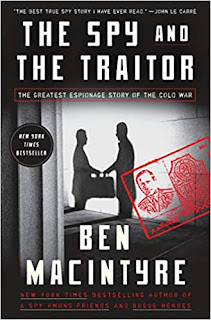
The Spy and the Traitor: The Greatest Espionage Story of the Cold War, by Ben MacIntyre I was slightly surprised to find that the subject of this book probably actually is the greatest espionage story of the Cold War.  It's a pretty gripping story, anyway. Oleg Gordievsky grew up in a KGB family; his father was an officer, and it was natural for Oleg and his older brother to join up as well.  But the building of the Berlin Wall gave him serious pause.  He became interested in dissident thought, and when he was posted to Copenhagen, he fell in love with the freedom and clean, cheerful city where everything worked.  He could read whatever he wanted and listen to the music he loved.  When the Prague Spring was so brutally suppressed in 1968, Gordievsky was appalled and became utterly disenchanted with the Soviet system.  He started to think it might be a good idea to help Western countries instead of his own. It took quite some time, but Gordievsky started to ...

The Golden Bough Readalong: Part the Sixth

Image
I've been reading along just fine, but finding time (and motivation) to blog isn't so easy.  But here we are, just about halfway through!  Much of this chunk was specifically about Adonis/Attis/Tammuz worship. XXXI. Adonis in Cyprus.  Cyprus looked pretty good to the Phoenicians, and Paphos was the center of Adnois worship.  Dubious-sounding pre-marriage practices involving "sacred harlots."  Story of Cinyras.  Music in worship, with references to Saul and David. XXXII. The Ritual of Adonis.  Adonis festivals involved a lot of mourning for the death of the god, who was often carried out to burial in water, and they would sing about his future revival.  Offerings of fruit, flowers, cakes -- the date of the ceremony is not known but probably summer.  Red flowers were said to have been dyed by his blood.  Once a society became agricultural, the focus shifted from general fertility to specifically grains/cereals.  XXXIII.  The Gard...

Six in Six 2020

Image
This is the first time I've heard of this game, but I like the idea!  Jo at The Book Jotter says: The idea being that as the end of June approaches and we are then halfway through the year,  let us share the books we have read in those first 6 months. In fact let’s share  6 books in 6 categories , or if time is of the essence then simply share just 6 books. Whatever combination works for you as long as it involves 6 books. Well, that sounds fun!  There are about a zillion categories, so it's hard to pick just six.  It had to be a little bit arbitrary if I was ever going to choose.  Here we go, six books in six categories: We all need a break from the world sometimes, so here are Six books to read to avoid politics :  The Murderbot Diaries Spock Must Die! The Rivers of London series Bellman and Black Coronation Summer Edward Lear: The Life of a Wanderer I love reading non-fiction, so: Six From the Non-Fiction Shelf : The Unwomanly Face of War Thir...

Tales From A Rolltop Desk

Image
Tales From A Rolltop Desk, by Christopher Morley Hey, two Christophers in a row!  Ha.  This Christopher, however, was an American journalist type who wrote a lot of funny stories, most famously Parnassus on Wheels and The Haunted Bookshop .  This little tome is a collection of short stories published in magazines in the late 1910s, back when short stories in magazines were the great American pastime.  Just about all of them are set in the journalistic scene of New York City, and they're nearly all funny -- but there's a mystery and a ghost story too!  They feature bright, clever secretaries and young reporters scrambling for their wages -- all the usual suspects for New York stories, and often reminded me of P. G. Wodehouse's New York stories, except these came first.  I wonder if the two knew each other... ...having done a few minutes of poking around, I can't see how the two could have avoided meeting, though there's nothing to indicate a friendship....

Summerbook #7: The Children of Húrin

Image
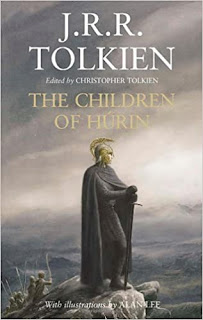
The Children of Húrin, by J. R. R. Tolkien/Christopher Tolkien As these very pretty editions of tales, packed with Alan Lee illustrations, have been published, I've been tempted to read them, but I wasn't sure what order they went in or what exactly they were (stories from the Silmarillion ...?), so it took me a little while to get around to it.  Christopher Tolkien explains in the notes that his father had written, variously, the bare bones of the Children of Húrin story, then a chunk of an enormous epic poem in the alliterative style of Anglo-Saxon poetry, and notes and versions.  The son then eventually kind of synthesized all of this material into something that would be readable and comprehensible to those of us not prepared to read several thousand lines of alliterative verse and still not know the end of the story.  So it's Tolkien's material, and Christopher's editing.  Three of the longer stories of the Elder Days have now been given this treatment, and I ...