Posts

February Reading, Part the Second
Image
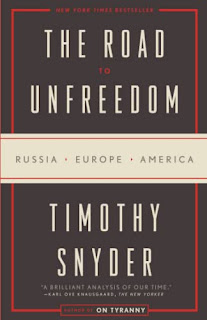
 I've been split between really quite heavy-duty books and incredibly light cotton-candy books.  I've read four Three Investigators novels in the last couple of weeks -- ones near the end of the series, so not as good as the earlier titles, but still fun.   I could tell the last one was different from the cover, and it turned out to be one of some stories originally written in German -- the Three Investigators were evidently hugely popular in Germany, and somebody wrote some sequels that come off more as fanfiction than anything else, I thought.  Anyway, on with the February reads: The Road to Unfreedom: Russia, Europe, America, by Timothy Snyder -- it took me a long time to work my way through this one.  Snyder took on the job of explaining the underpinnings of Russian (Putin's) political ideology and policy to Americans.  It's a very tough job, because to a Westerner it's fairly incomprehensible.  Snyder then moves on to explaining Russia's acti...

February Reading, Part the First

Image
 Hi ho!  I've been doing a lot of reading, but much of it is pretty heavy-duty long stuff and I won't be done right away.  (And I also indulged in two Barbara Michaels gothics -- fun!)  Here are the books I read in the first half of February:   Dark Archives: A Librarian's Investigation Into the Science and History of Books Bound in Human Skin , by Megan Rosenbloom --  a bit macabre, and an interesting read.  Not all books claiming to be bound in human skin actually are, and Rosenbloom's research group is able to do a test that confirms what kind of leather a binding is made from.  (You can't do a DNA test; the tanning process destroys all DNA.)  Most of the books in the English-speaking world were made by 19th-century doctors who were doing autopsies or dissections anyway, and lifted some skin while they were at it.  So Rosenbloom kind of goes all over the place, talking about the development of medical ethics and all sorts of things....

On Tyranny, Expanded

Image
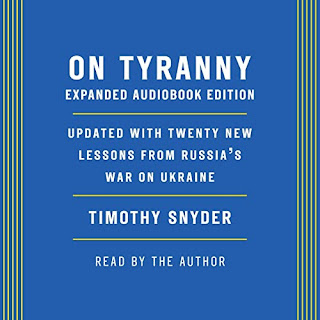
 On Tyranny: Expanded Audio Edition, by Timothy Snyder We all know I'm a Snyder fan and am trying to read/listen to as much of his output as I can.  I read the original of this book a few years ago; it's very short and an excellent book which I recommend.  After Russia's further invasion of Ukraine -- now almost a year ago -- Snyder decided to add to this small book.  This extra material is only available on the audiobook; I think he wanted to get it into the world right away.   So after the original content, narrated several years ago in the standard professional manner, Snyder just comes in and starts talking in a slightly more personal tone.  He evidently just sat down, pounded out all his thoughts, and is now going to pour them into your ear practically without a break because this is all super-important to him.  He loves Ukraine, his dear friends are being bombed, and a bunch of them are on the front lines or suddenly displaced from their ho...

Samson's Hoard

Image
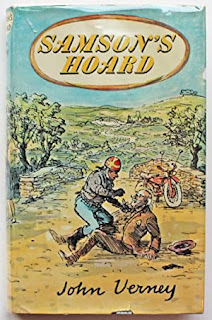
 Samson's Hoard, by John Verney Here we have the apparently almost unknown fifth volume in John Verney's Callendar Family series!  It was published in 1973, 14 years after the first volume.  They go: Friday's Tunnel February's Road Seven Sunflower Seeds ismo Samson's Hoard and they're narrated by various Callendar children -- whoever is about 14-15 at the time of the story.  This one is told by Berry, who is also the narrator of ismo . Dad is retiring from his journalism job -- no really this time -- and it's time for the family to downsize and move into Querbury proper.  They purchase a nice older home with a constantly overflowing water cistern, everybody settles in, and Dad decides to run for a seat on the town council.  One issue at stake is what to do with the gigantic old maltings on the edge of town; tear it down for a new road, or preserve it and turn it into a community center?  This is the sane plot, all sane and normal. But there's a car bo...

A January Riffle of Reviews

Image
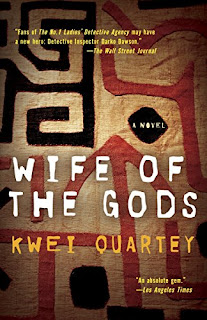
I've been having a good reading month!  Here are some of the more notable books I read in January.  I've also joined a daily chapter of Les Miserables , which I'm really liking so far, and I'm reading Letters From Russia , the record of a Frenchman's 1839 tour.  It's fascinating, and also nearly 700 pages long, so it will take me a while.  The Wife of the Gods , by Kwei Quartey -- the first in a series, or at least a pair, of detective stories from Ghana.  Darko Dawson is a CID man in Accra, and he's called to his mother's ancestral village (now a town) to investigate the murder of a young medical student.  As Darko wends his way through a maze of local politics, traditional beliefs, and family history, he is also wrestling with some of his own demons.  It's a good, solid mystery with great characters and lots of cultural detail, so I really enjoyed it. The plot hinges on adinkra cloth, which this cloth is not North to Paradise , by Ousman Umar -- t...

Spin #32 Title: The Female Quixote

Image
 The Female Quixote, by Charlotte Lennox What a fun read this was!  If you're looking for an 18th century novel that isn't too long or difficult, this is a good choice.  It's still long -- but nowhere near the size of Tom Jones, or Pamela, or Clarissa.  Published in 1750, it's just one of the many titles written by Charlotte Lennox, who was well-respected by the other major novelists of her day. This story is a satirical farce; like the original Quixote, Arabella has read too many romances and believes them to be history, with interesting results.  The books she has read would have been quite familiar to readers, and they aren't at all familiar to us, which puts us at a bit of a disadvantage.  I found the web project Arabella's Romances to be helpful in this regard. Arabella is a lovely and intelligent girl, but her father is a recluse and has brought her up on an isolated country estate, with no other relatives or friends to show her the world.  He ...

Hipployte's Island

Image
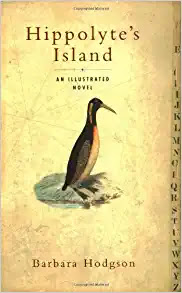
 Hippolyte's Island, by Barbara Hodgson This came across the donation table and I was intrigued by all the maps and diagrams and whatnot inside.  The copy is in like-new condition, so I didn't know that it was published in 2001.  It's not very much like a Griffin and Sabine book, but I do think it's a similar aesthetic. Hippolyte Webb is a bohemian sort of travel writer; kinetic, distracted, continually bouncing around.  Looking for a new adventure, he decides to look for the Auroras -- a small group of islands east of the Falklands, or at least so have a few explorers said.  Others haven't seen anything but open ocean, and so while some maps used to have the Auroras marked, modern maps do not.  Hippolyte figures he'll learn to sail, travel to the Falklands, find a boat, and sail out to seek for these islands.  He gets an old school buddy -- now a publisher -- to give him an advance, and off he goes. The first half of the novel is Hippolyte's journey, ...