Posts

This is Halloween...
Image
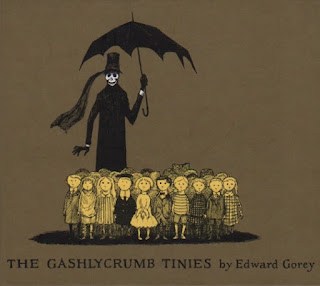
Happy Halloween to tender lumplings everywhere! These are a few of my favorite things: Edward Gorey, of course. Who else would come up with the title "The Helpless Doorknob"? He wore fur coats and Converse sneakers! Gorey said, "My mission in life is to make everybody as uneasy as possible. I think we should all be as uneasy as possible, because that’s what the world is like." If you're lucky, you can find a number of his collected works most easily in the three Amphigorey books. M. R. James was a late Victorian/early Edwardian scholar who wrote lovely creepy stories for fun. I've recently been lucky enough to get his collected stories in two volumes, so I'll review those soon. They are great stuff. James and Gorey were both inspirations for John Bellairs, who I've reviewed before here. Spooky, scholarly kids' stories that are a bit heavy on the repetition inherent in series, but much better-written and more interesting than most k...

Week 44: The Color of Water

Image
The Color of Water , by James McBride James McBride's book honoring his mother tells her unusual story. The chapters alternate between her own words explaining her life, and McBride's chapters telling about their family life as he grew up. McBride's mother never talked about her past and he spent years trying to get her to talk about it. She was white and Jewish, and married a black man in 1942. She became a Christian and together they started a church in the New York housing project where they lived. She had eight children before her husband suddenly died, and after a while she remarried and had four more before she was widowed for a second time. Her entire adult life was spent as the only white woman living in an entirely black area, trying to raise 12 children in poverty, and living out her determination to get all of them to college. She always said that money wasn't important; only education was important. It's a wonderful book and an amazing story.

Week 44: One of Our Thursdays is Missing

Image
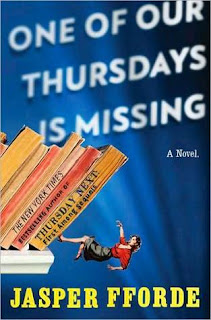
One of Our Thursdays is Missing , by Jasper Fforde If you love books, but have never read Jasper Fforde's Thursday Next series, you have missed a wonderful treat. This is the sixth book, and is actually told from the point of view of the written Thursday Next, who stars in her own series of books. Written Thursday is a citizen of the BookWorld, and she's hunting for the real Thursday, who is missing. She's doing her best to do what the real Thursday would do, and wild adventure follows. Quite a lot of this story is given over to world-building. Fforde must have had a whole lot of fun fleshing out the BookWorld, and he spends time showing it off. I know that's something of a no-no for fantasy writers, but it's so great that I think you should read the book just to enjoy all the amazing ideas he came up with. I had to stop about every other page and read a bit aloud to my husband, and I laughed a lot. Yay Thursday Next!

Week 43: Aftermath

Image
Aftermath: the Remnants of War , by Donovan Webster I found this book to be absolutely fascinating, and zoomed through it without putting it down much. Cheerful it is not, but it's very valuable reading. Webster tours several different battlefields of the 20th century, looking at what war has done to the landscape and the people. The first stop is France. It turns out that France is absolutely stuffed with unexploded ordnance from World War I (as are other spots). Trench warfare meant that armies stayed put for long periods of time, lobbying enormous amounts of ammunition at each other. It was fairly new technology, so a good 25% of the shells were duds. And they just stayed where they fell. Large areas of France are still cordoned off because they're full of the stuff--and dud shells can easily explode. Demining teams collect and destroy hundreds of tons every year, but it will take decades or longer to finish the job. I found an online article about it with some goo...

Week 43: How to Write a Sentence

Image
How to Write a Sentence, and How to Read One , by Stanley Fish The sentence is the building block of writing, and Stanley Fish devotes his book to playing with, admiring, analyzing, and imitating the best sentences he knows. What makes a truly great sentence? Wait, before we get to that, what is a sentence? Fish gives his own definition of what a sentence really is, and in passing he dismisses traditional grammatical teaching--both the usual definitions of a sentence and all the rest of it as well. This is the one part of the book that I take exception to; he repeats the claims (noted in my review of The War on Grammar ) that teaching grammar does nothing to improve writing and provides a sophisticated definition of a sentence. The only trouble with his definition is that it's one for adults, not one a child can understand at all. The traditional definition, "A sentence is a group of words that forms a complete thought," is not easily understandable to a young chil...

50 Things Every Young Lady Should Know

Image
50 Things Every Young Lady Should Know , by Kay West, John Bridges, and Bryan Curtis The young lady's etiquette manual has been updated for modern life in this little book. It's not too short and not too long, very readable, and full of good information for a younger teenage girl. I'd say that this is one step up in maturity from the excellent American Girl books on how to behave, and aimed at girls 11-15. My own 11-year-old daughter is reading and enjoying it. I think she'll be glad to have it to refer to now that she's a little older. West divides her material into tiny little chapters, one to each topic. Each section gives basic directions, a list of do's and don'ts with reasons, and then two or three rules to sum up. Topics include everything from making introductions and dealing with fancy table settings to cell phone etiquette and rules for Facebook. Those features of modern life are discussed in detail and the rules given are quite good, so ...

Feminist Classics: The Beauty Myth

Image
The Beauty Myth: How Images of Beauty are Used Against Women, by Naomi Wolf When Naomi Wolf published her diatribe against ridiculously unrealistic standards of beauty in 1991, doing such a thing was kind of new (at least, after the 80's). The Beauty Myth has had a lot of influence over the past 20 years. Thanks partly to Wolf, books denouncing the objectification and commercialization of women are now pretty common. Many more people are aware that our ideals of beauty are unrealistic and unattainable, and our ideas about beauty have expanded a bit to include some variation. At the same time, the standards have only gotten less realistic; Photoshop means that every image in every publication is fixed up to reflect something that no one could attain, and there is no such thing as being too gaunt. Look back at some 80's models and marvel at their curves! So this was an important book. But I didn't enjoy reading it, and I didn't finish it. Wolf makes some really gr...