Posts

Showing posts with the label World War I

The 39 Steps

Image
The 39 Steps , by John Buchan The Back to the Classics Challenge asks for "a classic mystery, suspense, or thriller."  It so happens that I picked up a collection of Richard Hannay thrillers some time back, and the first one, The 39 Steps , is certainly a classic thriller, so I picked that.  And then it so happens that I found a Franklin Library edition for almost nothing--I don't collect those (do any serious readers buy Franklins? To read? I want to know) but this one has illustrations by Edward Gorey.  They are not actually terribly interesting illustrations, with the exception of the cover image, which I share with you here. It's summer 1914, and Richard Hannay is visiting England after a lifetime spent on the African veldts.  He is bored stiff and planning to leave, when his upstairs neighbor invites himself in and tells a fantastic tale.  The Black Stone gang are planning to assassinate the only man who can keep peace, and he's got the vital informatio...

Some Poets of World War I

Image
One of my Classics Club selections was poetry by Wilfrid Owen. I thought June's WWI event would be a good time to do that, but then I found that a copy of only his poems was not easy to come by.  What I could find was a very nice collection of modern poetry that contained quite a bit from several WWI poets, both famous and not.  So I decided to replace Wilfrid Owen with "Selections From WWI Poets." I just went through and read everything by anyone who was a familiar WWI name or who had a poem that was clearly related.  This included Siegfried Sassoon, Rupert Brooke, Isaac Rosenberg, Wilfrid Owen, Robert Graves, and May Wedderburn Cannan. I enjoyed my hour or so with the poets, but I'm not much good at talking about poetry.  Instead I'll give you "Rouen," by May Wedderburn Cannan, who must have been a nurse. Early morning over Rouen, hopeful, high, courageous morning, And the laughter of adventure and the steepness of the stair, And the dawn acros...

August 1914

Image
August 1914 , by Aleksandr Solzenitsyn In January, I put this novel on my mental list for the year, thinking that it would be good for the 100th anniversary of WWI.  I hoped it would give me more insight into the Eastern front of the war, which I really know very little about.  August 1914 did do that, and although it's not my favorite Solzhenitsyn novel, it was very worth reading. Like In the First Circle , this is a sketch of an entire society at a particular moment in time.  There is a vast cast of characters, all doing their own thing and sometimes intersecting with each other.  We do not only see the warfront; there are people on country estates, in the cities, in schools, and even chapters consisting entirely of snippets from newspapers.  But the vast majority of the novel does take place with the soldiers going to war.  We don't see nearly as much of all the other things. Troop movements take up at least 2/3 of the book, and while I was interes...

A Question of Honor

Image
A Question of Honor , by Charles Todd I've enjoyed this series of mysteries set in World War I.  Bess Crawford is a nurse, so she gets around, moving from stations at the front to hospitals further back, and often traveling with wounded soldiers on their way to further recuperation.  She also has an Anglo-Indian background, having grown up in India as the daughter of a colonel, and almost the daughter of the entire regiment.  This fifth novel in the series draws on that Indian background for the story, which I thought was neat. Ten years ago, the Colonel Sahib's regiment was rocked by the sudden desertion of Lieutenant Wade, accused of five brutal murders (including his own parents).  Wade's body was reported as found in the mountains of Afghanistan, but the whole thing left a stain on the honor of the regiment.  Now, in a triage station near the front lines, Bess meets up with a dying Indian soldier who tells her that he has seen Lieutenant Wade alive and w...

The Perfect Summer

Image
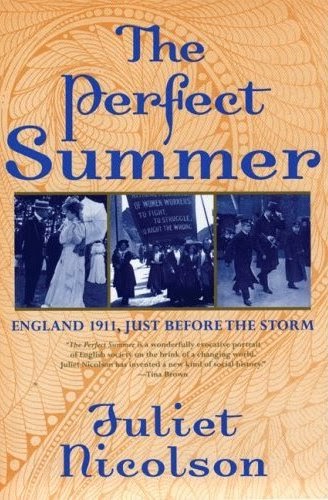
The Perfect Summer: England 1911, Just Before the Storm , by Juliet Nicolson This year I'm trying out a new thing for me--a sort of book club on Goodreads that reads a bunch of books centered around a theme and then discusses them.  It will just happen twice in a year.  Our first batch of books are all about World War I, which is of course very appropriate for the 100th anniversary this year.  The Perfect Summer is the only non-fiction title on the list, and it's really more of a look at the English society that is about to disappear forever. The summer of 1911 was unusually warm and sunny, and before too long it turned frighteningly hot and dry.  In this heat wave, George V was crowned King (and Queen Mary felt trapped).  Wealthy socialites attended endless parties, trying to stave off ennui with the help of drink and adultery.  Poor workers, fed up with horrific conditions, staged strikes and shut down London. The Russian ballet electrified everyone...

The Return of Captain John Emmett

Image
The Return of Captain John Emmett , by Elizabeth Speller This is an extremely complicated murder mystery set just after World War I.  Laurence Bartram, veteran and widower lacking in direction, is asked by his old friend's sister to shed a bit of light on why the friend might have committed suicide.  Captain John Emmett was living in a sanatorium for shell-shock victims, but seemed to be improving; why would he commit suicide?  The more Laurence looks into John Emmett's life, the more puzzling that question becomes, and soon Laurence is discovering how very much Emmett hid from his family. I'm feeling kind of lukewarm about this novel.  It wants to be a more serious and literary mystery than your average cozy British mystery, and that's fine, but the result is more verbiage than I was really interested in.  The mystery is pretty difficult to follow, though it resolves well enough.  But I felt like my interest was smothered a bit by those elements. ...

The Good Soldier Å vejk

Image
  The Good Soldier Å vejk , by Jaroslav HaÅ¡ek The Fateful Adventures of the Good Soldier Å vejk During the World War-- that's the full title of this influential (and gigantic) work.  Å vejk has become an icon of the little guy in Central and Eastern Europe.  And I found out that his name is pronounced Shvake .  I had to ask for help several times with the pronunciations; I was especially befuddled by the letter ů --never seen that one before! Å vejk is a dealer in stolen dogs, and when war breaks out, he is completely enthusiastic and patriotic.  (This is entirely suspicious; in World War I the Czechs lived under the Austro-Hungarian Empire, and they were conscripted into fighting for a power they didn't like, in a war they didn't care about or understand.)  He is arrested by the secret police, put into a madhouse, and eventually ends up in the army, where he consistently gets lost, in trouble, or even arrested as a spy.  Somehow or other, though, he n...

Goodbye to All That

Image
Goodbye to All That , by Robert Graves The War Between the Generations WWI Challenge has put a lot of books on my wishlist this year, and here is one of them.  Robert Graves, a fairly well-known author and poet ( I, Claudius, The Greek Myths, and The White Goddess are the most famous), served as an officer in World War I.  This is a memoir of his life from childhood until about age 30: "...my bitter leave-taking of England where I had recently broken a good many conventions; quarrelled with, or been disowned by, most of my friends; been grilled by the police on a suspicion of attempted murder; and ceased to care what anyone thought of me."  This is partly a reference to the events and subsequent scandal that led to the breakup of his marriage.  He left England for Majorca and stayed there for most of the rest of his life.  It turns out that the 1957 edition I read was an edited version, with all the scandal bits and a good deal of the venom taken out....

Lady Almina and the Real Downton Abbey

Image
Lady Almina and the Real Downton Abbey: the Lost Legacy of Highclere Castle , by the Countess of Carnarvon I've been seeing this history book all over the book blogs, and was happy to get a chance to read it.  This is the life story of Lady Almina, Countess of Carnarvon, and an exciting life it was.  The family, and the Carnarvon country seat of Highclere Castle, has been the inspiration for the hugely popular Downton Abbey TV series (which I have not yet seen the second season of, so no spoilers allowed!).  The current Countess took the opportunity to tell the real story of the Carnarvon family, which is much nicer and lacks backstabbing sisters or evil footmen. Almina Wombwell started off as a very pretty debutante with a  dubious background.  She was the natural daughter of somebody (Alfred de Rothschild), which made her very wealthy indeed but an outsider in Victorian England. Even so, young lords needed rich heiresses to keep their estates going, and ...

The First World War

Image
The First World War , by John Keegan I do not enjoy reading about World War I, which always seems to me to have been such a horribly avoidable and pointless war, fought for almost no reason at all.  But we have to learn about it, because the Great War created the modern world.  Most of what happened in the 20th century can be traced back to WWI, and of course that continues now. John Keegan's book is an overview of the entire war.  It can't get into details or personal stories much; the perspective is from the heights.  I found it difficult to get into for this reason, though it's not a flaw in the book--that's just how it has to be in order to get the story told.  Still, it's a dense book about war tactics, which is never easy for me to read.  I've been working on it for months, bit by bit. Keegan explains some on the reasons that World War I was such a mess.  For one thing, the state of technology at the time dictated the entire shape of the wa...

A Farewell to Arms Readalong IV

Image
The readalong at War Through the Generations is wrapping up, and here are the final discussion questions.  Don't read this if you don't want to know what happens at the end. 1.  In Chapter 31, as Henry is swept down the river, he refers to a “we”.  Who do you think this “we” is? I just assumed that he was speaking of himself only and using a sort of figure of speech.  I noticed it, but didn't think about it too much. 2.  After Henry’s escape into the river, he talks about not having any obligation to the war effort on either side, though he wishes both sides luck.  Do you think he is no longer brave/courageous or is it something else?  Explain. I think he's had enough and sees that moment of escape as an irrevocable choice to leave the war.  He's in a bind--he's been trying to do his duty and get the cars and equipment where they're supposed to go, but it's a mess, and now he's been picked up and will be shot as a deserter or a spy no...

Farewell to Arms Readalong III

Image
War Through the Generations is hosting a readalong of Hemingway's A Farewell to Arms .  This week we read chapters 21-30. 1.  “The coward dies a thousand deaths, the brave but one” is a statement made by Henry, and he and Catherine enter into a discourse about bravery.  Do you think either character is brave and do you think Catherine is right when she says the brave die more deaths but just don’t talk about it? Explain. I have to say, at this point I think Henry's pretty stoic.  He's put up with months of severe pain with barely a whimper (albeit with quite a lot of brandy).  He's not interested in running into battle, but he's reasonably cool under pressure and I think he's brave. Catherine, at least, is holding herself together at the prospect of having a baby out of wedlock in a foreign country in the middle of a war with no resources and nowhere to go.  I still think Catherine is a ninny, but I'll give her points for courage.  I think s...

A Farewell to Arms Readalong II

Image
The Farewell to Arms readalong is hosted at the War Through the Generations blog. For this week, we read chapters 11-20.  Here are this week’s questions, feel free to join the discussion. 1. There is a lot of talk about being tired or the priest looking tired in this section.  What do you think Hemingway is trying to get at? War exhausts everyone in the vicinity whether they're actually fighting or not.  The priest isn't fighting, but if he's working near the front or in a hospital (I can't quite tell from the story what he does, but he's working with ambulance drivers, right?), it's his job to comfort the dying, wounded, and distressed.  A priest in WWI had a lot of tough questions to answer!   And then he spends a lot of his time being needled by everyone else, too, which seems to be the main preoccupation, as though he never does any actual priesting.  Anyway, I'm not surprised he's tired. 2.  The relationship between Henry and Cath...

A Farewell to Arms Readalong

Image
So far I've read the first 10 chapters of A Farewell to Arms .  And so far I'm not enthralled, but hey, we can hope.  I didn't really expect to love Hemingway's famous style.   Here are the questions from the War Through the Generations blog: For this week, we read chapters 1-10.  Here are this week’s questions, feel free to join the discussion. So far, how do you feel about Hemingway’s writing style? Are you enjoying it? Not really.  He does make you work by plopping you into the story with no introduction; you just have to figure out where you are, and that's not a bad thing in my opinion (SF generally works best that way).  He likes run-on sentences without commas, which was probably quite new and original back then, but now makes me think of Cormac McCarthy.  Hemingway's words have not really grabbed me.  Everything is too surface or something.  I don't care about Henry or Catherine much at all, though I feel bad for the poor pries...

A Duty to the Dead

Image
A Duty to the Dead , by Charles Todd Bess Crawford is a nurse, serving on the Britannic during World War I. Well, she gets torpedoed in the first five pages, and after that she's on leave getting better, so she doesn't actually spend much time in the war, but this is a historical mystery anyway. During her recovery, Bess seeks out a wealthy Kent family to deliver a final message from a dying soldier. She doesn't know what the message means, and she's unsatisfied with the reception it gets from the family. As she gets to know the family and other village residents, she starts to develop suspicions about the past, and in trying to fulfill her duty, she gradually uncovers an old story of malice and horror. I quite enjoyed this mystery. There are a good many characters, but they're all individuals, and the mystery is sufficiently mysterious without being too complicated for credibility. I looked for this title because the story sounded interesting, and it deliver...

World War I Challenge

Image
I found another challenge to join! This one is hosted by War Through the Generations and is all about World War I. The information: War Through the Generation’s 2012 reading challenge will be World War I . The challenge will run from January 1, 2012, through December 31, 2012 . Rules: This year you have options when reading your fiction, nonfiction, graphic novels, etc. with the WWI as the primary or secondary theme. Books can take place before, during, or after the war, so long as the conflicts that led to the war or the war itself are important to the story. Books from other challenges count so long as they meet the above criteria. Dip: Read 1-3 books in any genre with WWI as a primary or secondary theme. Wade: Read 4-10 books in any genre with WWI as a primary or secondary theme. Swim: Read 11 or more books in any genre with WWI as a primary or secondary theme. Additionally , we’ve decided that since there are so many great movies out there about WWI, you can subst...