Posts

Showing posts with the label Scandinavian literature

Summerbook #16: Parables of Kierkegaard

Image
 Parables of Kierkegaard , ed. Thomas C. Oden I wasn't sure what to expect from this collction, but given the general intimidatingness of Kierkegaard, I figured I could deal with some parables.  I did actually read Either/Or in college, with particular focus on "Diary of a Seducer," but that was long long ago! What this turned out to be is a collection of parable-like stories gathered from the complete works of Kierkegaard.  Perhaps it's a few sentences of anecdote, perhaps it's a long excerpt on the experiences of a particular character known in 1830s. Christianshavn.  And, each little story comes with a moral quesion that the editor inserted to clarify what Kierkegaard was getting at.  I'm not sure it helped; to my mind it mostly gave an appearance of purpose more than there was, in fact, purpose. But it was a nice and fairly interesting thing to read.

Summerbook #6: It is Acceptable (Det GÃ¥r An)

Image
Wow, I hate this cover.   Look at them simpering! Det GÃ¥r An/It is Acceptable , by  C. J. L. Almqvist Long ago in college, I read a lot of Scandinavian literature, and one of my favorites was the Romantic novel The Queen's Diadem (Drottnigens juvelsmycker) .  The only other work of Almqvist I've been able to track down in English is Det GÃ¥r An/It is Acceptable , also published as Sara Videbeck .  This was a scandalous story in 1838 and led to Almqvist's removal from his position in the church. It all starts on a ferry; sergeant Albert notices a self-possessed young woman, clearly out on business.  They get to talking, and Sara tells him about her life running the family glassworks.  Soon they are good friends, and decide to travel together.  Nothing much happens except that they build a mutually respectful friendship, and when Albert wants to marry Sara, she argues that marriage is a trap, and they'd be much better off keeping their respective jo...

CC Spin #44: The Poetic Edda

Image
 The Poetic Edda: Stories of the Norse Gods and Heroes , trans. by Jackson Crawford This was fun!  I read a couple of poems per day.  These are the oldest sources we have for information about the Norse gods, and they're kind of cryptic.  It helps to have a little bit of context and background information, which Crawford provides, but not too much; he doesn't overdo it. The first poems are mostly about Thor, Odin, and Loki.  In one, Loki shows up and creatively insults everyone, and they just have to put up with it because Odin has sworn to always drink with Loki.  (The swearing of oaths seems to be a popular, and dangerous, pastime while drinking.)  Odin goes in disguise to a giant and they have a contest of wisdom.  One poem is just good advice from Odin.  In another, Odin and Thor insult each other across a ford.  I particularly liked a complicated poem about "the escape of Voland the smith," who ended up as Wayland in Britain.  ...

Hans Christian Andersen Fairy Tales

Image
 Hans Christian Andersen Fairy Tales , World Edition, 4 vols. A while back I decided I wanted to find the best edition of HCA's tales possible, and I came up with this: a 1959 four-volume set issued at Odense, which is where HCA was born.*  It's a very satisfying set, with little, fat hardbacks perfect for holding in your hand.  Each one has a different portrait in the front.  They're illustrated with the original drawings by Vilhelm Pedersen, who HCA chose himself, and the final volume has illustrations by Lorenz Fr ø lich, who continued the work after Pedersen's death.  I don't know that this is a complete and exhaustive collection of HCA's tales; he wrote a lot of things that weren't exactly fairy tales or poems or plays, so it would be difficult to make a complete list.  I did notice that "The Daisy" is not in this set. I'm not sure how the stories are arranged; it's not by date (I checked) and almost all of the most famous stories are ...

Summerbook #3: The Brothers Lionheart

Image
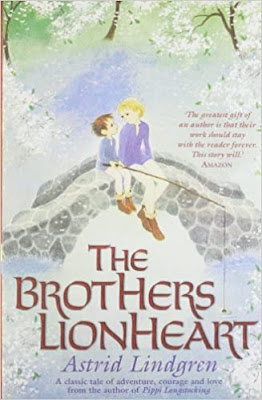
  The Brothers Lionheart, by Astrid Lindgren I guess I'm not very well up on Astrid Lindgren's body of work, because I'd never seen this book before.   Little Karl has always been sickly, and has spent much of his life lying on the sofa while his hard-working mother sews to make their living.  He just about worships his older brother, Jonathan -- who is not only healthy and strong, but also very kind, and intelligent.  He is able to go to school and everything, so every day Karl waits for him to come home.  Jonathan affectionately calls him Rusky, and to comfort him when he is afraid of dying, he tells him tales about the wonderful land of Nangiyala, where they will go when they die.  In Nangiyala Rusky will be healthy, and they'll camp out and have lovely times.  But in a tragic accident, Jonathan dies first. Karl lives for several more months, but at last he dies and indeed, he finds Jonathan in Nangiyala, and they have a cabin, and horses,...

The Wonderful Adventures of Nils

Image
The Wonderful Adventures of Nils, by Selma Lagerlöf I have enjoyed Lagerlöf's books of legends, and for a long time I've meant to read this story.  (After all, my oldest got it from the library and read it at age 5, so surely I can do it...)  She wrote it as a geography textbook for Swedish schools, published in 1906–07, and in the English edition, some of the longer geography passages are edited out.  This turns it into a long adventure story, still featuring a whole lot of Swedish geography. Nils Holgersson, age about 14,* is kind of a stinker of a boy.  He's lazy, rude, and mean to animals -- a real worry to his parents.  And one day, he spots the house elf, catches him....and the elf gets his revenge by turning Nils into an elf too!  Nils can now understand and speak with animals, but they don't think much of him.  What to do? He winds up taking a trip with the wild geese, who are migrating north to Lappland for the summer.  They call him Thum...

Moomin books

Image
The Moomintroll books, by Tove Jansson:  Comet in Moominland, Finn Family Moomintroll, Moominpappa's Memoirs, Tales from Moominvalley, Moominvalley Midwinter, Moominpappa at Sea ( I don't own the last , Moominvalley in November) We've all been feeling the strain lately, I know, what with the election and the Covid and the state of things generally.  I've reacted to it by reading nothing but the most comfortable of comfort reads.  The Russian history, the horizon-broadening literature, anything the least bit demanding, has fallen by the wayside.  I decided to take November off as far as events go, so no Australians (sorry, Brona) or non-fiction parties.  Instead, I have read at least six Moomintroll books in the last couple of weeks. I've long been a fan of the Moomins -- I discovered them in my mid-teens with a battered paperback of Finn Family Moomintroll.  That was about 1988 and they were at a low ebb of fame in the United States (and they've never been...

Four Stories (from Norway)

Image
Sigrid Undset Four Stories by Sigrid Undset Long, long ago I read Sigrid Undset's Kristin Lavransdatter books and liked them fine, and I wanted to try something else she'd written, so I picked up this volume of four short stories.   The cover was not very promising as it said "Four touching, evocative, compassionate stories of 'little people' in modern Norway."  By modern they mean in the 20th century; the stories have no specific chronological settings, but they seem to me to be set before 1930, with at least one before World War I.   The book was published in 1959. "Selma Brøter" is about a single lady office worker -- a spinster -- who observes and becomes involved in her younger co-workers' romance. "Simonsen" is about an aging workman whose son finds him embarrassing. "Thjodolf" concerns a sailor's wife whose only baby died at birth.  She fosters a little boy and becomes deeply attached to him, but then ...

Summerbook #19: Purge

Image
Purge, by Sofi Oksanen This was a pretty harrowing novel, folks.  It was interesting, and well-written, but I don't think I'll be revisiting it and it should maybe come with a warning on the cover. Aliide Truu, an old woman, lives in her farmhouse on the edge of the Estonian forest.  It's 1992, and an unknown young woman shows up in front of her house.   Zara is running from the terrifying men who captured and trafficked her, but she also has a reason for searching out this particular house. Neither of the women want to tell their stories, but they each need to find out who the other is.  The reader, meanwhile, is given access to chapters of their histories; Aliide remembers successive waves of German and Soviet occupation, her sister's marriage to the man Aliide loved, and just what she did to survive , and to get what she wanted.  Zara grew up in Vladivostok, surrounded by her mother's and grandmother's memories and fears.  When she wanted to ...

The Sibyl -- Summer Book 10

Image
The Sibyl, by Pär Lagerkvist I actually read this short novel a few weeks ago, on the way to Portland, but life has moved so fast that I haven't gotten around to blogging it yet.  It was easy to forget about, since the book disappeared from our AirBnB house -- perhaps it was a lovely present for the next person to come along?  I didn't mind losing it; it was an ancient paperback that my brother had left behind, and I was going to put it into the Little Free Library anyway. The one I lost.  Not very beautiful; I won't miss it. This was a very strange novel, I thought.  Near the oracle at Delphi, presumably sometime before about 500 AD, an aged sibyl lives up on the mountain with her son.  A man comes to visit her, asking for a prophecy, and tells his story; fearing bad luck, he told a man condemned to crucifixion not to lean on his wall to rest.  The man cursed him with immortality -- we have here the Wandering Jew of legend,* who complains against ...

Post-summer riffle of reviews: part II

Image
Here is a whole set of books I've read from various countries in the last few weeks.  Most of them will show up in my Reading All Around the World list, and one I picked for August's Women in Translation event, which I nearly missed!  Most of these were also on my original 20 Books of Summer list (which currently stands at 17!  No way will I finish that list in the next week, but I read quite a few other books too). Lyrics Alley, by Leila Aboulela  (Sudan) : This novel of a wealthy and powerful family in 1950s Sudan is a tapestry of interwoven lives.  The patriarch, Mahmoud Bey, is a forward-looking man invested in bringing infrastructure and wealth to his country.  His son, Nur, is about to marry a cousin and they are very much in love, but a tragic accident leaves Nur paralyzed and depressed.  The family dynamics are complex and sometimes disastrous. Nur has to break through the weight of expectations and pity in order to forge a new life and id...

Marie Grubbe

Image
Marie Grubbe , by Jens Peter Jacobsen This post is about a 19th-century Danish novel you've almost certainly never heard of.  But stick around till the end for a real surprise... J. P. Jacobsen is virtually unknown in the English-speaking world, but he was quite important in European literature.  I studied his more famous second novel, Niels Lyhne , in college, and re-read it a few years ago.   In that post, I gave a little background, and here it is again for your convenience:  ... a major classic of the late 19th century -- for literary middle-Europeans interested in Romanticism and Naturalism.  Thomas Mann and Rainer Maria Rilke considered it to be among the greatest of novels.  Henrik Ibsen and Stefan Zweig cited Jacobsen as an influence.  Both Zweig and James Joyce even wanted to learn Danish so they could read this novel in the original!  But J. P. Jacobsen remained obscure in the English-speaking literary world, and Niels Lyhne...

Last Tales

Image
Last Tales, by Isak Dinesen/Karen Blixen I always enjoy reading Isak Dinesen, and I have just about everything on the bookshelf because I took a course in college that was almost nothing but Dinesen (I did a good bit of Scandinavian literature).  She was an odd duck in her day, and reading her now is almost surreal; the stories are so strange to our sensibilities, especially in this last collection.  She did her level best to write as though she lived in the 18th century, or possibly earlier, and nobody thought more of aristocracy, nobility, or the mysterious power of femininity than she did. I remember once my instructor showed us a photo of her standing on a stage with Betty Friedan.  Two more dissimilar women could hardly be imagined, and I have to wonder if they'd ever read each other's works (probably not) or if they could possibly have had anything to say to one another.  Karen Blixen was tall, slim, elderly, elegant and proud.  She'd probably put bel...

Women and Appletrees

Image
Nobody in the novel is this well-dressed. Women and Appletrees, by Moa Martinson Moa Martinson (born Helga Maria Swarts) was a Swedish feminist writer who always worked on behalf of the working class.  Her whole life was given to her ideals, especially for working-class women.  (I seem to recall she was also in favor of free love, but that's left over from a long-ago class and may be somebody else.) Women and Appletrees starts with Mother Sofi and her best friend, Fredericka, and their lives in the 1840s.  They farm, and they shock the village with their scandalous habit of bathing once a week.  Sofi has many children, and two generations later... We follow Sally and Ellen, two of Sofi's descendants, through their lives up to about World War I (both are partial autobiographical portraits of Martinson herself, Sally more so).  Both grow up in slums, enduring hunger, violence, and trauma, and end up meeting in a tiny farming village.  Ellen has re...

The True Deceiver

Image
The True Deceiver, by Tove Jansson Tove Jansson is always worth reading, and this is an intriguing short novel that I think is also her darkest. In a remote village that is nearly cut off by winter snows, Katri Kling is an outsider.  She lives with her simple brother Mats and her menacing, unnamed dog, and she's been planning for a long time.  Mats' security is her goal; her method will be to take over the life of Anna Aemelin, an artist.  I enjoy Jansson's prose a lot, with its extreme particularity and focus on certain things.  I think a lot of her own thoughts about art and questions about what obligations the artist has to the audience show up in Anna's character, which is neat.  The main theme, though, is deception: what constitutes honesty or deception?  Each woman considers herself to be honest, but that doesn't mean that they always tell the truth. Excellent short novel--pick it up if you can.

The Song of the Volsungs

Image
The Song of the Volsungs After the Beowulf readalong, I went on quite the Anglo-Saxon/early medieval kick.  Beowulf mentioned Sigurd, so I wanted to read his story.  I read some little texts from the British Museum about the Lewis Chessmen and the Sutton Hoo helmet; those were great. Then I started the Venerable Bede's Ecclesiastical History , but I'm not finished with that yet; still about 100 pages to go there.  Anyway, for Sigurd's story I picked up this fancy new Penguin edition, featuring the 1990 translation by Jesse L. Byock. The saga traces the history of the Volsung clan, starting with Sigi and going down through lots of murders and power struggles and incest (!) and people murdering their own children (!) until we get to Sigurd, who kills the dragon Fafnir.  Fafnir has not always been a dragon; he is the brother of Regin and was once human.  Regin gets Sigurd to agree to kill Fafnir by promising him the dragon's massive hoard of gold. This was...

Mysteries

Image
Mysteries , by Knut Hamsum A few weeks ago, Tom at Wuthering Expectations posted a casual invitation to join him and a few others in reading Mysteries with this: All too soon Ricardo de la Caravana de recuerdos , and I hope many, many others, will join me in a reading of and conversation about Knut Hamsun’s 1892 novel Mysteries .  If it is like other Hamsun novels, some of that “conversation” will be closer to stunned silence and questions like “What is this?”  Well, I could hardly refuse an opportunity to ask "What is this?" so I joined in. Mysteries is an 1892 novel by the Norwegian Knut Hamsun (whose name confused me until the introduction explained that it was Hamsund, after the family's farm, but a printer's typo inspired him to drop the D permanently).  He was something of an iconoclast in Norwegian literature, determined to smash all orthodoxies and write "a new literary psychology" that was all about the stream of consciousness and its ...

More mini-reviews!

Image
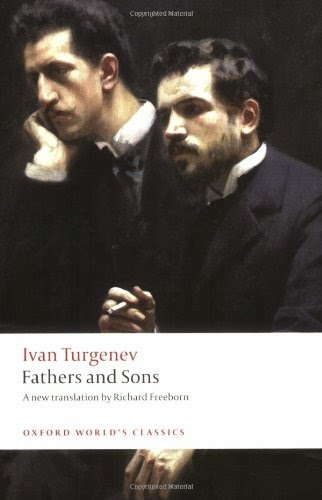
My desk is inundated with books from 3 different libraries and my own shelves.  I'm going to have to continue with the mini-reviews! Fathers and Sons , by Ivan Turgenev -- I enjoyed this so much, but I finished it right when I lost energy to blog.  Now all the impressions are dim.  But here we have two young men, Arkady and his good friend Bazarov.  Bazarov has been a controversial figure since the day he stepped on to the page; he's a Nihilist who claims to believe in nothing.  He wants to smash all of society, clear the ground so that a new and better world can be built from scratch, but he has little to say about what that world should look like.  Sort of proto-communist and scientific--Bazarov likes science, though not very much.  Then he falls in love, which he can't deal with at all.   Turgenev is showing us the generation gap he experienced.  I loved it, but I can't tell you too much about it in a mini-review. Shadow on the Mounta...

Eirik the Red

Image
Eirik the Red and Other Icelandic Sagas , ed. Gwyn Jones I've had this little old collection of sagas sitting on my bookshelf for years--longer than I had realized, in fact, since inside it I found a receipt from Black Oak Books (now sadly closed), dating from 1995.  I probably bought it on a date with the guy who is now my husband.  Like the Tolstoy  book I just read, it's an old hardbound Oxford World Classics title from the 1960s, very small and engaging, but with the price cut out of the book jacket. This is a collection of  eight sagas about Icelandic people--mostly their feuds--and one "saga of times past."  The historical sagas are careful-sounding records that give lots of detail about exactly where farms were and just who owned them, and the stories contained in them all sound like the Hatfields and the McCoys.  A feud will start with something small and escalate very fast, until it all ends in someone's manor going up in flames with everyone...

Winter's Tales

Image
Winter's Tales, by Isak Dinesen I read this book of short stories slowly, about one per day maybe.  I remember enjoying them very much in college.  Now I think I liked the Seven Gothic Tales a little more, but these were great too.  I will have to read Last Tales to finish out the collections that go together (in my mind, anyway).  I remember one very striking story in that collection. These stories are mostly set in or partially in Denmark.  They are a little simpler and mostly don't have the complicated frames that are so characteristic of Dinesen, and they are (I think) marginally more realistic, but they are still mysterious, Romantic, aristocratic to the point of obsession, and carry that particular Dinesen feeling she does so well.  "Sorrow-Acre" and "Peter and Rosa" were my own favorites, but looking back over the list of stories now, they were all very good. Dinesen always seems to be to be--well, not behind her times exactly, but something...