Posts

Showing posts with the label Russian literature

CC Spin #34: First Love and Other Stories

Image
 First Love and Other Stories, by Ivan Turgenev Wow, Turgenev sure could write.  Here we have short stories written over 20 years of his writing career.  Most of them illuminate a short episode and its meaning for a whole life, or a zeitgeist. "The Diary of a Superfluous Man" is the final diary of a dying man -- though he is only about 30, he has just days to live, and decides to set down the one significant thing that has ever happened to him, and in which he was utterly futile, as he believes his whole life to have been.  He got to know a local family, and fell in love with the daughter (age 17), but Liza never noticed him at all.  She fell instead for a visiting nobleman, and at the end of a romantic summer, he of course left without proposing.  Our narrator wanted to warn her, to help her, to marry her afterwards, but she never wanted any of his warnings or help and married another man. "Mumu" concerns a well-to-do widow living in St. Petersburg -- real...

"We Never Make Mistakes"

Image
  "We Never Make Mistakes:" two short novels by Aleksandr Solzhenitsyn This is what I mean about my April reading slump -- it took me the entire month to read this very short, very readable volume.  I don't think we can call these two stories novels -- at best they're novelettes or longish short stories.  About 70 pages each.  Also, I love love love the cover design, with its stark buzz saw blade.  There are, of course, no buzz saws of any sort in the stories. "An Incident at Krechetovka Station" centers on Lieutenant Zotov, who runs a small country train station.  It's 1941 and everything is overwhelmed by the recent German invasion.  Trains of troops, goods, refugees, medical supplies...there's not enough fuel to keep them all going, and nowhere near enough food.  Zotov has one competent assistant, Valya, and various other personnel who all seem to be lazy, corrupt, or very elderly. A 'straggler' arrives in the station, a man who has been ...

The Eternal Husband

Image
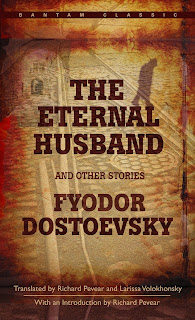
  The Eternal Husband and Other Stories , by Fyodor Dostoevsky I picked this one from my TBR pile for February because the Classics Club's dare for the month was to read something that had to do with romance/love.  I looked at my pile, and, well, an eternal husband sounds like it has something to do with love!  Or at least marriage, which isn't at all the same thing in a Dostoevsky novel.  In fact these stories were utterly without romance, even the ones that had marriage in them.   In fact, the first story, "A Nasty Anecdote," is all about a wedding!  Ivan Ilyich Pralinsky is a general, and has spent the evening with two friends, boasting about his liberal credentials.  On the way home, he comes upon the wedding celebration for a very lowly clerk in his office, and decides to prove his boasts by entering the event and being generously kind to his employee.  It goes horribly, horribly wrong.  Everyone is embarrassed, Ivan Ilyich, a non-d...

A Writer at War

Image
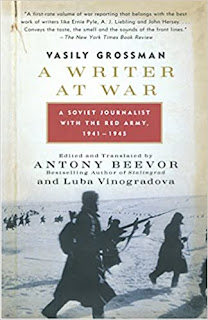
 A Writer at War: A Soviet Journalist With the Red Army, 1941 - 1945, by Vasily Grossman, edited by Antony Beevor and Luba Vinogradova Wow, this book packs a whole lot into what looks like a medium paperback.  It took me much longer to read than I thought it would! Over a year ago, I read a biography of the writer and journalist Vasily Grossman , and this was next on the list of his works that I want to read.   Grossman was attached to the Red Army as a journalist throughout World War II, and he always wanted to be on the front lines.  He was present for the early days of the invasion, the Battle of Moscow, most of the Battle of Stalingrad, the Battle of Kursk, and for much of the Soviet advance through Germany and Berlin.   This book collects Grossman's notes taken down in real time; it does not reprint the articles he wrote for the Krasnaya Zvezda (Red Star) newspaper.  The editors give context to the notes, telling us what's going on and who e...

A Backpack, a Bear, and Eight Crates of Vodka

Image
 A Backpack, a Bear, and Eight Crates of Vodka: A Memoir, by Lev Golinkin Here's my last Russian title for 2020!  It paired very well with the book I read earlier this year, When They Come For Us, We'll Be Gone , which was about the effort to get persecuted Soviet Jews out of the USSR.  Lev Golinkin was a persecuted Soviet Jew who wanted desperately to get out, though he was only a child. So: back in the 1980s, as the USSR was teetering on the brink of collapse -- though no one realized it -- the Golinkin family lived in Kharkov, in the eastern end of Ukraine (it's now known as Kharkiv).  They were Jewish, and that meant that they were publicly despised: the USSR proclaimed the brotherhood of all men, but they still required that your ID card state your ethnicity, and having "Jewish" on that line meant that you were subject to random quota limits and routine persecution.  Lina, the elder daughter, wanted to get into medical school, but the most stellar achieveme...

Reading challenge wrap-ups

Image
 The early part of the year seems so long ago and far away now that it is actually difficult to realize that I read some of these books this year.   Keely at A Common Reader ran a Russian Literature Challenge.   I read some great stuff, but this was also one of the challenges that really suffered during my slump.  I read eight books in total, which isn't bad, but boy howdy, I still have a lot of Russian literature on my shelf: Subtly Worded: stories by Teffi  Red Cavalry, by Isaac Babel The Unwomanly Face of War, by Svetlana Alexievich Virgin Soil, by Ivan Turgenev There Once Lived a Woman Who Tried to Kill Her Neighbor's Baby, by Ludmilla Petrushevskaya White Guard, by Mikhail Bulgakov Resurrection, by Lev Tolstoy Rachel at Hibernator's Library hosted a History Non-fiction Reading Challenge, which I really liked.  I read 20 titles, of which 8 had something to do with Russia/the USSR.  I still have plenty of Russian history to read, but I did mak...

CCSpin #24: Resurrection

Image
 Resurrection, by Lev Tolstoy Wow, what a novel this is.  It was published in 1899, Tolstoy's last great work, and also his first novel in over 20 years.  He had come to believe that art had to have a purpose and that he should no longer write novels, but when the Dukhobor sect needed money to emigrate to Canada, he wrote this as a fundraiser, and to express the views he had come to hold. Prince Nekhlyudov is your average dissipated rich nobleman; having gone to school and served in the military, and now living in society, he has been well trained in manners, dress, extravagance,  overindulgence in drink, and affairs with women.  He probably ought to settle down and is looking for a society wife.  Called to serve on a jury, he is astounded to recognize one of the defendants in a murder case; it's Katusha, the servant girl he once loved, and then seduced and abandoned.  Realizing that her entire sad life is his fault, he decides that he needs to atone -...

Summerbook #18: White Guard

Image
 White Guard, by Mikhail Bulgakov This is Mikhail Bulgakov's first novel, written in 1921 and published serially -- except that the magazine shut down and the last part of the novel was not published at the time.  Instead, it was turned into a play, The Days of the Turbins, and the play was such a smash hit that the novel was kind of ignored.  Bulgakov didn't finish it for several years. It is 1918, and the Turbins of Kiev are a family of three siblings: Elena, whose husband has been working for the German hetman, Alexei, a doctor with the Russian (White) army, and Nikolka, just 17.  They belong to the Russian-based urban/military class.  Ukraine has been pulled nearly to pieces in the complicated war; at the start of the novel, the Germans had installed a hetman to run the country for them, but now they are pulling out.  Elena's husband heads out with them.  Now there are three sides to the war: the Russian military trying to restore the Empire, Petly...

There Once Lived a Woman Who Tried to Kill Her Neighbor's Baby

Image
  There Once Lived a Woman Who Tried to Kill Her Neighbor's Baby: Scary Fairy Tale s, by Ludmilla Petrushevskaya This is the second collection of Petrushevskaya's stories I have read, and she is a great writer, although her material is mostly raw misery, Russian style.  In the other post, I quoted a review blurb as saying, "nothing about it screams 'political' or 'dissident' or anything else.  It just screams."   That said, the 'fairy tale' genre works well.  It actually took me all summer to read this collection; since I often get tired of too many short stories at once, I eked it out over months.  Even so, I can recall first story in the book -- the one about the woman who tried to kill her neighbor's baby -- as though I read it yesterday.  Another story deals with a plague in the city and the family that tries to survive it.  Or there's a teenage girl who dies, and her father makes a deal to save her. Twin ballerinas run afoul of a ...

Virgin Soil

Image
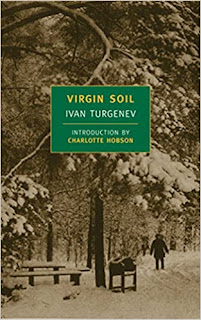
Virgin Soil, by Ivan Turgenev Turgenev's final novel, published in 1877, was a surprisingly easy and enjoyable read.  Maybe I'm just getting better at understanding Russian literature?  Anyway, it's a sympathetic rendering of young and idealistic reformers (called Populists) in the 1860s/70s -- so, the Russian serfs have been liberated from serfdom, and Tsar Alexander II has instituted some reforms, but he's also become more reactionary after an assassination attempt in 1866.*  The Populists wanted to bridge the massive divide between the wealthier, more educated classes and the people .  (Remember, at this time a lot of wealthier Russians didn't speak Russian; they spoke French.  There were essentially two populations.)  So a lot of them put on folk outfits and went out to the people , trying to educate them and encourage them to become revolutionaries.  It didn't go very well. This novel was a big success internationally, but upper-class Russians did...

The Unwomanly Face of War

Image
The Unwomanly Face of War: An Oral History of Women in World War II, by Svetlana Alexievich This book was originally published in 1985, and was first translated into English a few years later, but I don't think it became very well-known at the time.  This is a new translation on the heels of Alexievich's winning the Nobel Prize and becoming well-known for her collections of oral histories.  Alexievich spent, as far as I can figure, at least a couple of years collection the material for this project.  She visited places all over the USSR, and interviewed thousands of women who had served in the war, but who had never been asked about their experiences or set down their memories.  After the war, the USSR preferred to focus on the great victory rather than the incredible hardships it took to get there, and people tended to assume that it was exclusively a men's victory.  So I am very grateful that Alexievich worked so hard to get all these women's stories!...

When They Come for Us, We'll Be Gone

Image
When They Come for Us, We'll Be Gone: The Epic Struggle to Save Soviet Jewry, by Gal Beckerman Well, this title took me a little longer than I expected it to!  Embarrassing to relate, I started it in January and got bogged down a few times, especially when we started the lockdown.  For a while I couldn't concentrate well at all, and while it's a fascinating history, it's also a fairly heavy-duty book. This is the amazing history of the struggles of Soviet Jews, and outside efforts to help them.  The dilemma was that, while the USSR didn't really want Jews around, it wasn't willing to let them leave either.   In theory, the Soviets would band together as one; in practice, Jews were always treated as second-class citizens, which kept them out of jobs they were qualified for and made them feel unwelcome.  But if they applied to leave, they would just about always be denied...and would also lose their jobs and social circles.  This meant that even Jews...

Red Cavalry

Image
Red Cavalry, by Isaac Babel First off, I just have to say that visually speaking, this is one of the most awesome book covers in the history of the world and I love it.  Of course, what it actually depicts is terrible; it's a Soviet propaganda poster showing a map of Eastern Europe/Russia, with a giant Red soldier stomping on his neighbors -- specifically Poland -- and the neighbors are mostly depicted as bloated plutocrats and outdated military officers.  So it's not that I like the subject matter; it's just an amazing poster showing the official Soviet message -- an arresting primary source and window into this time. This time is 1919 -1920, when the newly-established Soviet Russia and Ukraine are involved in a war with Poland.  The whole thing is complicated enough that I'm just going to direct you to the Wikipedia page on the conflict , but the very short version is that Poland wanted to extend its territory east, and invaded Ukraine, and the Soviets wanted to...

Subtly Worded

Image
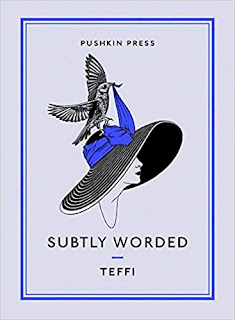
Subtly Worded, by Teffi I didn't know anything about Teffi, and that turned out to be a real shame, so I'm going to give you a quick rundown.  Teffi is a Russian author not to be missed! Nadezhda Alexandrovna Lokhvitskaya, married name Buchinskaya, lived ~1872 - 1952.   She became an established writer of great popularity in the early 1900s -- everybody liked Teffi, from Tsar Nicholas II to Lenin.  Teffi mostly wrote short stories, sparkling satires and tragicomedies that often seem like comedy until you look again.  Some of her works were not very friendly to the tsarist government, and in 1917, she was a supporter of the October Revolution.  She soon realized that the Bolsheviks were not what she hoped, and escaped to Istanbul and then Paris, where she spent the rest of her days, along with so many other Russian émigré s.  She continued to write her short stories until the end of her life. Subtly Worded is a survey of Teffi's short works, inc...

Vasily Grossman and the Soviet Century

Image
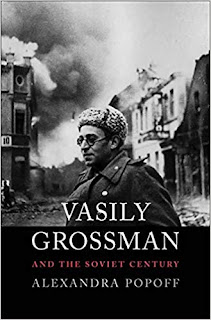
Vasily Grossman and the Soviet Century, by Alexandra Popoff Vasily Grossman isn't anywhere near as well-known as he ought to be.  My plan is to read some of his books, but they're heavy stuff so I thought I'd start with this biography so I could get situated. Grossman was born in 1905, in the Russian Empire, and was educated as a chemical engineer in the USSR.   He changed careers and became a writer and journalist in the 1930s -- he was always trying to tell the truth about what he saw, so his first novel was about the miners he'd known at his job.  He then worked as a journalist attached to the army during the war, and was present through nearly all of the battle of Stalingrad.  He was also one of the first people to witness what had happened Treblinka.  After the war, he had to deal with constant censorship and difficulty, as he spent just about the rest of his life trying to communicate what he knew and believed. He worked on the Black Book of Russia...

Russian Literature Challenge 2020

Image
Keely at A Common Reader is hosting another Russian Literature Challenge, hooray!  You would not believe the amount of Russian literature on my shelf.  Well, you would.  But it's a lot.  This challenge goes right along with my 2020 goals, and it's nice and relaxed, so I'm excited to join up.  Keely says: Personally I'm not the greatest fan of challenges that have too many rules and regulations so I only have one: read as much (or as little) Russian literature in 2020 as you want to and share your thoughts if you so desire! I have a recommended reading list that I'll add the link to at the end of this post for ideas but how you define Russian literature is up to you.  Here are some titles, in no particular order, that are on my list of things to read, but I'm not committing to anything specific at this time. The White Guard or Heart of a Dog , by Mikhail Bulgakov Shorter works of Tolstoy Last Witnesses and The Unwomanly Face of War , by Sv...

Summerbook #17: Secondhand Time

Image
Secondhand Time: The Last of the Soviets: An Oral History, by Svetlana Alexievich Wow, this book is...an achievement.  Alexievich won the Nobel Prize in Literature, and it was well-deserved.  It's not a regular book of history; it's more like a monument, really. What Alexievitch does -- has been doing for well over twenty years -- is interview people and transcribe their stories.  Mostly just ordinary people, and the stories are not edited much.  They're just set down.  The result is very immediate; you can almost see the people as they speak. Many of the people in this book are elderly, and tell of long Soviet lives.  Others are quite young and may not even remember Soviet life. There's a former Soviet officer, who offers the rather stunning information that a good 70% of the Soviet economy was militarized, and in his opinion that was only correct.  They weren't about to convert tank factories into factories for toasters!  They had to be ...

The Light and the Dark

Image
The Light and the Dark, by Mikhail Shishkin A few years ago I read a modernist novel by Shishkin, Maidenhair , which was strange and intriguing.  I've been meaning to read his next book for quite some time and I finally did it.  By now he's probably published three more, oh dear. This is a love story, maybe.  Alexandra (Sasha) and Vladimir (Vovka) are separated lovers who write to each other.  In long alternating letters, they reminisce about their time together, talk about their memories, and share what's happening in their lives.  Except...after a while, the reader starts to notice strange things.  Volodya is a soldier, and eventually we realize he's in China, helping to put down the Boxer Rebellion.  If you look for indications of Sasha's environment, there are few clues, but she is more modern and seems to live at the end of the century. And both of them seem to be writing into a void; they never reference each other's letters.  Vladim...

CC Spin: Crime and Punishment

Image
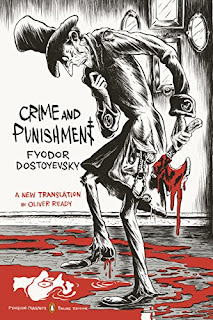
Lurid cartoons on every panel! Crime and Punishment, by Fyodor Dostoyevsky, trans. by Oliver Ready My chunkster Spin title was Crime and Punishment, and despite the completely un-cozy nature of the novel, I really was pretty excited to read this new translation by Oliver Ready.  I read Crime and Punishment once before, years ago (maybe 15?  after I moved to this house but before I started the blog), and I don't know what translation that was, other than an older one -- given that I was reading a very elderly pocket paperback, it was probably Constance Gannett.  I remember almost nothing, but I did find it something of a slog.  Well, this translation is not a slog! The story is well known: Raskolnikov, a student in St. Petersburg, has no money and no energy either.  Everything makes him angry, and he lies in his filthy little room and feverishly stews over his terrible, tempting plan -- there's this awful pawnbroker woman, and if he killed her, he could...

2017 Challenge Wrapup

Image
Time to start wrapping things up, though I still have one or two things to check off the list: Reading All Around the World: Good progress with 27 countries. My very own project!  It's officially not a challenge, and it's certainly not just for 2017, so if you'd like to join me, please do.  This is a long-term deal.  I read books from 27 countries (two of which are freshly read and will be posted in a day or two).  That's about 15% of the total, so not bad!  Mount TBR 2017: Completed with 29/24.   I aimed for 24 and wound up with 29 titles read, and of course more books on the TBR shelf than were there when I began...though that's largely because I went through my bookshelves and moved a bunch! European Reading Challenge 2017: 12 unique countries.   I read a lot of things set in Europe -- I have 17 on the list but there were plenty more -- but only managed to hit 12 countries.  I was hoping for more.  Maybe in 2018! ...