Posts

Showing posts with the label language

Summerbook #9: The Deorhord

Image
The Deorhord: An Old English Bestiary, by Hana Videen This followup to The Wordhord was a lovely read.  Videen uses her wordhord format to write a bestiary, explaining how medieval people loved to used animals as examples of Christian ideas.   Plus I always enjoy learning about Old English words, because they are often cognate with both modern English and with Danish.  Deor (animal), which in English evolved into deer , is also related to Danish dyr  (animal). Videen has sections of everyday animals, 'wonder' animals (such as elephants), creatures that especially symbolized good and evil, and just plain mysteries.  The good animals are the lion, deer, phoenix, and panther, and the evil ones are the whale, snake, dragon, and wolf.  The mysteries are usually taken from Alexander the Great's writings about his conquest of India; one sounds kind of like a crocodile, except that it has a head like the moon and also crocodiles were well-known.  Another...

Babel

Image
Babel: Around the World in Twenty Languages, by Gaston Dorren Back in 2016 I enjoyed Dorren's Lingo a lot, so when I saw he'd written another book about the intricacies and quirks of world languages, I jumped on it. If you take the 20 most-spoken languages in the world (by mother tongue), you cover just about half of the world's population.  If you learned all of them, you could communicate with most of the world, since lots of these are spoken as second/third/etc. languages.  So why not take a look at the top 20 and see which ones are what ones and what ones are who? As in Lingo , each chapter covers one language -- he gives some basic statistics at the start, and then dives into whatever aspect of each language tickles his fancy.   He starts with #20, the smallest of the top, and the chapters are therefore numbered 20 - 1 instead of 1 - 20.  #20 is Vietnamese, which is a fiendishly difficult language if you are not Vietnamese, and Dorren knows this f...

That's Not English

Image
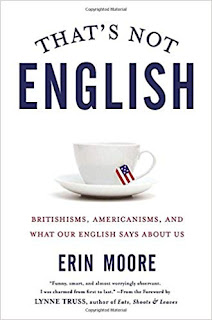
That's Not English: Britishism, Americanisms, and What Our English Says About Us, by Erin Moore This was a fun, fast read that I enjoyed a lot because I will never not want to read books comparing the British to Americans and vice versa.  I cannot get enough of those. Erin Moore is American-born, moved to England, married into a trans-Atlantic family, and is now raising a little Briton of her own, so she's had plenty of opportunity to experience culture shock (both ways) and delve into the mysteries of our respective characters.  Each chapter is dedicated to a word or expression that either means different things to each side ( quite, sorry, cheers, ginger ) or is practically unknown to one side ( knackered, bespoke, dude ).  So, some random observations from me: Indeed, I use quite as an intensifier that means just plain really .  Apparently Britons aren't quite that enthused when they say it. Moore says that English parents say to their children "You get w...

The Story of English in 100 Words

Image
The Story of English in 100 Words, by David Crystal I've been listening to an excellent podcast, the History of English , which I highly recommend to language nerds.  It starts with a whole series on Indo-European roots and language.  I'm only in the early 20s of the episodes (so far about 100), and we haven't gotten to Old English yet.  It's a lot of fun. So I thought it would be a good time to take this book off my TBR shelf and indulge in a little fun etymology.  And indeed it was fun!  Crystal goes chronologically, which is nice, starting about 1500 years ago with a runic inscription.  His words are chosen not just for their individual interest, but also for what they illustrate about the English language, so "street" talks about Latin loan-words generally, and "gaggle" is about the fun of collective nouns.* The last ten or so words are from my lifetime and include app, LOL, and sudoku , so not quite as interesting to my mind.  But the ti...

Our Magnificent Bastard Tongue

Image
Our Magnificent Bastard Tongue: the Untold History of English , by John McWhorter Somebody, probably my mother, mentioned McWhorter's name while we were on our UK trip, and then when I got home and went to work weeding the library collection, I came upon this book, so I took it home. There are a zillion books out there that will tell you about the history of the English language, but McWhorter feels that they're inadequate and do not properly address the why of how the language evolved.  Why, for example, do we say "I'm driving to the park" instead of "I drive to the park" like every other Germanic speaker?  (I have often wondered this myself.)  Why do we say do all the time when it doesn't actually mean anything much? Well, McWhorter is here to tell you why.  He's got some very strong opinions, and in fact he's rather given to ranting--I think about half of this book is dedicated to rants about linguists who disagree with him and w...

Lingo

Image
UK subtitle?  I don't know Lingo: Around Europe in Sixty Languages , by Gaston Dorren Oooh, languages!  I love languages and their weird quirks.  As a teenager I wanted to learn a lot of them, and I did try--but it's not as easy as I wish it were! Dorren is Dutch, which gives him a little different perspective.  It's refreshing for me.  And this is a fun little book; it's not a big serious treatment of European languages, but a little dip into the qualities or oddities of each one.  Every language gets a short chapter, and he talks about whatever he feels like talking about.  That might be a historical anecdote, an unusual grammatical feature, or the subtleties of what makes a dialect.  I expected the Danish chapter to maybe talk about articles (which are stuck on to the end of a word, and he talks about that feature in...Hungarian maybe?), but instead it was about the history of how Danish hegemony shrank down to almost nothing. There a...