Posts

Showing posts with the label poetry

CC Spin #40: Lucretius' De Rerum Natura

Image
  De Rerum Natura (The Way Things Are, or On the Nature of Things), by Titus Lucretius Carus, trans. by Rolfe Humphries I didn't really know quite what I was getting into with this book, but it worked out great.  Thanks to Tom the Amateur Reader, I got an excellent translation that I enjoyed a lot.  I won't claim to have understood it particularly well -- for that I'd need a whole deep dive and probably a class -- but for a basic first read, I'm calling it a success. So here we go... We don't know all that much about Lucretius, except that he was a Roman poet and philosopher, upper-class, and this is the only surviving of his works.  He was born around 99 BCE and died, at 44, in 55 BCE.  St. Jerome said he went mad from a love potion and killed himself, which seems to be inaccurate, but the slander stuck around for centuries, right up to the modern era.  Our poem was very nearly lost, but a single surviving copy was found in a German monastery in the early ...

The Blythes are Quoted

Image
 The Blythes are Quoted, by L. M. Montgomery The day before her (sadly, almost certainly self-inflicted) death in 1942, L. M. Montgomery turned in one final manuscript.  The editors don't seem to have known quite what to do with it, and while versions were published a couple of times, the whole thing was never published in the form LMM wanted it until 2009. It's a bit of a strange book, because even though Anne, Gilbert, and the Blythe children are the organizing principle of the text, they feel mostly absent.  It's divided into two halves of stories and poems set before, and then after, WWI.  One story goes all the way up to 1939 and the start of WWII.  The idea is that we move between stories, which are about other people in the area, with references to the Blythes here and there, and occasional Blythe family evenings with Anne reading out her own, or later on Walter's, poetry.  After a poem or two there will be a short family dialogue. The stories are m...

Song of Names

Image
 Song of Names: A Mormon Mosaic, by James Goldberg and Ardis E. Parshall Here are another two LDS writers I've followed for a while, and they have produced an amazing, lyrical work.  Ardis Parshall is a historian and runs a fascinating blog of historical bits, Keepapitchinin .  James Goldberg is a writer and poet, and also has a blog, Mormon Midrashim, which he hardly ever posts to but it's worth it when he does.  James writes: A few years ago, Ardis and I started writing a book together. An ambitious book, that would combine history and poetry to give people a viewed of Mormon history through individual lives as varied as stained glass. We wanted to take the extra research steps and writing steps to get at pieces of the past left out past the edges of our collective memory.   We did our best to find and sing forgotten names. So this is a book of poems about the lives of real people.  Each one starts with a page of context -- a short description of th...

A Celtic Miscellany

Image
My copy is ancient; but it's still in print! A Celtic Miscellany, ed. Kenneth Hurlstone Jackson This is one of those TBR books I've had around forever and ever.  I can tell, from the price written on the inside front page, that I got it at our local used bookstore, but it must have been a long time ago! Miscellany is an appropriate description; here we have samples of literature from six Celtic languages, primarily Irish and Welsh, but also Cornish, Scottish-Irish, Breton, and Manx.  The translator, Jackson, wanted to produce a representative collection that wouldn't just include all the things everybody is already familiar with -- but some of the favorites had to go in, or else it wouldn't be representative.     The selections are in themed sections, starting with adventure stories (Cu Chulainn, Fionn, and others), and going on to such topics as love, nature, epigram, satire, elegy, and so on.  They also go somewhat chronologically, with the earliest mater...

Summerbook #4: Edward Lear

Image
Edward Lear: The Life of a Wanderer, by Vivien Noakes This one got on my list because of the Slightly Foxed podcast, which luckily is only monthly, because it usually adds at least one book to my wishlist.  When I looked this one up, I was pleasantly surprised to discover it in our library collection at work.  So I took it right home. I only know Edward Lear as a writer of nonsense verse, but that isn't what he did for a living.  And he was just a lovely man, but he had a really difficult life.  So here we go... Edward was the 20th child of his very tired mother (she had 22!!! and a lot of them died), and after he was about 4, she left him to his older sister.  The sister was kind and loving, but the poor little guy was devastated, and his parents had an awful marriage.  That and a couple other things he never talked about just blighted his life; he was terribly lonely, yet couldn't really contemplate living with anyone. He also had epilepsy, which at the t...

Robin Hood

Image
Robin Hood: Green Lord of the Wildwood, by John Matthews A little while ago, I had to buy a 'history of Robin Hood' book for the college library to replace the one that had been lost.  It's a little tricky to purchase something like that, because you know the majority of what's out there is going to be...kind of woo-ey.  This looked like the best of the bunch.  And then one day I was in the mood to read about Robin Hood, so I brought it home for the quarantine and gave it a try.  I do think it's a little bit woo-ey, but mostly not -- and although he walks right on the border, usually when he crosses over and quotes something really out there, he points out that it's wild speculation and seems unlikely.  I'm not entirely sure how seriously to take it, but it was pretty interesting. I was expecting more of a literary /dramatic history of Robin Hood, and what I actually got bore a startling resemblance to The Golden Bough .  Matthews figures Robin Hood is kind...

Four British Fantastists, Boneland, and Sir Gawain and the Green Knight: Some Chaotic Thoughts

Image
Four British Fantasists: Place and Culture in the Children's Fantasies of Penelope Lively, Alan Garner, Diana Wynne Jones, and Susan Cooper, by Charles Butler Boneland, by Alan Garner  Sir Gawain and the Green Knight, trans. by Simon Armitage I've been having one of those times when books criss-cross each other, and most of it was while I was taking a break.  But I really want to talk about them, so call it a themed riffle of reviews... I loved Four British Fantasists so much!  Obviously it's right up my alley, seeing that DWJ and Cooper are two of my favorites.  I've never read Penelope Lively, but this book convinced me to.  If, like me, you are really into at least two of these four writers, you'll enjoy this analysis.  There were lots of wonderful insights, but the part I'll talk about here concerns Alan Garner, who does get a large share of the book because he concerns himself so much with place -- to the point of obsession. The four aut...

Othello

Image
Othello, by William Shakespeare Erica at The Broken Spine has been hosting the tragedy part of the Year of Shakespeare, and so I thought I'd sign up for a couple titles.  I decided to read Othello , and hope to read Antony and Cleopatra too, before the end of the year. (The trouble I always have with writing blog posts about famous classics is...what do I say?   It's not like I'm going to tell you something you don't know.) Othello is a newish and excellent general in Venice, and he's a Moor.  He's been winning battles and impressing everybody, and he's just secretly married the lovely Desdemona, daughter of one of Venice's senators.  His ensign, Iago, hates Othello because the general promoted a younger man, Cassio, above him, and vows to have his revenge upon all of them with the help of the dissolute Roderigo, who wanted to marry Desdemona. Iago plays upon Othello's jealousy, implying that he knows that Desdemona is having an affair wi...

Book of Ballads and Sagas

Image
Book of Ballads and Sagas, by Charles Vess (and Co.) Back in the 1990s, Charles Vess did a series of comics/graphic novels in which he collaborated with various writers to produce versions of old ballads (plus one Norse myth story, thus the 'sagas').   Featured authors included Charles de Lint, Jane Yolen, and Neil Gaiman -- your standard 90s list of up-and-coming fantasy writers, in fact!   Now, those comics have been collected and reissued in a nice hardback edition, and if you were bookish in the 90s, this is guaranteed to give you some flashbacks. So here we have (quick count) 13 ballads, surely a lucky number.  Most of them are reasonably well-known to anybody with a passing knowledge of ballads; there is Thomas the Rhymer, Barbara Allen, The Demon Lover, The Twa Corbies, and Tam Lin.  They're frequently given extra detail -- I was rather tickled to see that in "The Demon Lover," the girl runs off with James Harris -- or considerably more backstory...

Summerbook #9: The Wanderer

Image
The Wanderer: Elegies, Epics, Riddles, by unknown Anglo-Saxons I sure wish I could read Anglo-Saxon.  Alas, I cannot, and if I ever get enough time to study it I'll probably be too old to learn it very easily.  (I probably already am; it was easy to learn the Russian alphabet at 19, but I cannot seem to learn the Greek alphabet now.  Maybe I just need to try harder.)  Anyway, we don't have a lot of Anglo-Saxon literature; you can fit it all into one good-sized book.  This is a collection of pieces, some from the Exeter Book, some from other sources, that I suppose is meant to serve as an introduction to Anglo-Saxon literature that isn't too difficult to enjoy. Some of the pieces should be familiar to anyone who has taken a little bit of English literature: Caedmon's Hymn , the Dream of the Rood , a few short selections from Beowulf (why?) .   But this collection is interesting because it features a lot of material that isn't as familiar.  I was h...

Summerbook #5: Four Birds of Noah's Ark

Image
Four Birds of Noah's Ark: A Prayer Book From the Time of Shakespeare, by Thomas Dekker I've never been a big Thomas Dekker fan, because the first thing I read by Dekker was his version of Patient Griselda , which is about as calculated to offend modern sensibilities as it could possibly be, and while I am pretty easygoing about historical perspectives, I would have been just as happy if the Patient Griselda story had never been invented.  Apparently I should really read some of his other, less horrifying plays. By all accounts, Dekker was not a particularly religious man, but he did live and breathe in an atmosphere more saturated with religion than we can easily imagine, and he spoke the language of devotion fluently.  And in 1608, when plague was ravaging London, he wrote a book of prayer-poems for the people of England.  There is something for everyone here. The book is divided into four parts, named after four birds.  First, the Dove presents poems for ord...

Spin title: Henry IV, Part 1

Image
Henry IV, Part 1 , by William Shakespeare My Spin title!  It wasn't exactly a 'scary' one, but I wasn't too excited either; I'm more looking forward to Part 2.  But here we go...this play is second in a line of four, after Richard II and before Part 2 and Henry V. Henry IV is king of England, but the story is really more about his son, Prince Hal -- the future Henry V.  It's set in 1402-03, and we have a couple of major plot lines that converge.  The king won't do as the powerful Percys wish, and he threatens young Hotspur (Henry Percy, and about the 4th Henry in the play), who decides to foment a rebellion.  Meanwhile, Prince Hal is spending all his time hanging around inns, drinking with commoners, and generally causing consternation at court.  He's always with Sir John Falstaff, a corrupt old knight who prefers carousing to all else, and everybody is wondering if the Prince is going to be able to do his job.  The Prince's plan is to quit this...

Boris Godounov

Image
Boris Godounov , by Alexander Pushkin A year or so ago, I was browsing in the used bookstore and found this great edition of Boris Godounov by Pushkin, illustrated by Zvorykin.  But it was kind of on the pricey side, so I thought I might get it later...and then of course it wasn't there any more, and I regretted everything.  But!  Then I started this volunteer job sorting used books for the library, and the very first thing that happened was that the same book came across the table!  So I finally got to read it, and for free too.  It turns out to have a companion volume of fairy tales, so I'd like to get that as well. Boris Godounov is a play written in blank verse, but I think more people are familiar with it in the Mussorgsky opera based upon the play.  (Comment and tell me!)  It's a historical play, and I had to learn some Russian history before I could make head or tail of the story.  The quick version: Ivan IV (the Terrible) murdered...

Faerie Queene Book VI, Part II

Image
It only took me over a year, but I have done it!  I finished the Faerie Queene !  Woohoo!  I do wish Spenser had been able to finish his great work, but I don't know if I could have read all of it. When we stopped last time, it was right after a fight in a castle between Arthur and Turpine (the bad guy).  Turpine now wants revenge, and he meets two knights, who he talks into pursuing Arthur.  They attack, and Arthur kills one before the other cries mercy and informs on Turpine.  Arthur kills Turpine and hangs him from a tree.  Arthur is really getting pretty violent!  Meanwhile, Serena and Timias (remember them?) meet Mirabella, who is the messy maiden from a couple of cantos back.  She is beautiful, but of low birth.  Her pride has led her to be cruel to many men, so Cupid has decided to seize control and teach her a lesson (normally, remember, Cupid shoots his arrows at random, so the natural order is being overturned here). ...

Faerie Queene, Book VI, Part I

Image
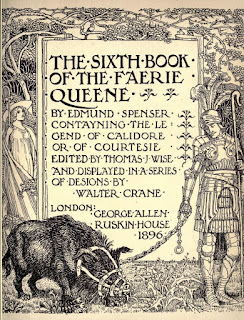
I'm almost there!  Almost finished!  I'd get finished a lot quicker if I was more on the spot with these posts.  They're so long I tend to put them off. But now we're on Book VI, which is really pretty strange.  Book V consisted mostly of allegorical versions of recent events in Elizabeth's time, and Book VI kind of goes off the rails.  This is the Book of Courtesye, which Spenser partly defines as the art of appropriate speech (or, you might even say, rhetoric?).  The Knight of Courtesye is Sir Calidore, known by all the court as a naturally gentle knight, mild, gracious, comely, and muscular.  He always knows what to say and loves truth and honesty.  But he is sent off upon his quest without a clue of how to accomplish it.  He wanders aimlessly, confused and overwhelmed by his task...and in the end, his quest is actually undone.  All of the Faerie Queene project seems to unravel under Spenser's embittered pen. Yeah, OK, it's...

The Faerie Queene: Book V, Part II

Image
Still trucking along in the Faerie Queene....when last we left our hero Artegall, he was a captive of the Amazon Queen Radigund, who forced him to wear women's clothing and spin thread.  Britomart is on the way to save him! Ahahaha, will I finish in a year?  I'm betting not... Britomart arrives at the Temple of Isis (who is Equity); she enters, but Talus is not allowed in.  Isis wears silver and linen, and is shown standing over a crocodile.  Britomart prays to her, and sleeps in the temple.  She is protected and refreshed, but she also has a bizarre vision, in which she merges with Isis.  The crocodile threatens her, but must submit, and then he fathers a great lion upon her.  Waking, Britomart is very disturbed and asks the priest for an interpretation of this dream.  He tells her that Artegall is the crocodile, and also Osiris, and together they will produce the British kings.  Calmed, Britomart sets off for the Amazons' land, where...