Posts

Showing posts with the label Victorian

CC Spin #42: No Name

Image
 No Name, by Wilkie Collins  Wilkie Collins was incredibly prolific, but this is one of his 'great four' novels, along with The Woman in White, Armadale, and The Moonstone .  So now I just need to read Armadale and I'll have the set!  No Name is set in the late 1840s but was written in 1862 and serialized in All the Year Round .  It gets very exciting as it develops, and I enjoyed it a lot.  If you're interested in Victorian 'sensation' novels, this should be on your list. The Vanstones are a happy and fairly wealthy family.  Mr. Vanstone is the most amiable and generous of men; his wife, a loving and gentle woman, but weighed down with a  dangerous late pregnancy.  Their two daughters are very different: Norah, in her mid-20s, a responsible and gentle brunette, and Magdalen, an energetic and mercurial 19 with unusual light grey eyes. Ruin strikes when Mr. Vanstone is killed in a railway accident and the shock brings on labor and death to ...

Wyllard's Weird

Image
  Wyllard's Weird , by Mary Elizabeth Braddon Mary Elizabeth Braddon was the Victorian sensationalist author of Lady Audley's Secret .  She was hugely prolific, and lived a rather sensational life herself -- she lived with the publisher John Maxwell as his wife and had six children with him, but Maxwell was already married and had five children with his actual wife, who was still alive.  No wonder her most famous novels were about bigamy!  I've always wanted to read Wyllard's Weird for no other reason than its title, and it became my book to read on my phone for a couple of weeks. We start in a train going to Cornwall -- as the train is on a bridge over a deep gully, a young woman falls to her death.  Mr. Wyllard, a wealthy man, is the first to reach her, but she is dead, and there is no identification at all.  She has no luggage, nothing but a basket containing a little food for the journey.  She seems French in her dress, but that's the only clue....

In May I truly think it best...

Image
 ...to read lots of books?  That doesn't rhyme.  I have to do it right. ...to be a robin lightly dressed, concocting soup inside my nest! Mix it once, mix it twice, mix that chicken soup with rice! No, actually, I'm not making soup, I'm reading books.  Quite a few books, so here at the halfway point I'm doing a post.  The Marquis' Secret, by George MacDonald:   I'm a bit of a sucker for these sort-of translated 1980s Bethany House versions of George MacDonald's very Victorian Scottish romances.  This one was originally The Marquis of Lossie , a sequel to Malcolm.  Malcolm, a poor fisher-boy, is the true heir to the estate of Lossie, but his half-sister Florimel (a definite Faerie Queene reference!) thinks she is, and so he becomes her groom in hopes of finding a way to break the news to her without ruining her life.  Confusion and hijinks ensue; Malcolm despairs of influencing his sister for good; and also he falls in love.  Can this ...

A Winter Riffle of Reviews

Image
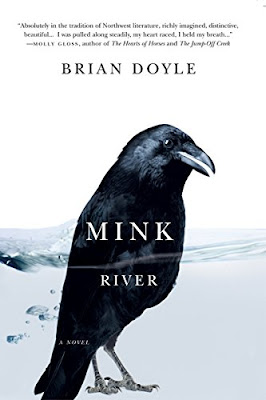
I'm hoping to get this year wrapped up in this final week.  Which is kind of a lot to leave undone until December 26, so wish me luck! I've read some neat books and a good bit of fluff in the last couple of months, and I'm just going to run through some of the ones I want to count for challenges...    Mink River, by Brian Doyle Doyle writes the story of a town: Neawanaka , a tiny place on the Oregon coast where a river meets the sea.  It's beautifully written, and I highly recommend it. Read Dangerously, by Azar Nafisi Written as letters to her (deceased) father, Nafisi discusses the importance of reading literature, especially in troubled times.  I wanted to save a couple of quotations: It is when you cast off the mantle of victimhood that you become a menace, a danger to your oppressor.  It it intriguing that in order to cease being a victim, you must accept responsibility for who you are and who you might become -- thus, ironically, acknowledging ...

CC Spin #25: Lorna Doone

Image
 Lorna Doone , by R. D. Blackmore I am happy to report that I enjoyed Lorna Doone quite a bit!  It's an exciting historical romance of a story, very much like something by Sir Walter Scott.  And it is not set in Scotland at all; I was completely wrong about that.  It is set in Exmoor, which I had to look up on a map -- I have helpfully included one near the bottom of this post, so you can see where Exmoor is too.  Much of it is now a national park.  Also, Porlock is one of the larger towns in the area, so I kept thinking of Coleridge, who is not in this story. R. D. Blackmore had a long writing career (which was a side gig to his main interests of classicism and fruit farming!), and he wrote a lot of varied stuff.  I'm going to have to get Erema , which is set in California!  Lorna Doone was his big smash hit of a novel, published as a triple-decker -- not in a serial format.  It was hugely popular, everybody read it, and the foreword says ...

The Tower of London

Image
 The Tower of Lo ndon: A Historical Romance, by William Harrison Ainsworth, illustrated by George Cruikshank  This was a fun read -- I got it from Gutenberg.  It's an early Victorian historical novel, published serially in 1840, and it's all about Lady Jane Grey, the Nine Days' Queen.  The story starts with her entering the Tower as Queen (July 1553), and ends with her execution (February 1554).  But really, the main character of this story is the Tower itself; Ainsworth wrote his story so that he could talk about the Tower of London, and at least half of the illustrations are of specific rooms in certain towers.  Only the other half show the action of the story, all of which takes place in the Tower.   Jane's reign and imprisonment are the setting of the story, but much of it involves intrigue behind the scene, both "upstairs and downstairs," as you might say.  The Spanish and French ambassadors plot against Jane and each other, along with a...

After London

Image
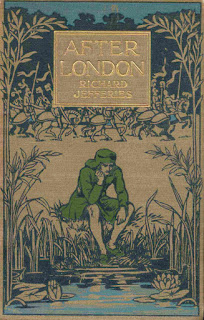
 After London, or, Wild England, by Richard Jefferies I've been reading this forever on my phone.  (Since I hardly ever read on my phone, it took a long time!  But it was nice to have a 'phone book.')  My brother recommended it to me and he was right; it was a very interesting thing to read. Jefferies published his story in 1885.  People would have thought of it as romance at the time, as in an improbable adventure.  We'd call it something like post-eco-apocalypse; the story is set hundreds of years in the future, long after some mysterious disaster has killed most of the population of England and presumably the rest of the world.  Water levels have risen, and the formerly great cities are submerged, exuding unknown poisons into the water.  The Thames Valley is now a gigantic lake, and petty kings exert power over small, feudal populations (the story is pretty much confined to the Thames Valley and maybe a bit north). The first part of the novel ...

Summerbook #9: The Uncommercial Traveller

Image
The Uncommercial Traveller, by Charles Dickens This is one of my oldest TBRs!  It's been sitting around forever.  These are essays published over years in Dickens' magazine, All the Year Round .  His conceit is that instead of being a commercial traveller (a traveling salesman), he's an UNcommercial traveller, always wandering around looking for a story.  So these are portraits of situations or places, mostly in London but sometimes elsewhere. Dickens starts off with a bang, being present at the aftermath of a tragic shipwreck off the coast of Wales, and chronicling the tremendous care and work the locals give to the situation.  Then it's off to an assortment of places -- a tour of the Wapping workhouse, the lead-mills, or the gigantic dockyards, interviews with mistreated English soldiers or destitute families looking for work.  He explores a Stepney school for pauper children, of which he highly approves because they're so well cared-for.  He rants ...

Coronation Summer

Image
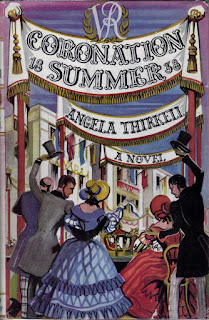
What a fun cover!  Mine isn't. Coronation Summer, by Angela Thirkell A couple of people around the bloggy world have been reading Angela Thirkell, which strikes me as a perfect author for reading while hiding out from a global pandemic.  I had this one on my TBR shelf, and indeed it was an ideal read for right now.  I'm going to pass it on to my mom and then to a friend; it was so refreshingly funny! Fanny Harcourt is 17 in the summer of 1838, when the young Victoria is going to be crowned.  She and her best friend Emily Dacre manage to talk Fanny's father into spending the summer in London so they can see all the sights and experience the excitement.  The girls also spend quite a bit of time thinking about the young men they meet; Emily has a crush on Fanny's older brother Ned, and Fanny is much struck by the romantic-looking dandy, Mr. DeLacy Vavasour, who has published several sensational novels.*  Mr. Darnley, on the other hand, is also charming...

Summerbook #12: The Claverings

Image
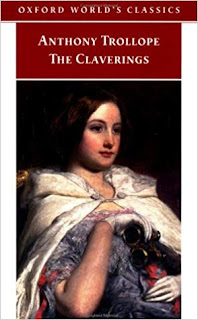
The Claverings, by Anthony Trollope Now that my big paper is pretty much done, I can write proper blog posts again!  I read The Claverings on the bus between Chicago and Champaign, and then on the way back again.  I finished it in O'Hare airport, waiting for my flight.  And what a lovely read it was -- so absorbing that I didn't want to put it down! This is one of Trollope's individual novels; not part of a series.  It was written in 1864, and did not appear until 1866-67, serialized in the Cornhill Magazine . (Imagine, a novel all finished and not being written even as it was being published!) Harry Clavering is the son of a clergyman who is cousin to a baronet -- on the edges of, but not part of, the nobility.  Harry has been brought up to be a rich, idle clergyman too, but he decides to buck authority and become an engineer, building bridges and railroads.  He also wants to marry the lovely Julia Brabazon, sister to the baronet's wife; but Julia, ...

The Shepherd's Castle

Image
The Shepherd's Castle , by George MacDonald You may well know of George MacDonald, a Scottish minister who wrote a lot of books and was a great inspiration to C. S. Lewis.  He wrote some children's fairy tales that are real classics, such as At the Back of the North Wind and The Princess and Curdie , and he wrote a couple of fantasy novels, Lilith and Phantastes , that are very strange indeed and must-reads for those interested in pre-Tolkien fantasy literature.  MacDonald also wrote a stack of realistic, romantic novels that have practically disappeared, except for the most well-known, Sir Gibbie .  (I have an old copy that had disappeared, but I just found it again!)  Well, interesting things come across the donation table, and one was a copy of one of these romantic novels, The Shepherd's Castle , in a 1983 reprint from Bethany House; they published four of these stories.  This one is a companion to Sir Gibbie .  Now that we have all that background...

Miss MacKenzie -- Summer Book 6

Image
There are no good covers of this book. Miss Mackenzie, by Anthony Trollope It's been quite a while since I made time for a Trollope novel, and I've missed them!  I love Trollope's writing.  Miss Mackenzie has been sitting on my TBR shelf for a little while now; I found this nice old Oxford Classics edition from the 1920s that's in really good shape still, and a pretty olive green with art deco gold designs on the spine.  On the back flyleaf, somebody parked a needle many years ago, and now it's rusty. Miss Mackenzie is not your average novelistic heroine.  She is thirty-five, not particularly beautiful or educated, and she's spent nearly the last 20 years nursing her father and then her brother.  Now she has a small fortune to live on, and no knowledge whatsoever of the world she so desperately wants to see more of.  So she moves to "Littlebath," a small city, and hopes to find congenial society. What she mostly finds is that Littlebath is ...

The Brothers Karamazov

Image
The Brothers Karamazov , by Fyodor Dostoevsky I've been working on this novel for a couple of months.  Now I'm not sure what to say about it.  What is there for me to say about one of the great masterworks of the 19th century and of Russian literature?  It is beautiful, and I loved most of it.  I wasn't too hot on the trial and the long lawyers' speeches.  I thought the translation was pretty great.  Not that I know a lot about translating Russian literature, but I liked the feel and I could tell it was Dostoevsky and not Gogol or Tolstoy.  I read the Pevear/Volokhonsky translation, and it came with a good tip: Karamazov is pronounced with a regular old Z, not a ZT sort of sound like Mozart.  Who knew? This is a pretty hopeless post really but hey everybody, read The Brothers Karamazov if you can!  It's a great work of literature and a great experience too.

Wives and Daughters

Image
Wives and Daughters , by Elizabeth Gaskell This novel has been on my pile all year. I wanted to read it for the Back to the Classics Challenge.       A couple of weeks ago, I was going to spend several hours on a bus, and I needed some nice wholesome reading to pass the time. Wives and Daughters seemed the perfect choice, and it turned out lovely. Molly Gibson is the village doctor's daughter, and she's been raised very simply (this is in the 1830s).  When she is seventeen, her father starts worrying that he can't chaperone or guide her properly, and so he marries a pretty, insinuating widow who is in fact shallow, manipulative, and selfish.  Molly does her best to get along with her new stepmother, but it's a continual struggle. Her comfort is her new stepsister, Cynthia, who is charming and sophisticated, having grown up largely in French boarding schools.  The two become very close, but Molly does not always understand what Cynthi...

The Thrilling Adventures of Lovelace and Babbage

Image
The Thrilling Adventures of  Lovelace and Babbage: the (Mostly) True Story of the First Computer , by Sydney Padua I should have written this post for Ada Lovelace Day last week, but I've been having some trouble with my arms and repetitive stress. So I've been putting off writing any posts. I'm now experimenting with voice recognition on my tablet, and I'm pretty impressed by how well it works. I could type these posts - I'm not that badly off - but I need to save my typing for work. Of course, the voice recognition doesn't work anywhere near perfectly, but I can get a good amount of material down and then go back and edit it by hand. The author of this graphic novel says that she wrote one comic for fun and then responded to popular demand by producing the entire work. It is a whole lot of fun to read. Padua posits that Ada Lovelace did not die at a young age, but survived, built the Difference Engine with Babbage, and then had some wild adventures with...

The Jungle Book

Image
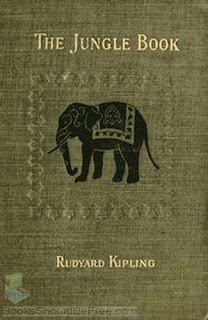
The Jungle Book , by Rudyard Kipling For this month's literary movement challenge, I was pretty stumped.  It's Victorian month, and I've already read one Dickens and two Trollopes this year, so I was inclined to cry uncle.  My daughter suggested a children's story, which was a good idea...and then the light dawned.  Kipling!  I have read almost no Kipling!  It's doesn't get any more Victorian than that.  Said daughter was appalled to learn that I had never read The Jungle Book ( "What??  I've read it three times!" ), and so my choice was made.  (Don't tell, but I have also never read Just So Stories all the way through.) The first half of the book is stories about Mowgli and will be sort of familiar to people who have seen the Disney movie, though these are a lot more serious.  Jungle inhabitants have strict laws and standards.  And this is not a novel; it's two or three short stories that do not happen in chronological order. Af...

Work

Image
Work: a Story of Experience , by Louisa May Alcott I was kind of lost for a Transcendentalist pick for the literary movement challenge.  I've read the most famous works and I'm not that big a fan.  (While I'm all for simplicity and self-reliance and all, I just don't like the song and dance they make about it.)  So I was looking at my bookshelf, rather hopelessly, when I noticed Louisa May Alcott's Work , a novel I never got around to reading.  It turned out to be a perfect choice, which is not to say that I enjoyed it much as a novel, but it's a perfect specimen of Transcendentalist feminism, a meditation on the very Victorian question "what can a woman do? " (I actually own a book titled What Can a Woman Do? or, Her Position in the Business and Literary World, by one Mrs. M. L. Rayne, from 1893.  Mrs. Rayne writes about professional women in every branch of business, including law, and also gives a selection of morally uplifting poetry and prose...