Posts

Showing posts with the label English literature

Galahad and the Grail

Image
 Galahad and the Grail, by Malcolm Guite A young coworker of mine follows this author and let me know about this project: a four-volume poetic retelling of the Arthurian story.  It's titled "Merlin's Isle."  This is the first volume, and The Coming of Arthur will be the second in November. Malcolm Guite is an Anglican pastor and has spent much of his life studying the stories.  I'm pretty picky about my modern retellings, but the beautiful cover attracted me, and I was very curious. First, the part where the story is entirely in poetry.  Guite keeps it simple, in balladic lines that are easy to read and would be pleasant to read aloud.  He sometimes uses common phrasing from ballads, which is nice.  Otherwise, it's arranged in three books of several staves (chapters) each. And Guite certainly knows his stuff!  An appendix explains his sources, here mostly Malory and the Quest for the Holy Grail  (this gave me an opportunity to feel extremely...

Summerbook #19: War In Heaven

Image
 War in Heaven, by Charles Williams  I sort of started this accidentally; I wasn't sure if I'd read it before, and next thing I knew, I was away.  Charles Williams, quite a strange man, wrote novels which were also quite strange.  He worked at Oxford University Press, but in London, was a connection of the Inklings, had a large theological and literary interest, and seems to have been highly charismatic.  He wrote six novels, all "supernatural thrillers," and this was the first, published in 1930.  Williams' ideas of what a supernatural thriller might be are not at all what anybody else would think of. We start at a publishing house in London, where Mr. Rackstraw comes back from lunch and discovers a dead body in his office.  So there's a mystery there.  Also, one of his authors has just turned in a manuscript tracing the history of the Holy Grail (Graal), and concluding that it currently rests in a small country church in the village of Fardles....

Summerbook #12: Beau Geste

Image
 Beau Geste, by P. C. Wren Whoof, this was an exciting one!  If you're not familiar, as I was not, Beau Geste*  was a smash hit back in the 1920s, was promptly made into a big-budget film (and a lot of radio plays, more films, and a TV show), and is just the sort of book everybody read back in the day, like Ben-Hur  or Lorna Doone.  If you grew up (as I did) reading old Peanuts collections from the library, you'll remember Snoopy being a Legionnaire at Fort Zinderneuf.   Three brothers, orphans, grow up at Brandon Abbas under the care of their lovely aunt, Lady Brandon.  Michael, the oldest, is the leader and known as Beau.  His younger twin, Digby, follows, and John, the youngest, is the narrator.  Along with playmates and cousins, they love to look at Aunt Patricia's prize jewel, the huge sapphire known as the Blue Water; and one evening it's stolen.  No one could have done it but the seven people in the room, and Michael decide...

Summerbook #9: Early Riser

Image
 Early Riser , by Jasper Fforde Here's another donation table title that's been sitting around too long.  (I'm going to go put all of these in the local Little Free Library, since the booksale is on hiatus at the moment.)  I love Fforde's Thursday Next series -- did you see a new and final one is coming out? -- but I wasn't sure what to make of this one and had a vague feeling that it was one of the Nursery Crimes series, which it is not.  It's a stand-alone. On an alternate Earth where ice ages have never ended, humanity has evolved to deal with the bone-chilling winter months by hibernating.  Pretty much everyone bunks down in dormitoria of ancient design, watched over by the few willing (or necessitated) to stay awake through the dangerous winter.  These porters, consuls, and others are supposed to protect the sleepers from the cold, the Villains who wish to plunder, and the legendary (?) Wintervolk who may plan to suck the marrow from your bones.  ...

Summerbook #8: Castle Dor

Image
 Castle Dor , by Arthur Quiller-Couch and Daphne du Maurier Yep, this is my copy You've almost certainly heard of the novelist Daphne du Maurier, writer of Rebecca and many other tales, often set in Cornwall.  As a young woman, she became friendly with Sir Arthur Quiller-Couch, who lived in Cornwall when he wasn't being an eminent Cambridge professor of literature.  He was working on a novel, but had little time for writing, and then the war came, and he died in 1944.  The manuscript was unfinished and had no notes about where it was going to go, but in 1960, du Maurier completed the novel at the request of Q's daughter.  The result is Castle Dor , set in a factual Cornish landscape (you can look up most of these spots on the map, though Dor is Dore now), but playing with legend. In the early 1860s, a young and beautiful Mrs. Linnet Lewarne meets Amyot Trestane, a Breton sailor.  Somehow, their immediate attraction to each other sets in motion a long-past ...

Summerbook #1 and 2: A couple of children's books

Image
 Doing well so far!  I'm deep into a more serious book, but in the meantime I enjoyed TWO children's books from the UK that probably qualify as minor classics and which I quite enjoyed. Knock Three Times! by Marion St. John Webb: this 1917 fantasy tale reminded me of E. Nesbit in its Edwardian tone with humorous asides, but it was weirder.  Nine-year-old twins Molly and Jack receive birthday presents from an aunt, and while Jack gets the paint box he'd hoped for, Molly gets a very disappointing pincushion shaped like a grey pumpkin.  But!  That night, Molly sees the pumpkin grow and roll away out of the house.  She and Jack follow it through a tree portal into the Possible World -- a pleasantly bucolic and magical land, where the inhabitants are horrified to hear that the Grey Pumpkin is back.  That Pumpkin contains an evil wizard who once menaced the kingdom, and who was imprisoned in a regular pumpkin (it turned grey from his wicked soul) and dispos...

Circles of Stone

Image
 Circles of Stone: Weird Tales of Pagan Sites and Ancient Rites, ed. Katy Soar This is one of the British Library's titles in the "Tales of the Weird" series, in which they get researchers to read old serials and mine them for forgotten short stories.  I love this series and have a few of them; I'd happily get the whole giant collection.  And this one features spooky stories about my favorite thing: ancient stone monuments!  Yay! Some of these are famous names: E. F. Benson, Algernon Blackwood, Arthur Machen.  Others aren't familiar to me, and one or two are practically unknown, like Stuart Strauss, who published three stories in early Weird Tales issues and was never heard from again; presumably it was a pseudonym, but who Strauss really was is a mystery.   The stories also have a variety of themes, from villages untouched by the modern world to race cars, human imagination and stones that just eat people.  It's all very enjoyable, loved it, this...

Robin Redbreast

Image
  Robin Redbreast, by David Lack I read an old Slightly Foxed issue, which always adds to my TBR list, and this book sounded intriguing and fun.  It's a complete collection of folklore, literary references and poetry, and historical mentions of....robins!  Mostly just in the UK, where robins were popular and beloved -- while over on the continent, they were often hunted and eaten.  Now the European robin and the American robin are two totally different species, so if you're American, you have to think of a different bird. David Lack wrote an entire book observing the life of the wild robin, and this was by way of being a fun but scholarly collection of literary and cultural robins,   We start off with legends about robins, because there was a belief that robins would come and reverently cover the face of anyone they found dead in the forest -- especially if the person had been murdered.  And then, why are robins always boys, culturally married to wren...

CC Spin #42: No Name

Image
 No Name, by Wilkie Collins  Wilkie Collins was incredibly prolific, but this is one of his 'great four' novels, along with The Woman in White, Armadale, and The Moonstone .  So now I just need to read Armadale and I'll have the set!  No Name is set in the late 1840s but was written in 1862 and serialized in All the Year Round .  It gets very exciting as it develops, and I enjoyed it a lot.  If you're interested in Victorian 'sensation' novels, this should be on your list. The Vanstones are a happy and fairly wealthy family.  Mr. Vanstone is the most amiable and generous of men; his wife, a loving and gentle woman, but weighed down with a  dangerous late pregnancy.  Their two daughters are very different: Norah, in her mid-20s, a responsible and gentle brunette, and Magdalen, an energetic and mercurial 19 with unusual light grey eyes. Ruin strikes when Mr. Vanstone is killed in a railway accident and the shock brings on labor and death to ...

Summerbook #4: Nightingale Wood

Image
 Nightingale Wood, by Stella Gibbons Who among us does not love Cold Comfort Farm ?   If you don't, it's probably because you haven't read it.  This one is less well-known, but it's still a fun read, if not the perfect comedic gem that is CCF.  Nobody could pull that off twice, after all. The Withers are an upper-middle-class family near a village, and their life is completely stultifying.  The two adult daughters are repressed and not allowed to do anything much; all Madge wants is a dog to love, and Tina wants...well, a life.  Into the house comes Viola, the young widow of the oldest son.  She was, horrors, a shopgirl, and she hasn't really got anywhere to go.  Is she, too, going to see her youth wasted in the desiccated atmosphere of the Wither home? Through winding byways, walks through the wood, and heartbreak, each member of the family eventually comes to find their own version of happiness.    It's a nice read, a pleasant 193...

Wild

Image
 Wild: Tales From Early Medieval Britain, by Amy Jeffs    After I read Storyland , I wanted to read Wild ; I really wondered what kind of stories Jeffs would collect into this book.  This one is shorter, and also I think takes more liberties with the material, and the result is intriguing.   Jeffs takes some of the more obscure poems from things like the Book of Exeter, or panels of the Franks Casket, often melds a couple of them together, and turns them into short tales.  So we read of the Sorrow of Hos -- Hos is named in a real manuscript, and Jeffs gives her a story fitting the existing clues.  "The Wanderer" is adapted a bit and told from the perspective of Grendel. I enjoyed these short tales and the explanations Jeffs provided of how she came to write them.  The illustrations, again linocuts, and this time not so plentiful, were also very good.

The rest of the Wolves Chronicles

Image
 ...and wow, there are a lot of them!  Since Witch Week, I've been indulging in reading the entirety of the Wolves Chronicles, for a total of 12 (13?) titles (nine for this post).  I tried to read them pretty much chronologically, that is, in some sort of publishing order.  I didn't totally succeed and almost missed one (Midwinter Nightingale ) so that happened nearly at the end.  Aiken sometimes went back and slotted a story into a previous storyline, so for example, Dido eventually has two adventures on her way back from Nantucket to England, but those were written later. I've been highly entertained by how Aiken gets more and more fanciful the further she goes.  By the end, England is divided into several small countries(?), Jamie Three's father was named Angus the Silent, and genealogy goes absolutely wild, as does world geography.  I would love to see a map! The Stolen Lake :  Dido takes a detour to Hy Brasil, where Queen Guinevere has been w...

Witch Week and Joan Aiken!

Image
It's Witch Week!  And this year we are reading Joan Aiken, one of the true greats of 20th century children's literature (not to mention some very fun other things).  One of my favorite go-to presents for children is Aiken's Arabel and Mortimer books, which are so funny and worth reading many times over.   But for this Witch Week I decided to revisit the alternate-history world of the Wolves Chronicles, which are set at the beginning of the 1800s under the reign of James III (often called Jamie Three).  In this world, not only are wolves the scourge of England in winter, but the industrial revolution is well under way, and the Hanoverians are forever plotting to overthrow King James and set the German Bonnie Prince George upon the throne. Aiken builds an amazing, adventurous, eccentric, and very dangerous world for her characters. Aiken is incredibly imaginative and inventive, so you never know what will happen next, and the language is wonderful.  Dido is the...

Wyllard's Weird

Image
  Wyllard's Weird , by Mary Elizabeth Braddon Mary Elizabeth Braddon was the Victorian sensationalist author of Lady Audley's Secret .  She was hugely prolific, and lived a rather sensational life herself -- she lived with the publisher John Maxwell as his wife and had six children with him, but Maxwell was already married and had five children with his actual wife, who was still alive.  No wonder her most famous novels were about bigamy!  I've always wanted to read Wyllard's Weird for no other reason than its title, and it became my book to read on my phone for a couple of weeks. We start in a train going to Cornwall -- as the train is on a bridge over a deep gully, a young woman falls to her death.  Mr. Wyllard, a wealthy man, is the first to reach her, but she is dead, and there is no identification at all.  She has no luggage, nothing but a basket containing a little food for the journey.  She seems French in her dress, but that's the only clue....

CC Spin #38: The Black Arrow

Image
 The Black Arrow: A Tale of the Two Roses, by Robert Louis Stevenson  It's Spin Day!  Did you read your book? The Black Arrow was fun.  It's set -- as the subtitle says -- during the Wars of the Roses, a chaotic and confusing time when two branches of the English nobility fought over which would control the throne.  Everybody else fought on one side or the other, and quite a few switched sides on the regular, according to who looked like winning.  This lasted decades, in patches, and was essentially a series of civil wars that took up much of the 1400s.  It ended with the death of Richard III in 1485 and the accession of Henry Tudor, a Lancastrian who married Elizabeth of York to unite the two branches.  But in this story, Richard III is a young man.  Strictly speaking he isn't even the Duke of Gloucester yet, but RLS makes him duke a little prematurely to avoid confusion. Richard Shelton, called Dick, is a teenage orphan in the care of Sir...

A sudden pile of books

Image
 Hey everybody!  I disappeared for a while there, and I'm not quite sure what I am going to do, but I'll tell you about it.  My reading mojo disappeared; I mean, it took a long vacation and I wondered if it was coming back.  I think it had mostly to do with my husband's layoff back in January; worry took up most of my brainspace and there was not much left over.  I could read the fluffiest mysteries, and Diana Wynne Jones.  I read something like eight of Anne McCaffrey's Pern novels, would you believe -- I liked those when I was around 13.  But I couldn't seem to keep up with blogging, or anyone else's blogs, or read anything new or in the least challenging.  I saw the CC Spin and I just couldn't do it!  Instead I embroidered things and played too much on my phone. A couple of weeks ago, my husband got a nice contracting gig, and I instantly felt much better.  Pretty soon my reading came back, and with renewed energy -- I read two Shakes...

CC Spin #36: Rob Roy

Image
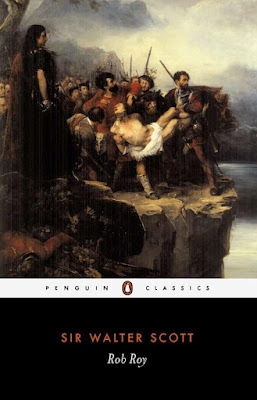
 Success!  I had a little trouble with this one, because I was trying to read it on my phone, and that was just not working very well.  I was less than halfway through and March was looming, but a nice Penguin copy came across the donation table and I took it home.  After that, it was easy to read 50 pages a day and zoom through... Rob Roy, by Sir Walter Scott When I read The Heart of Mid-Lothian , I was surprised that it wasn't about Jacobites adventuring all over the highlands, but that turns out to be Rob Roy.  Honestly I preferred Jeanie Deans, but this was quite fun.  I can see why stay-at-home English folks of the mid 1800s loved reading this! It's 1715, and our narrator is Frank Osbaldistone, whose father is a London businessman.  Young Frank prefers art and poetry to accounting (and doesn't quite see why he should work hard when his dad has plenty of money), and his exasperated dad sends him off to cousins in Northumberland, pointing out that h...

June reading, part II

Image
 Happy July!  I had an unexpectedly busy week so I'm a couple of days late but who cares.  One thing I did was spend an afternoon at the county board of supervisors' budget meeting, lobbying for them not to cut the library budget (which they already did last year).  It would have brought the largest branches in the system down to three days a week.  To our great surprise, it actually worked and the board decided not to enact the cuts -- but only for one year.   We also held an unexpected early birthday party, due to various factors such as the presence of the person involved and another friend being present from out of town.  So I spent a lot of time thinking about food -- a thing I don't do a lot any more now that I'm an empty nester.  And now, on to the books!  Actually, I have been too lazy.  There are too many books here for just one post.  I'm going to put my Books of Summer here, and do another post on the books I've read...

Spin #32 Title: The Female Quixote

Image
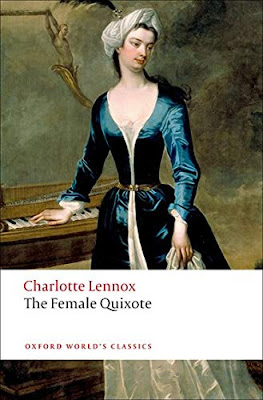
 The Female Quixote, by Charlotte Lennox What a fun read this was!  If you're looking for an 18th century novel that isn't too long or difficult, this is a good choice.  It's still long -- but nowhere near the size of Tom Jones, or Pamela, or Clarissa.  Published in 1750, it's just one of the many titles written by Charlotte Lennox, who was well-respected by the other major novelists of her day. This story is a satirical farce; like the original Quixote, Arabella has read too many romances and believes them to be history, with interesting results.  The books she has read would have been quite familiar to readers, and they aren't at all familiar to us, which puts us at a bit of a disadvantage.  I found the web project Arabella's Romances to be helpful in this regard. Arabella is a lovely and intelligent girl, but her father is a recluse and has brought her up on an isolated country estate, with no other relatives or friends to show her the world.  He ...

The Female Quixote

Image
 The Female Quixote, by Charlotte Lennox This is my Spin title, so I want to save the 'real' post for January 29th.  I'm posting now just to say that I have finished the novel, it was a lot of fun and not too difficult or crazy-making (despite the innumerable Capitals applied to Nouns), and indeed Arabella needs some help in understanding modern (to her) mores and letting go of ideas gleaned from bad translations of old French romances about ancient princesses.  What may be appropriate for a fictional Thracian princess is not necessarily correct for the maiden of 1750!