Posts

Showing posts with the label science

Summerbook #22: Sunken Lands

Image
Sunken Lands: A Journey Through Flooded Kingdoms and Lost Worlds, by Gareth Rees  I loved this book.  Rees has, since childhood, had a fascination with legends of sunken cities, and I get that!  What's more enticing?  So I've been excited to read this, and it was good stuff.  Rees is British, and the British Islands have lots of sunken lands around the edges.  Former ice ages bound lots of water up in glaciers, and when those ice ages ended, the seas rose and covered coastal regions.  He starts off with Doggerland, which was inundated tens of thousands of years ago, and works around through ancient forests to the Lowland Hundred, Lyonesse, and other lands that passed into legend.  Then he looks at manmade land sinks, like the eastern fenlands. The second half of the book ranges abroad, first through myth with a long section on the stories of Atlantis, and then to the ancient Roman resort town of Baiae (across the bay from Pompeii, it was not dest...

Summerbook #20: Walking the Bones of Britain

Image
Walking the Bones of Britain:  A 3,000 Million Year Geological Journey from the Outer Hebrides to the Thames Estuary, by Christopher Somerville I suppose it's a bit ironic that this was my first summer book, and it just took me the whole time to read it.  There's a lot of geology and it's not a terribly light read, so I took it slow and enjoyed the walk. Christopher Somerville is the walking correspondent for the Times, because of course the Times has a walking correspondent.   This is the UK, and walking is big.  He's written quite a few books, and this one I picked up two years ago in a little bookshop during our Ridgeway hike.  (I told the bookshop lady I liked books about walking, but not Robert Macfarlane, and she showed me this guy.  Yes!) The premise of this particular book is that if you look at a geological map of Great Britain, especially the simple and colorful kind of Somerville's old schoolbooks, you see that you can kind of start at t...

Summerbook #3: Braiding Sweetgrass

Image
  Braiding Sweetgrass: Indigenous Wisdom, Scientific Knowledge, and the Teachings of Plants, by Robin  Wall Kimmerer Yep, I'm ten years late to the party, but I got there!  This book made a huge splash some years ago, and rightfully so.  I'm going to hand it to my youngest, who will love it. Robin Wall Kimmerer is a botanist and a member of the Potawatomi Nation, and comes at the natural world with two perspectives that merge into one, and that were never really that different to begin with.  Her point, which she makes over and over with various stories and ecological histories from several places in the United States, is that the Indigenous peoples of North America had (and still have) massive scientific and ecological knowledge about their environments, gained through centuries/millennia of practical experience in cultivating abundance and working with local resources.  When colonizers arrived, they simply assumed that the Native peoples were ignorant, an...

The Observant Walker

Image
 The Observant Walker: Wild Food, Nature and Hidden Treasures on the Pathways of Britain, by John Wright Oh, this book was a delight.  As we know, I'm now a devotee of the Ridgeway, and so I've been collecting books about walking in Britain (and other places) for a while.  There are a lot of them, so I'm not planning to be exhaustive!  I actually got this book on the Ridgeway hike, when we were staying in Wallingford.  There was a bookshop, and I asked what she would recommend if I liked books about walking in nature, but I don't like Robert MacFarlane . That stumped her a little bit but she recommended John Wright, and him I like! Wright is all about the plants.  He likes to walk around and drive everyone else crazy by spending all his time carefully studying the plants and fungi and lichens he sees.  (And if the lichen is in London, he'll lie in the gutter to get a good photo.)   He and Tolkien would have a grand time standing in one plac...

CC Spin #40: Lucretius' De Rerum Natura

Image
  De Rerum Natura (The Way Things Are, or On the Nature of Things), by Titus Lucretius Carus, trans. by Rolfe Humphries I didn't really know quite what I was getting into with this book, but it worked out great.  Thanks to Tom the Amateur Reader, I got an excellent translation that I enjoyed a lot.  I won't claim to have understood it particularly well -- for that I'd need a whole deep dive and probably a class -- but for a basic first read, I'm calling it a success. So here we go... We don't know all that much about Lucretius, except that he was a Roman poet and philosopher, upper-class, and this is the only surviving of his works.  He was born around 99 BCE and died, at 44, in 55 BCE.  St. Jerome said he went mad from a love potion and killed himself, which seems to be inaccurate, but the slander stuck around for centuries, right up to the modern era.  Our poem was very nearly lost, but a single surviving copy was found in a German monastery in the early ...

All in Her Head

Image
  All in Her Head: The Truth and Lies Early Medicine Taught Us About Women's Bodies and Why It Matters Today, by Elizabeth Comen Elizabeth Comen is an oncologist specializing in breast cancer, and as she worked with her patients, she came to realize just how badly our medical system is set up -- for everyone, but particularly for women.  Looking back into history, she collected evidence and traced stories illustrating how attitudes and beliefs have come down to us and are still hanging around. Dr. Comen works through chapters dedicated to systems of the human body, starting with skin, bones, and muscles, right through to nerves, hormones, and reproduction.    (While the entire book is enraging, this guarantees that the intensity will ramp up and the  most enraging material will probably be at the end.)  Readers will probably be familiar with quite a few of the stories already -- Ignaz Semmelweis' failed attempts to get doctors to wash their hands, the horri...

CC Spin #39: The Ring of Bright Water

Image
 The Ring of Bright Water, by Gavin Maxwell When I opened this book and started reading, I was a little taken aback when the introduction to the trilogy edition explained that all three books had been edited down in order to become the trilogy.  I didn't sign up for that!  I wanted the whole thing!  But then it turned out that complete editions of the first book are no longer easy to get; they've long been replaced by this shortened trilogy version.  And so, resigned, I decided to read the first part of the book and then see how it was going before committing to all three books.  And I did really enjoy Ring of Bright Water , but I don't think I'm going to continue. Read on to see why. Gavin Maxwell, wanderer and general nature guy, had tried running a shark-hunting business on the Scottish island of Soay.  He'd gone back and forth to the Middle East a few times, for what exactly he does not say, but writing seems to come into it, and probably also gen...

The Light Ages

Image
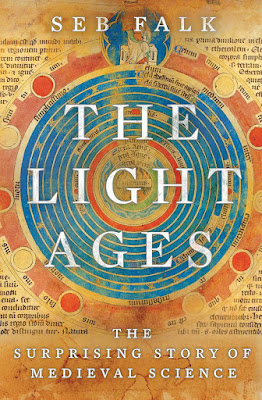
 The Light Ages: The Surprising Story of Medieval Science, by Seb Falk You know I always love a good book about how the Middle Ages were way cooler than you thought.  This one came out at almost the exact same time as another book called The Bright Ages , so there was definitely something in the air that year.  This book, however, is specifically about certain aspects of scientific progress during the Middle Ages, especially astronomy, and it constructs its narrative around a monastery in St. Albans, which is just north of London. We start with a very grabby story, about how in the 1950s a scholar found an old hand-written astronomical treatise at Cambridge and thought, for fairly good reasons, that it might possibly be a holograph by Chaucer.  The manuscript described an instrument that was not an astrolabe...what even was it?   And from there we set off to St. Albans and a tour of medieval calendar math, clocks, universities, astronomical prediction (with...

More November Reading

Image
 Here's some more November reading!  I'm thinking about going back to single-book posts, but on the other hand I'm having trouble finding time to write even these quickie riffles through several books at a time.  What do you think?     The Canceling of the American Mind: Cancel Culture Undermines Trust and Threatens Us All -- But There is a Solution , by Greg Lukianoff and Rikki Schlott:   I've been looking forward to this book for a long time!  The title is a riff on Lukianoff's last book, co-written with Jonathan Haidt, and the two titles work together.  This time, Lukianoff is teamed up with a Gen Z writer, Rikki Schlott, to bring in a younger perspective.  The thesis here: that cancel culture (which yes, exists) is a manifestation of false ideas discussed in the earlier book, and which serve to make us less mentally healthy and less able to function as a society.  The ideas: Fragility: that people are fragile and need comfort; they...

May Reading Part 2

Image
 My semester is over and I'm on summer break!  And the weather has been absolutely fantastic, not too hot, so I've been trying to spend a lot of time outside and hiking.  My goal is to do plenty of that this summer.  I've also read quite a bit in the last couple of weeks, and here is some of it, but it doesn't include the Louise Penny binge I went on of three novels in a row; they were good too! #antisemitism: Coming of Age During the Resurgence of Hate, by Samantha A. Vinokor-Meinrath : A survey and analysis of GenZ Jewish kids and how they feel about their Judaism and the rising incidence of antisemitism.  Most of these kids have GenX parents (like me) who grew up with very little antisemitism in the US, and I was shocked at how it's just common now for GenZ kids to have experienced, at the very least, comments from friends and schoolmates.                  A Place for Everything: The Curious History of Alphabe...

The Woman They Could Not Silence

Image
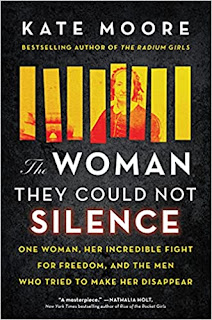
 The Woman They Could Not Silence: One Woman, Her Incredible Fight for Freedom, and the Men Who Tried to Make Her Disappear, by Kate Moore  It's hard to say anything about this book besides --- wowzers, this is a fantastic, amazing story, and everyone should read it.  Including you. This is the life story of Elizabeth Packard, a completely ordinary woman, wife, and mother of six in Illinois.  In 1860, as the United States was headed towards war, Elizabeth and her husband were in disagreement about religion.  Theophilus was a Presbyterian minister, and while Elizabeth had been joyfully discovering new ideas about women's rights, he was under pressure to guide his congregation into a stricter, more conservative theology (which, among other things, was neutral about slavery, in contrast to the church's previous anti-slavery position).  Elizabeth's insistence on her right to read widely, have her own ideas, and argue them in public grated on Theophilus, and he ...

The Mystery of the Exploding Teeth

Image
  The Mystery of the Exploding Teeth: And Other Curiosities From the History of Medicine, by Thomas Morris My oldest would love this book!  The premise is simple:  Morris spent a lot of time combing through antique medical journals for the unusual case studies that were sometimes published in them.  The resulting collection is organized on a somewhat thematic basis, and is a wonderful read (though not for reading over your lunch) and, at the same time, a minor survey of historical medical practices. One chapter is "Unfortunate Predicaments," featuring such stories as the sailor who swallowed pocketknives in quantity as a party trick, which worked for years but eventually ended badly; and a young boy who was playing with a goose's larynx (it works like a kazoo!) and coughed, which lodged the larynx in his own throat. "Mysterious Illnesses" contains some very eye-opening stories, and "Dubious Remedies" describes such inventions as mercury cigarettes and...

Mom Genes

Image
 Mom Genes: Inside the New Science of Our Ancient Maternal Instinct, by Abigail Tucker This is a fantastic book, and if you're a mom you'll want to read it.  If you're not a mom, it's probably a good idea to read it anyway, because after all, there are a lot of moms around. Scientists have only recently really started to seriously study the biological changes that come with motherhood.   We've long assumed that adults, on the whole, don't change much .  And it turns out that moms change -- a lot.  Our cells, our genes, our brains...all go through massive reconstruction. Tucker goes through a whole lot of research (she's a journalist, not a science person herself) and combines it with stories from her own life.  She's a mom of four herself and has plenty of relevant experience.  This is definitely a popular science book for laypeople, and it's got a good deal of humor as well. Compared to their rapidly developing infants, moms have a reputation f...

Summerbook #4: Are We Smart Enough to Know How Smart Animals Are?

Image
 Are We Smart Enough to Know How Smart Animals Are? by Frans de Waal For most of the 20th century, Western scientists stubbornly denied the possibility that animals could have anything approaching consciousness or intelligence.  Surely they could not truly learn, have memories, make deductions or plans, or have real social networks.  Anything that looked like that must really be instinct, blind chance, or in the behaviorist category of learning to do a simple action for an immediate reward.  There was a distinct demarcation between human and animal, and humans have something that animals never have. Well, Frans de Waal is here to tell you all about what he thinks of that nonsense.  After decades of working with animals and studying their intelligences, he has collected lots of research from many biologists, and he's going to teach you about animal cognition -- which we're only getting started with. It makes sense that if you're going to test an animal's intelli...

Stuff

Image
 Stuff: Compulsive Hoarding and the Meaning of Things, by Randy Frost and Gail Steketee As a somewhat messy person who collects books and fabric, I've often worried about becoming somebody with too much stuff.  This was especially true when the kids were younger and we also had tons of homeschooling paraphernalia, and I had a really hard time with keeping things clean and organized (I found that we could have only two of three at any one time: good homeschooling, a reasonably clean house, or reasonable meals.  All of them at once were not humanly possible.)  I would sometimes watch shows like "How Clean is Your House?" or "Hoarders" in order to motivate myself to clean, despite the twinge of conscience I experience from exploitative shows like that. The kids are older now and I've much improved my housekeeping/decluttering skills, so that I'm fairly happy with my stuff level.  (I recommend Dana White's blog/podcast/books ; they have helped me tremend...