Posts

Showing posts with the label Germanic literature

The Treasure Chest

Image
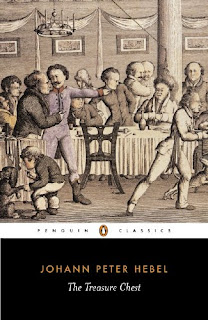
  Schatzkästlein des rheinischen Hausfreundes ( The Treasure Chest), by Johann Peter Hebel I have no idea how I got this book; it's been sitting on my tablet for some time now.  A few weeks ago I started reading it at bedtime, for which it is perfect, because it's a collection of short little stories, vignettes, jokes, and so on, usually with a little moral theme.  Johann Peter Hebel (1760 - 1826) was from Basel in Switzerland and spoke the Allemanische or Alemannic dialect of German, which is/was spoken in much of Switzerland, Bavaria, and Baden.  He lived in a few different places in those areas, and I'm going to count him for Switzerland.  Hebel became a professor, a poet/writer, and a deacon in the Lutheran Church.  Eventually he rose to become a prelate and a member of the Parliament of Baden, though what he really wanted to do was be a parish priest in the Bavarian/Swiss borderland.  Anyway, in the first years of the 19th century, he also edited ...

Momo

Image
Momo, by Michael Ende In the US, The Neverending Story is the only work of Ende that is really well-known.  But I'd heard that there was this other story, Momo, and kept my eye out for it.  The first copy I found (on the donation table) turned out to be in Spanish, but eventually I got hold of it... At the edge of town, there is an ancient ruined amphitheater where children go to play.  Momo, a very small person in ragged clothing, arrives and takes up residence in a sort of cubbyhole under the stage.  Adults come and offer to take her in, but she prefers to stay as she is, so they share their food and goods with her.  Momo is an excellent listener -- the kind that seems to spark ideas and solutions for problems just by listening so well -- and she has many friends.  Games are always more fun when Momo is around. But the city is changing.  Unobtrusive grey men, in grey suits, are visiting citizens and convincing them to save time by banking it with the...

The Green Face

Image
The Green Face, by Gustav Meyrink Getting back into the swing of things -- I hope -- I'll start with a book I actually finished a while ago.  (As I type, the carpet guy is stretching the carpet, which seems to mean getting the edges in place.  Everything in the house is now so chaotic that there is very little for me to actually do except sit at the computer!  I already did the dishes.) I've been meaning to read this novel for so long, but I only had it on Kindle, and I'm not very good at reading books on my phone.  This book turned out to be quite hard to get into; it starts off with a man going into a shop with a strange sign that is nearly unreadable on a phone.  But, as I mentioned a month or so ago, I found a paper copy at the giant research library I visited in July, and I read the first few chapters there, which helped me get into it.  Then I read a lot on the plane home, which got me about halfway through.  Progress was quite slow after th...

The Opal and Other Stories

Image
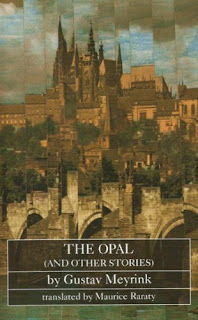
The Opal and Other Stories, by Gustav Meyrink Here's another book I found at the university library.  I actually looked for The Green Face , because although I have that on my Kindle, I've been finding it difficult to get into.  I figured if I got started with the physical book, maybe I could then read the rest on Kindle.  Well, I didn't only find The Green Face -- right next to it was this collection of short stories that doesn't seem to be in print any more in the US (you can get it on Kindle though).  So I grabbed that and read it...and I did get enough time to read the first few chapters of Green Face as well, and my plan worked.  I'm now well into that novel. So this is a collection of Meyrink's early short stories, written right at the beginning of the 1900s, before he wrote any novels.  (His later novel, The Golem , is what made him famous.  I've now also read Walpurgisnacht. )  At this time, he's trying and failing to make a livin...

Summerbook #16: Hartmann von Aue

Image
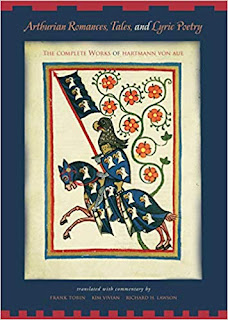
Arthurian Romances, Tales, and Lyric Poetry: the Complete Works of Hartmann von Aue This is a long-held goal of mine, to read the complete works of Hartmann von Aue!  I did, some time ago, get hold of a (terrible) copy of Poor Heinrich, which is how I found out about this medieval German knight and poet.  I shall now quote my own blog post for background: If you were here for my Arthurian literature project of 2014, you know that the mania for knightly romances and Arthurian tales spread through Western Europe in the 1100s.  I read French and German tales as well as English ones.  There were three great German poets of the courtly romance: Wolfram von Eschenbach wrote Parziva l , and Gottfried von Strassburg wrote Tristan , but before them came Hartmann von Aue, who introduced the idea into Germany in the first place in the 1190s.  He has not become nearly as well-known in English as the two later poets... This volume contains Hartmann's four narr...

Belonging

Image
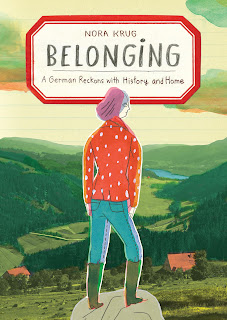
  Belonging: A German Reckons With History and Home, by Nora Krug This showed up on the new books cart at work and I couldn't resist.  That happens a lot, and it's becoming a problem, because I can't read as fast as I can take books home...so I'm trying to only take the books that I don't have on a list.   It probably isn't helping much, but maybe I can read a lot over the summer.  (I say that every summer and it never works.)  Anyway, this was a graphic novel of sorts, and therefore wouldn't take long... It's actually more like a scrapbook, collage, and diary.  Nora Krug grew up in Germany, and must be just about exactly my age.  This the record of her struggle with being German in the wake of the 20th century; growing up as a child with this sense of collective shame and guilt, while also not quite understanding what actually happened, and having these blank spaces where family members might have been.  The questions: what did her gra...

Undine and Other Stories

Image
Undine at the start (Rackam, obvs.) Undine and Other Stories , by La Motte - Fouqué Well, his whole name was Friedrich Heinrich Karl de la Motte, Baron Fouqué, but that was too difficult, so even my book only says "La Motte Fouqué" on the title page and never elaborates.  He lived from 1777 - 1843 and was a German Romantic to the core; my little Oxford World Classics book (from 1932) says we "may now recognize in Fouqu é the latest and the most uncompromising of the Romanticists, the man who accepted most unflinchingly the principles of that school, and who carried them out most thoroughly."   It also calls him "somewhat stupid" and goes on to note that his output "was positively prodigious, and most of it, so far as modern readers are concerned, might very well have been left undone."   Poor Fouqué!  The introduction does allow him several stories to keep for posterity, and these four make up the majority of them. It must be admitted tha...

An Autumn Riffle of Reviews

Image
I now have seven books sitting in front of me to review, and some of them were read well before the fire.  Now I can barely remember them.  So, I'm going to do quickie reviews of all of them, and consider that a fresh start to the winter season. The Infernal Library: On Dictators, the Books They Wrote, and Other Catastrophes of Literacy, by Daniel Kalder:     Oh boy, this was not to be missed!  How do you pass up that title?  Kalder gives us a tour of the terrible, awful literary productions of 20th century dictators, from Lenin on down.  The material is no fun, but he helps the reader survive with a large dose of wit.  The big names go first, with Mao taking up quite a lot of space, but there's room for a whole lot of less-famous dictators, such as Salazar of Portugal and Hoxha of Armenia.  Everybody felt the need to write books that would dictate how the world should work: Gaddafi wrote the Green Book , Saddam Hussein wrote allegorical...

Walpurgisnacht

Image
Walpurgisnacht, by Gustav Meyrink I saved this book to read over actual Walpurgisnacht, which is April 30.  The novel starts at that point and then continues for a couple of months, except that time is also stalled; the characters can't get past it.  Meyrink wrote Walpurgisnacht in 1917, and it continues the train of thought he was following in his prior novel, The Green Face , which I haven't read yet.  I guess I got it a little bit out of order. The story is set in Prague, during World War I.  German officials and aristocrats live in a sort of palace/office complex and virtually never leave; certainly they never, ever cross the river to the ordinary people of Prague.  The river (Moldau then, now Vltava) is a nearly uncrossable barrier.  These aristocrats are few, elderly, decrepit, and senile, with the exception of the young and voracious Polyxena.  She is carrying on an affair with Ottokar, a poor violinist. The actor Zrcadlo (Mirror) appear...

Steppenwolf

Image
My paperback cover -- terrible, isn't it? Steppenwolf, by Hermann Hesse In my endeavor to appreciate Hesse, I've now read Siddhartha and Steppenwolf .  I'm working my way up to The Glass Bead Game .  Of course, this novel is indelibly and vaguely associated with 70s late-hippie music in my brain, as I'm sure it is for most people my age, but I never really knew what 'steppenwolf' was supposed to mean in English.  It turns out to be very simple: wolf of the steppes, or as we'd say, a lone wolf.  The title could be rendered as Lone Wolf and that would work.  (For some reason, Wikipedia claims that a wolf of the steppes is a coyote, but it isn't and that doesn't work at all.  My advice is not to try to think of this as Coyote .  No.) Harry Haller, mid-50s, thinks of himself as a double-natured being.  One side of him is an intellectual, high-culture sort of man, and the other is a wild and bloodthirsty lone wolf, always on the move and nev...

Germania

Image
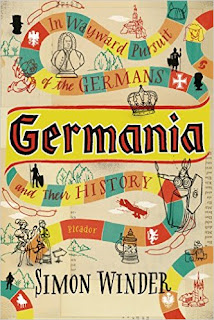
Germania: In Wayward Pursuit of the Germans and Their History, by Simon Winder I was attracted to this book as soon as I saw it in the store, and it's been on my TBR shelf for a little while.  Once I began reading, I was charmed by Winder's fun writing style and by his prompt mention of Regensburg, the only German city I have really properly visited.  Right there in the introduction he talked about the centuries-old bratwurst restaurant right by the bridge!  I've BEEN to that restaurant, and so from that moment on I was completely enamored.  Winder did not disappoint. Simon Winder has an unusual love for many things German, and here he indulges it freely, wandering around history, poking here and there for treasure.  He stops at 1933 for obvious reasons, but especially because a large part of his goal in writing is to bring up a lot of the wonderful stuff about Germany that got buried by the horrific 20th century.  The result is a really neat book th...

The Neverending Story

Image
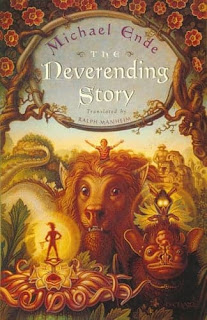
The Neverending Story , by Michael Ende A couple of months ago, I took my kids to see The Neverending Story at the movie theater for the 30th anniversary.  We had a lot of fun -- there was a little documentary first about the filming of the movie, and about a kerfuffle with Michael Ende (he hated the ending) -- and the movie was beautiful to see on the big screen.  Naturally, I promptly wanted to re-read the book, but I wanted my 13yo daughter to read it first.  It's one of her favorite movies, and so I've seen it several times over the years, but I haven't read the novel since the mid-1990s. My kid still hasn't gotten around to reading it my battered old paperback, but a couple of weeks ago at work I was going through the children's literature/YA section and moving a bunch of things down to the reading lounge, where they will get more use.  There was a mystery book with black tape on the spine and no title on the cover, but when I opened it up it turned out to...

The Threepenny Opera

Image
The Threepenny Opera , by Bertold Brecht When I first put my Classics Club list together, I pulled from a lot of pretty random sources and I put some things on the list that I'd vaguely heard of, but didn't know anything about.  That way, I'd learn new things!  (This is kind of how I operate in a lot of areas.)  Somehow, I wound up with two Brecht plays on my list, and what I've mainly learned from that is that I do not like Bertold Brecht.  So now I've learned some new things, yep. The Threepenny Opera is a musical play that was based on the 18th century Beggar's Opera by John Gay.  Although it was originally written in German (during the inter-war period), it's set in Victorian London.  It's supposed to be a savage commentary on capitalist bourgeois society from a Socialist standpoint.  It was a big hit in Germany.  Critics in the baby USSR loved it.  Americans liked the music, but not a lot else; one critic called it "a dreary enigma...

Siddhartha

Image
Good old Shambhala* Siddhartha , by Hermann Hesse I always had this vague impression that Siddhartha was a book about Buddhism that deep people read in college.  I never had any particular desire to read it myself, but eventually I figured that I don't know anything about Hermann Hesse and maybe I ought to find out.  For one thing, The Glass Bead Game sounds like something I do want to read, but it's on the scary side, so maybe I should start slow with Siddhartha and Steppenwolf , huh? Hesse was an intellectual, philosopher kind of guy with severe health problems that prevented him from doing the things that were normal for people his age, like university and war.  He wound up in Switzerland and did join the military during World War I, but was unfit for front duty.  Anyway, he was totally uninterested in the nationalistic trends around him and instead read a lot about Theosophy, Buddhism, and pacifism, and all that led to the writing of Siddhartha in 192...

Man's Search for Meaning

Image
Man's Search for Meaning , by Viktor Frankl I've been wanting to re-read this for a while.  I think it qualifies as one of the important books of the 20th century, a must-read, though I'm not sure how Frankl's ideas about psychotherapy are viewed now. The first half of the book is Frankl's personal account of his time in Nazi concentration camps.   It's not chronological and exact; it's more a series of stories and impressions, and his views on how he and his fellow prisoners kept going--or not--under such horrific conditions.  Frankl's assertion is that the way to find meaning in life, under any circumstance, is to turn the question around: .. .it did not really matter what we expected from life, but rather what life expected from us.  We needed to stop asking about the meaning of life, and instead to think of ourselves as those who were being questioned by life--daily and hourly.  Our answer must consist, not in talk and meditation, but in rig...

The Notebooks of Malte Laurids Brigge

Image
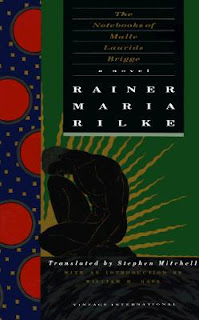
The Notebooks of Malte Laurids Brigge , by Rainer Maria Rilke Rilke wrote one novel, and this is it.  At the time, he was living in Paris, having left his new wife and baby behind while he went in search of some income (and to get away from said baby, who was so inconsiderate as to cry and want to eat while he doing important stuff like being inspired and all; everyday life is too vulgar for a poet).  Notebooks was largely written out of his experiences in Paris. Malte Laurids Brigge is a young Danish aristocrat of sorts--the poor sort--living in Paris.  His two notebooks/journals consist of his experiences, memories, and imaginings.  There isn't really a plot to speak of; the thread goes back and forth and it's just like a real notebook in a real young man's life--a life based very much on Rilke's own.  Sometimes he's looking at young women students copying the Cluny tapestries (see?? I told you they were everywhere), and sometimes he's thinking of his chi...

Poor Heinrich

Image
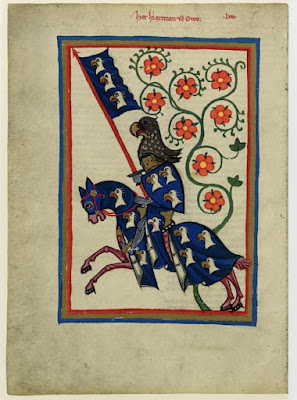
Poor Heinrich , by Hartmann von Aue I have missed being here!  It's not that I ran out of books, or had a reading slump, or even a blogging slump.  I just couldn't seem to grab some time to blog in.  So I have some fun things to tell you about, and the first is going to be Der armer Heinrich , by this Hartmann guy. Hartmann von Aue himself! If you were here for my Arthurian literature project of 2014, you know that the mania for knightly romances and Arthurian tales spread through Western Europe in the 1100s.  I read French and German tales as well as English ones.  There were three great German poets of the courtly romance: Wolfram von Eschenbach wrote Parziva l , and Gottfried von Strassburg wrote Tristan , but before them came Hartmann von Aue, who introduced the idea into Germany in the first place in the 1190s.  He has not become nearly as well-known in English as the two later poets, and in fact I had an interesting time finding a copy.  ...

Spin Title: The Adventurous Simplicissimus

Image
The Adventurous Simplicissimus: Being the description of the life of a strange vagabond named Melchior Sternfels von Fuchshaim , by H. J. C. von Grimmelshausen Full disclosure: I had already started this book before I put it on my Spin list, but I felt it was pretty fair because it's not an easy read at all, and I could use the help!   This is a very early German novel, from 1668.  Like Don Quixote , it's a picaresque novel, consisting of one adventure after another and not too linear in plot.  It is set during the Thirty Years' War (1618-1648), and the beginning, at least, is a fairly savage satire on war and soldiers, but then it moves into the picaresque adventures. The narrator is born a German peasant, but his home is plundered and ruined by soldiers looking for food, women, and loot.  Believing his whole family dead, he wanders in the forest and ends up living with a hermit, who teaches him religion and names him Simplicius Simplicissimus, because...