Posts

The Subjection of Women

Image
The Subjection of Women, by John Stuart Mill (and Harriet Taylor Mill?) John Stuart Mill, it turns out, was a feminist. His wife, Harriet Taylor, probably gave him some of the ideas for this book; she way well have helped him write it. While Mary Wollstonecraft tried to convince her audience that women would become better if they were treated better, Mill asserted that it didn't matter whether or not women as clever or as moral as men; being human beings, they should have equal rights regardless of individual qualities. I enjoyed reading t his book, and actually finished it a few weeks ago, but I'm afraid I haven't got anything terribly worthwhile to say about it. It's a good selection for this years Feminist Classics project, though, and you should read it. The edition I read was quite helpful and included a collection of reactions from Mill's contemporaries, though I would have liked to see information on Harriet Taylor as well.
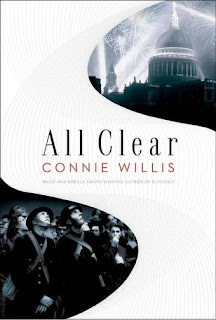
Week 9: All Clear

Image
All Clear , by Connie Willis I zoomed through this second half of the story that started in Blackout . Three historians are trapped in London during the Blitz--or is it four? And is the reason that they're trapped because the space-time continuum has been damaged, or something else that they haven't thought of? The story is riveting, and Willis jumps between about six different viewpoints to give you little pieces of the puzzle. The author's tendency to take a very, very long time to tell her story is evident here, but the ride is awfully enjoyable, so don't mind. It's very worth the time. All the talk of Agatha Christie novels put me in the mood to read a few, and to re-read (for the zillionth time) Willis' time-travel comedy, To Say Nothing of the Dog .

Week 9: We've Got Issues

Image
We've Got Issues: Children and Parents in the Age of Medication , by Judith Warner Judith Warner started out to write a rant about the overdiagnosis and overmedication of children in this degenerate age of pressure to perform. She was going to denounce perfectionistic parents who gave their normal, if boisterious, children drugs in order to get better grades out of them or give them an edge in a competitive world. The trouble was, she discovered that the story everyone knows isn't actually true. So We've Got Issues is her effort at documenting the actual state of modern child psychiatry--and I'd recommend it to anyone struggling with these difficult issues. We hear a lot of things like "Kids didn't have ADHD or bipolar disorder when we were kids!"--but that's not really true. A lot of children were simply labeled stupid or bad or delinquent. Children with severe mental issues were not seen because they were often simply institutionalized--for ye...

Victorian Literature: Under the Greenwood Tree

Under the Greenwood Tree , by Thomas Hardy This was recommended to me as the book to read if you want to read Hardy, but don't want your heart ripped to shreds and then stomped on. And in fact I'm glad I read it; it's a nice story, sweet but not overly so, and my heart survived intact. The story concerns a resident of Mellstock village, one Dick Dewy, a young man who is quite ordinary. He falls in love with the village's schoolmistress, Miss Fancy Day--a bit above him on the social scale. The story of their courtship, with its stumbles and blocks, is interesting because they're both ordinary human beings with virtues and flaws. Fancy isn't really quite the angel Dick thinks she is, but we hope she learns from her mistakes. This is my fourth Victorian book, so I'm done with the "Sense and Sensibility" category! Yay me.

Week 8: Blackout

Image
Blackout , by Connie Willis I love Connie Willis' time travel books, which posit a future where Oxford historians travel back in time to study the past. No objects can be carried into the future, and it's a relatively new science that sometimes has unexpected issues arise. So there are no commercial interests; time travel is just for historians with a penchant for discomfort and danger. Willis' previous major time-travel books are Doomsday Book (excellent, very very sad) and To Say Nothing of the Dog (a Victorian comedy with lots of in-jokes about 30's mysteries). In Blackout , several different historians are in England during the early days of World War II. The story bounces between Dover/Dunkirk, a country manor filled with refugees, London under the Blitz, and a couple of other locations that are a little more mysterious. The historians find themselves trapped, unable to get back to their own Oxford, and the story stops right in the middle because Blackou t ...

Week 8: After the Quake

Image
After the Quake , by Haruki Murasaki Murasaki is an eminent surrealist Japanese novelist, and I've had some of his books for years, and I mean to read them this year. So I got this particular book from the library; it's not one of the ones I own at all. This is a collection of short stories, all set soon after the 1995 Kobe earthquake. The earthquake is nearly always kind of incidental to the stories here. There is a girl who likes bonfires. A man raised in a cult that calls him the son of God spends a day tailing someone he thinks might be his father. Another man meets a giant talking frog who asks for his help in saving Tokyo. That one was my favorite. I will be reading more Murakami.

Week 7: People of the Book

Image
People of the Book , by Geraldine Brooks I've read a couple of Geraldine Brooks' nonfiction books about women's lives in the Middle East, and I was curious to see what she would do in a novel. This is an art history/literature mystery novel, which I always enjoy if it isn't all Da Vinci Cod e -y. It's definitely a cut (or two) above Dan Brown, and I really liked it. The plot centers around a real illuminated book: the Sarajevo Haggadah, one of the earliest known Jewish medieval books, which was made in Spain before Ferdinand and Isabella threw all the Jews out in 1492. It eventually ended up in Sarajevo, where it has twice been saved from destruction by Muslim librarians, so it is a national symbol of tolerance as well as one of the most valued books in the Bosnian collection. Brooks takes all the known history of the Haggadah and makes up a story for it, alternating between the protagonist, Hanna--an Australian book conservator--and chapters that move progressiv...