Posts

Notes on a Silencing
Image
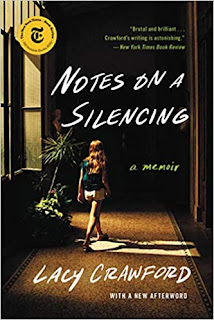
 Notes on a Silencing: A Memoir, by Lacy Crawford Lacy Crawford is about the same age as I am, a year or so younger.  She came from a semi-privileged background and her parents very much wanted to send her to a prep school and an Ivy League college, so at 14, off she went to St. Paul's, a very elite boarding school.  In this memoir, which loops back and forth through her memories, she chronicles her experiences -- finding her place, enjoying sports and friends -- and then the devastating assault from two 18-year-old boys when she was 15.  They bragged about what they'd done, and soon Lacy was not only traumatized and ashamed, she was a social pariah.  And then she got sick. What Crawford wants to talk about, however, is not so much the attack -- awful as it was, it is also not unusual as these things go, and she is careful to say so.  What really did the job on her, and countless other young students, was the school's reaction.  Faced with undeniable e...
November Nonfiction IV: Stranger Than Fiction

Image
Week 4: (November 22-26) – Stranger Than Fiction with Christopher at Plucked from the Stacks : T his week we’re focusing on all the great nonfiction books that *almost* don’t seem real. A sports biography involving overcoming massive obstacles, a profile on a bizarre scam, a look into the natural wonders in our world—basically, if it makes your jaw drop, you can highlight it for this week’s topic.   I've read a lot of jaw-dropping non-fiction this year, so it's hard to pick.  I'm going to ignore the WWII titles, because so much of it is just inherently insane.  From the rest, I've chosen two titles, and the links go to my original posts: Are We Smart Enough to Know How Smart Animals Are? by Frans de Waal :  De Waal chronicles the ineptitude of many of our attempts to categorize animal intelligence, and offers a whole lot of wonderful observations.  I wrote... ...critters are constantly surprising biologists with what they can do, and cognition seems to wo...

Lotharingia

Image
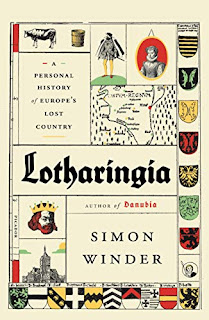
 Lotharingia: A Personal History of Europe's Lost Country, by Simon Winder I have finished Simon Winder's fantastic trilogy about European history, and I love it so much that I will definitely be re-reading one of these days.  I previously read and wrote about Germania and Danubia with great joy.  Simon Winder is just right up my alley -- he pretty much just goes out and frolics around barefoot through the meadows of central European history, and his enjoyment comes through beautifully.  He knows that it's impossible to get a real handle on a thousand years or so of matter, and so he picks and chooses his favorite bits, and we just come along for the ride. Lotharingia is about the much-fought-over stripe of Europe that covers eastern France, western Germany, some of Belgium and the Netherlands, and Luxembourg.  It ends where Switzerland starts, pretty much.  Charlemagne's heirs divided the massive empire into three parts and Lotharingia was the middle pa...

Guest House for Young Widows

Image
  Guest House for Young Widows: Among the Women of ISIS, by Azadeh Moaveni It's almost ten years ago now that ISIS became known on the world stage, amid such complex circumstances in Syria and the surrounding areas that I can't possibly sum them up here.  They included Syria's civil war, the disappointed Arab spring, and the war in Iraq.  And young, often educated Muslims started leaving their homes to join up with ISIS and the proclaimed caliphate.  Why?  In particular, why the girls?  Azadeh Moaveni, who has spent years embedded in these conflicts, wanted to get to know them and understand their stories.  Her book contains thirteen young women (out of quite a few more) from many different circumstances, and she narrates their stories with understanding.  Early on, the young people who joined up tended to be idealistic.  They heard about atrocities in Syria and wanted to stand against injustice and violence against their fellow Muslims....

The Things She's Seen

Image
The Things She's Seen, by Ambelin and Ezekiel Kwaymullina Here's my title for AusNovember!  I've been excitedly waiting for it to wend its way through the library process so I could check it out.   This is a new YA novel by a brother and sister team.     Beth is dead, to begin with.  The only person who can still see her is her dad, who was so devastated by her death in a car accident that she stuck around in hopes of helping him get back on his feet.  He's a policeman -- a detective -- and he's been asked to investigate a house fire in a tiny country town that left one unidentified person dead.  A simple case for a guy who needs easing back into his job. Or perhaps not.  Beth is sure there's more to this than meets the eye.  The house was a group home for foster kids, run by an administrator and a nurse, but nobody ever saw the kids out and about.  The single witness to the fire is a girl who will only communicate what she kno...

November Nonfiction III: Cloth and History

Image
Week 3: (November 15-19) – Be The Expert/ Ask the Expert/ Become the Expert with Veronica at The Thousand Book Project : Three ways to join in this week! You can either share 3 or more books on a single topic that you have read and can recommend (be the expert), you can put the call out for good nonfiction on a specific topic that you have been dying to read (ask the expert), or you can create your own list of books on a topic that you’d like to read (become the expert).   For week 3, I decided to Be The Expert (and do a little Becoming) about the history of fabric, thread,  the development thereof, and its place in societies and history.  I stayed away from fashion -- that's not my area.  But I sure do love reading about fabric!    These are the books I've read so far: Women's Work: The First 20,000 Years Women, Cloth, and Society in Early Times, by Elizabeth Wayland Barber : My favorite book comes first, and is about the invention of string, w...

The Wonderful Adventures of Nils

Image
The Wonderful Adventures of Nils, by Selma Lagerlöf I have enjoyed Lagerlöf's books of legends, and for a long time I've meant to read this story.  (After all, my oldest got it from the library and read it at age 5, so surely I can do it...)  She wrote it as a geography textbook for Swedish schools, published in 1906–07, and in the English edition, some of the longer geography passages are edited out.  This turns it into a long adventure story, still featuring a whole lot of Swedish geography. Nils Holgersson, age about 14,* is kind of a stinker of a boy.  He's lazy, rude, and mean to animals -- a real worry to his parents.  And one day, he spots the house elf, catches him....and the elf gets his revenge by turning Nils into an elf too!  Nils can now understand and speak with animals, but they don't think much of him.  What to do? He winds up taking a trip with the wild geese, who are migrating north to Lappland for the summer.  They call him Thum...