Posts

Showing posts with the label politics

Summerbook #21: The Power of the Powerless

Image
 The Power of the Powerless, by Vaclav Havel This is one of those very famous books you always mean to read, and so I thought I'd give it a try this summer.  It's short and dense, just 21 chapters long, and published in 1978.  The edition I read has a very helpful introduction from Timothy Snyder, and so here's some information I cribbed from that: Ten years after the Prague Spring, nobody was particularly pro-communist anymore, but Havel was worried about how everyone just...adapted and resigned themselves to the status quo.  He wrote this book asking what ordinary people could do to make change wherever they were; he considered that he was critiquing the West too. Essentially, Havel asks, do we just go along, playing the game (whatever it may be), or do we try to live in truth?  By 'live in truth,' he doesn't mean to take up another Big Philosophy and live by it, or foment yet another revolution; he means to make decisions according to a personal sense of what...

Summerbook #13: On Lying and Politics

Image
  On Lying and Politics, two essays by Hannah Arendt I love this cover though This little book contains two very long essays: "Truth and Politics" and "Lying in Politics."  Both take questions of the Vietnam War and apply them to a wider context.  "Lying in Politics" is a direct response to the release of the Pentagon Papers. Arendt is probably a little above my head.  I have ambitions to read her larger works, but I don't know that I even managed to plumb the depths of these short ones.  "Truth and Politics" talks a lot about what kinds of truth there are and how they might be manipulated or if truth is even very findable.  It's less concrete, more abstract than the second essay. "Lying in Politics" meditates upon the question of "how could they?" in relation to Vietnam and the Pentagon Papers,  why and how politicians lie, and particularly focuses on lying as a method of trying to make reality conform to the liar...

More November Reading

Image
 Here's some more November reading!  I'm thinking about going back to single-book posts, but on the other hand I'm having trouble finding time to write even these quickie riffles through several books at a time.  What do you think?     The Canceling of the American Mind: Cancel Culture Undermines Trust and Threatens Us All -- But There is a Solution , by Greg Lukianoff and Rikki Schlott:   I've been looking forward to this book for a long time!  The title is a riff on Lukianoff's last book, co-written with Jonathan Haidt, and the two titles work together.  This time, Lukianoff is teamed up with a Gen Z writer, Rikki Schlott, to bring in a younger perspective.  The thesis here: that cancel culture (which yes, exists) is a manifestation of false ideas discussed in the earlier book, and which serve to make us less mentally healthy and less able to function as a society.  The ideas: Fragility: that people are fragile and need comfort; they...

Finishing all those books in November

Image
 I'm working on that pile!  Here are three of my pile books, plus two quick reads I stuck in around the edges. Junk Film: Why Bad Movies Matter , by Katharine Coldiron -- This book was just a delight to me, but then it was written by somebody who likes many of the same terrible movies I do but is much more knowledgeable than I am.  The first third of the book is dedicated to a monograph of Plan 9 From Outer Space and what makes it so interesting as a terrible movie.  Wonderful!  She talks about a failed TV show called Cop Rock in which somebody mashed a serious procedural cop show with a musical -- "I promise this is true."  Coldiron gets into literature and compares Irene Iddesleigh with Sean Penn's novels.  She explains why a low-budget 70s horror film called Death Bed is actually pretty good.  I loved it. If you like bad movies, this is a great book for you.  Others possibly not so much.     How Democracies Die , by Steven L...

February Reading, Part the Second

Image
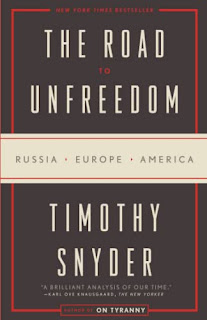
 I've been split between really quite heavy-duty books and incredibly light cotton-candy books.  I've read four Three Investigators novels in the last couple of weeks -- ones near the end of the series, so not as good as the earlier titles, but still fun.   I could tell the last one was different from the cover, and it turned out to be one of some stories originally written in German -- the Three Investigators were evidently hugely popular in Germany, and somebody wrote some sequels that come off more as fanfiction than anything else, I thought.  Anyway, on with the February reads: The Road to Unfreedom: Russia, Europe, America, by Timothy Snyder -- it took me a long time to work my way through this one.  Snyder took on the job of explaining the underpinnings of Russian (Putin's) political ideology and policy to Americans.  It's a very tough job, because to a Westerner it's fairly incomprehensible.  Snyder then moves on to explaining Russia's acti...

February Reading, Part the First

Image
 Hi ho!  I've been doing a lot of reading, but much of it is pretty heavy-duty long stuff and I won't be done right away.  (And I also indulged in two Barbara Michaels gothics -- fun!)  Here are the books I read in the first half of February:   Dark Archives: A Librarian's Investigation Into the Science and History of Books Bound in Human Skin , by Megan Rosenbloom --  a bit macabre, and an interesting read.  Not all books claiming to be bound in human skin actually are, and Rosenbloom's research group is able to do a test that confirms what kind of leather a binding is made from.  (You can't do a DNA test; the tanning process destroys all DNA.)  Most of the books in the English-speaking world were made by 19th-century doctors who were doing autopsies or dissections anyway, and lifted some skin while they were at it.  So Rosenbloom kind of goes all over the place, talking about the development of medical ethics and all sorts of things....

On Tyranny, Expanded

Image
 On Tyranny: Expanded Audio Edition, by Timothy Snyder We all know I'm a Snyder fan and am trying to read/listen to as much of his output as I can.  I read the original of this book a few years ago; it's very short and an excellent book which I recommend.  After Russia's further invasion of Ukraine -- now almost a year ago -- Snyder decided to add to this small book.  This extra material is only available on the audiobook; I think he wanted to get it into the world right away.   So after the original content, narrated several years ago in the standard professional manner, Snyder just comes in and starts talking in a slightly more personal tone.  He evidently just sat down, pounded out all his thoughts, and is now going to pour them into your ear practically without a break because this is all super-important to him.  He loves Ukraine, his dear friends are being bombed, and a bunch of them are on the front lines or suddenly displaced from their ho...

The True Believer

Image
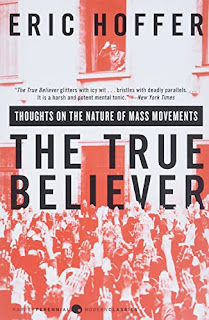
 The True Believer: Thoughts on the Nature of Mass Movements, by Eric Hoffer My sister lent me this fascinating short book, which was published in 1951.  Eric Hoffer was not an academic or famous intellectual; he was self-educated and worked as a longshoreman, and he was a thinker with plenty of experience of the world.  He wrote ten books, apparently mostly "in his spare time while living in the railroad yards."  This book is a collection of observations and thoughts on, well, the nature of mass movements -- not just in the 20th century, though that's a lot of it, but all over the place.  Religions, rebellions, and takeovers through history are the grist for his mill.   Though there are footnotes, this is not what we would think of as an academic treatise.  It's Hoffer giving us his thoughts, and he doesn't expect us to agree with everything; indeed some things are overdone to make an interesting point.  Because I'm reading it with 70 more y...

The Storm is Upon Us

Image
 The Storm is Upon Us: How QAnon Became a Movement, Cult, and Conspiracy Theory of Everything, by Mike Rothschild Since I'm always interested in reading about conspiracy theories, and I've had a hard time wrapping my head around the Q movement, I snapped this one right up from the library.  I must say that it really just tickles me that the author's name is Rothschild (no relation, he specifies), since that name is so often caught up in conspiracy theories too. Rothschild gives us a readable history of Q, which is pretty impressive given the chaotic material he had to work with.  He explains the boards it started on, the major names, related scams, and the unusual nature of the movement, which is charismatic but practically leaderless.  It also co-opts many older narratives into this new form and trades mostly in fear.  After the history, Rothschild meditates on possible ways to reach loved ones who have fallen down the Q rabbit hole and gives some limited advic...

Learning From the Germans

Image
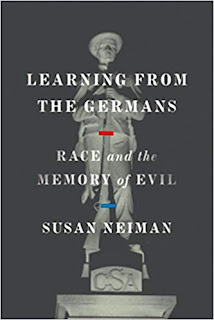
 Learning From the Germans: Race and the Memory of Evil, by Susan Neiman It's actually been a while since I read this -- it was a long, slow read and very worthwhile, and I finished somewhere in the start of January.  So probably this post will be shorter and less deep than I would like! Susan Neiman has been studying German history and culture for a long time, and she got to thinking about German efforts to face up to the past.  How have those efforts worked, and what can we learn from them?  Are there lessons we can apply in the US? Neiman offers in-depth analysis of various programs in Germany, which is fascinating.  Just after WWII, occupying forces put up posters of the concentration camps with captions saying "this is your fault."  Unsurprisingly, that did not make German people feel very repentant.  In fact a lot of people felt that they were the true victims -- after all, look how much they lost!  It took time and perspective for people to...

Guest House for Young Widows

Image
  Guest House for Young Widows: Among the Women of ISIS, by Azadeh Moaveni It's almost ten years ago now that ISIS became known on the world stage, amid such complex circumstances in Syria and the surrounding areas that I can't possibly sum them up here.  They included Syria's civil war, the disappointed Arab spring, and the war in Iraq.  And young, often educated Muslims started leaving their homes to join up with ISIS and the proclaimed caliphate.  Why?  In particular, why the girls?  Azadeh Moaveni, who has spent years embedded in these conflicts, wanted to get to know them and understand their stories.  Her book contains thirteen young women (out of quite a few more) from many different circumstances, and she narrates their stories with understanding.  Early on, the young people who joined up tended to be idealistic.  They heard about atrocities in Syria and wanted to stand against injustice and violence against their fellow Muslims....

Don't Label Me

Image
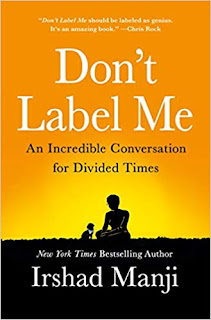
  Don't Label Me: An Incredible Conversation for Divided Times, by Irshad Manji Irshad Manji is a person well worth following; she's just so interesting!  For several years she's had the Moral Courage Project on Youtube , which is about getting people of opposing viewpoints together to discuss solutions.  Manji dislikes labels because she feels, rightly enough, that they diminish our humanity and complexity.   As both a devout Muslim and a lesbian, she tends not to fit neatly into the expectations those labels generate. The foundational conceit of the book is Manji's own experience with dogs.  Raised to fear and loathe dogs as unclean and dangerous, Manji discovered a whole new dimension to life when she ventured to get to know dogs -- and the woman who became her wife.  Here, Manji sets up her thesis as a fictional conversation between her and Lily, urging all of us to look past our labels and our fears, and talk honestly with each other -- not to sco...

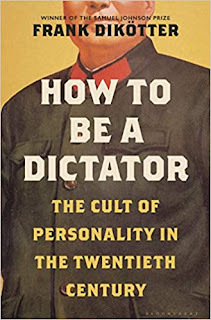
How to Be a Dictator

Image
 How to be a Dictator: The Cult of Personality in the Twentieth Century, by Frank Dikötter  I found this title pretty hard to resist!  Many of the people in this book (though not all) are very familiar; Dikötter takes us on a selective tour of dictators of the 20th century -- specifically those who fostered a cult of personality -- starting with Mussolini.  Of course Stalin, Hitler, and Mao are included, but Dikötter keeps the focus just on the personality cult, which means that I learned quite a bit even though I'm pretty familiar with those guys.  After that, we take a turn into lesser-known dictators: Kim Il-Sung (North Korea), Duvalier (Haiti), CeauÈ™escu (Romania), and Mengistu (Ethiopia).  These were fascinating.  Most of them were not as adept or as focused as the Big Four (that's an Agatha Christie joke for you, sorry).  Some were Communist or Fascist, and some just plain dictators; they all felt the need to have a self-named philosophy ...