Posts

Showing posts with the label education

Excellent Sheep

Image
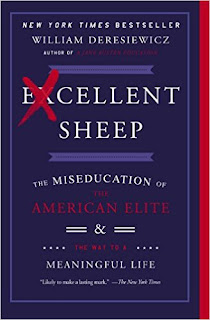
Excellent Sheep: The Miseducation of the American Elite and the Way to a Meaningful Life , by William Deresiewicz Several years ago, William Deresiewicz published an online essay, The Disadvantages of an Elite Education, which garnered a lot of attention.  He then turned the essay into a book which I've been meaning to read for some time. Deresiewicz, a Yale professor, starts off critiquing the ever-more-strenuous race to get into the Ivy League (or even a highly-ranked public school, but mostly the Ivies), and then the conformity seen on campus.  Perfect Ivy candidates do not have time for eccentricity; they have to fit a mold.  I think this is the strongest part of the book, with some excellent points about why we have this system and how it serves the people who benefit, but nobody else. He then starts asking what college is actually for and what 'leadership' is really about.  There is some good stuff in there, but I did feel like it got kind of repetitive...
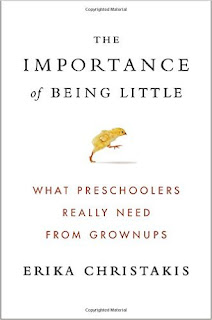
The Importance of Being Little

Image
The Importance of Being Little: What Preschoolers Really Need From Grownups , by Erika Christakis I'd heard great things about this book!  It's been widely praised, and also Erika Christakis is interesting anyway, because if you recall the Yale kerfuffle of Halloween 2015, she was the person who wrote the email suggesting that college students are adults who can choose and police their own costumes.  (I think her email was too long and diffuse, which made it easy to lose the core message.  But anyway.)  Christakis has since left Yale, which, judging by this fantastic book, is their loss. Preschool.  Some parents see it as the beginning of the road to Harvard; others are skeptical but worried.  Important people in Washington say it's the key to better equality and the US should have universal preschool.  On the ground, actual preschool teachers are frequently pressured to do things that they know are not best for their little charges, and they don't...

Up From Slavery

Image
Up From Slavery , by Booker T. Washington A few years ago I read W. E. B. DuBois' The Souls of Black Folk  as part of my Classics Club list and realized that really, I should have read Up From Slavery first, since DuBois was responding to Washington in his book, although DuBois was writing analytical and historical essays on several topics, while Washington was mostly writing a memoir in which he also talked about his ideas.  But then I didn't get a copy for a long time, until a friend of mine traded my DuBois for his Washington.  Once I got started, I didn't put it down and devoured the whole thing as fast as I could. Washington recounts his early life in slavery, and young manhood in freedom.  He wanted desperately to go to school, and mostly persevered despite the difficulties poverty threw in his way.  At last he conceived an ambition to attend a black technical school that he heard would allow students to work for their board.  His determination ...

The End of College

Image
The End of College: Creating the Future of Learning and the University of Everywhere, by Kevin Carey Kevin Carey firmly believes that the future of higher education is largely (or at least a lot) online.  MOOCs are getting better all the time, and so are the verification systems that make it difficult to cheat.  Here comes the future!  He's pretty convincing about a lot of it, and I do think this will happen.  I want it to happen; kids in Uzbekistan and Iowa and Chad deserve access to the educational opportunities available mostly to the relative few fortunate enough to go to an excellent college.  But I have a lot of questions! Carey starts off by taking a course himself: MIT's basic biology course that all students must take.    (You can take it too, for free; just follow the link.)  He gets video lectures, problem sets, interactive protein-folding games--everything that MIT students get, except he can press 'pause' to take better n...

Beauty in the Word

Image
Beauty in the Word: Rethinking the Foundations of Education , by Stratford Caldecott I read Caldecott's Beauty for Truth's Sake a couple of years ago; it's about the Quadrivium, or the four branches of learning (mostly applications of mathematics) that come after the Trivium in classical education.  This book is a followup, or maybe a prequel, because it's about the Trivium as a foundation of education, specifically within a Catholic tradition.  Caldecott was (he just passed away a couple of weeks ago) a very intellectual and very Catholic scholar at Oxford, and really he's a bit above my head.  I think partly I don't quite understand his very Catholic language, but I gave it a good stab and I'll have a go again sometime. Caldecott first talks about child-centered methods of education and making them into something that he thinks would be ideal.  He then tackles the Trivium itself in three sections, equating each branch with certain things.  For example...

The blog you've been waiting for...

Image
In the past few months I've mentioned a few times that I've been working on a group blog project that will focus on classical homeschooling.  Well, it's finally here!  It's still an infant blog, but I hope it will grow and become a helpful resource.  If you're interested, please hop on over to From Sandbox to Socrates and check us out.  And if there's any homeschooling topic you'd like to learn about, please ask and we'll see if we can write a post about it!

A little update

Image
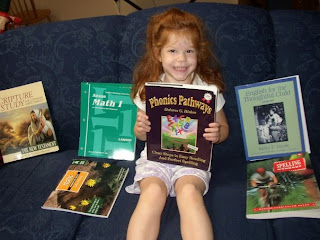
I didn't mean to stay silent for a week!  The only books I've finished have been re-reads of mysteries by favorite British authors.  I have some serious reading going on too, but let's face it--it's really hot, there's a lot going on, and I'm trying to get ready for the start of school, and my brain has not been quite up to facing the Great Depression or Kafka.  Even though they are really interesting.  I haven't even touched the EBB/RB love letters since Monday!  Oh no! What I have been doing is prepping for the start of school in a few weeks, and in case you care, I'll tell you about it.  This is your cue to skip this post if you don't care!   We are due to start in about 3 weeks, and I have done very little over the summer, because by June I always need at least a month where I do not have to think about homeschooling at all.  I do have most of my materials, because I do the bulk of my purchasing in the spring before the old school year ends...

Norms & Nobility

Image
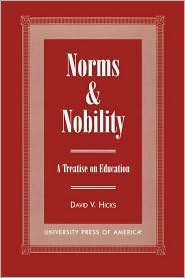
Norms & Nobility: a Treatise on Education , by David V. Hicks I've wanted to read this book for years.  It's one of the foundational texts on classical education.  So it's been on my wishlist forever, but it's also pretty expensive and not that easy to find in a library.  I finally got around to ILLing it, and have been working on it for a few weeks. This is a difficult and heavy text, with a whole lot to think about--even though it's less than 200 pages long.*    Hicks lays out why a classical education is worth pursuing and how to do it (there is a whole syllabus for grades 7-12).  He has a lot to say.  I read it quite slowly, and it would be good to own the book so I can read it again...and then again. I think it's also rather advanced in the world of classical education.  This is not a book for a beginner to read; if I'd tried to read it 10 years ago it would not have made much sense to me.  At that time, The Well-Trained M...

Beauty for Truth's Sake

Image
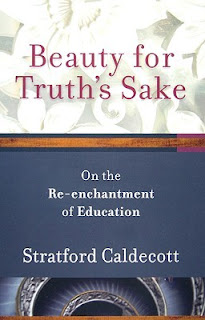
Beauty for Truth's Sake: On the Re-Enchantment of Education , by Stratford Caldecott A fellow classical homeschooler recommended this to me a little while ago.  It's a bit difficult to summarize, honestly, especially because I think I didn't really wrap my head around the first few chapters.  I'm going to have to go back and re-read at least the first half, or just the whole thing.   In essence, Caldecott is laying out his vision for what true education looks like and an argument for the liberal arts.  Caldecott is Catholic, and so this book is as well. Caldecott gives a rundown of the seven liberal arts, the trivium and quadrivium, and chooses to focus most on the quadrivium: arithmetic, geometry, astronomy, and music.  Really, he is concentrating his attention on mathematics and its applications in cosmology.  Most of this book is about the truth and beauty of math, and the importance of math in theology: Music, achitecture, astronomy, and phys...