Posts

Showing posts with the label Jewish literature

CC Spin #33: Motl the Cantor's Son

Image
 Motl, the Cantor's Son , by Sholem Aleichem  I'm late delivering my Spin title, even though I finished it a couple of weeks ago!  I enjoyed this so much.  Various people told me that it was a lot lighter than Tevye the Dairyman , which I read a few years ago, and it definitely was. Motl is a little boy, 8 and 9 years old, telling his story of getting to America -- in installments, because it was published as a serial in a newspaper.  We start in a shtetl in the Russian empire; I'm pretty sure it would be Ukraine now.  Motl's family is poor but cultivated, because his father is Peysi the cantor and a very well-respected man.  After his death, the family is left penniless and Motl's older brother resolves to take everyone to America, 'everyone' being their mother, Elyahu the brother, his wife, his best friend (a comedic bookworm given to declaiming about Columbus), and little Motl.  It's about 1910, the pogroms are getting worse, and America promis...
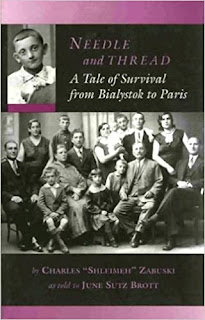
Needle and Thread

Image
  Needle and Thread: A Tale of Survival From Bialystok to Paris, by Charles 'Shleimeh' Zabuski as told to June Sutz Brott I nabbed this memoir from the donation table a couple of years ago.  I nearly always grab any Holocaust memoir I come across, but this one was particularly attractive because I like sewing, and because the author is from Bialystok, which I had read very little about, but remembered because Vasily Grossman's mother had lived there. June Brott wrote down this story through many interviews with her cousin Charles, originally Shleimeh.  They didn't really have a language in common, so it was quite difficult and was a process that took some years.  Charles had never spoken about his experiences and did not want to, but because he was the only member of his family to survive, he decided that it was important that their stories be heard. Shleimeh tells his whole life story; the oldest of 4 children, son of a tailor who had planned to emigrate to Argentin...

How to Fight Anti-Semitism

Image
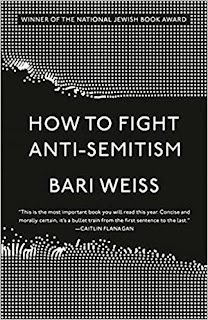
 How to Fight Anti-Semitism, by Bari Weiss  This wound up being kind of timely; I'd just started reading it when the news about the Tennessee school board pulling Maus from the curriculum broke*, and then the whole Whoopi Goldberg/View/Holocaust thing happened, and so I wound up watching interviews with David Baddiel and reading think-pieces about it.** The final part of this book is, indeed, about fighting anti-Semitism, but a good 60% of it comes first, and it's about explaining anti-Semitism for the twisty, sneaky, ever-morphing thing that it is.   There's the Nazi version, which we can still see today in diatribes about Jews "replacing" people and attacks on synagogues.  Weiss actually opens the book with the story of the Tree of Life synagogue attack in October  2018, because that was her parents' own place of worship and community. Then there's a quieter version, in which anti-Semitism is bad, sure, but not as bad as real racism, and very understan...

A Writer at War

Image
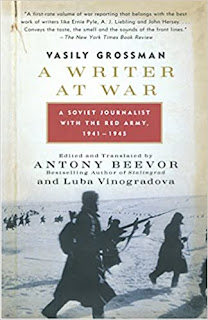
 A Writer at War: A Soviet Journalist With the Red Army, 1941 - 1945, by Vasily Grossman, edited by Antony Beevor and Luba Vinogradova Wow, this book packs a whole lot into what looks like a medium paperback.  It took me much longer to read than I thought it would! Over a year ago, I read a biography of the writer and journalist Vasily Grossman , and this was next on the list of his works that I want to read.   Grossman was attached to the Red Army as a journalist throughout World War II, and he always wanted to be on the front lines.  He was present for the early days of the invasion, the Battle of Moscow, most of the Battle of Stalingrad, the Battle of Kursk, and for much of the Soviet advance through Germany and Berlin.   This book collects Grossman's notes taken down in real time; it does not reprint the articles he wrote for the Krasnaya Zvezda (Red Star) newspaper.  The editors give context to the notes, telling us what's going on and who e...

The Book Smugglers

Image
  The Book Smugglers: Partisans, Poets, and the Race to Save Jewish Treasures From the Nazis: The True Story of the Paper Brigade of Vilna, by David E. Fishman Vilna, in Lithuania, was once "the Jerusalem of Europe" -- the intellectual and cultural hub of European Judaism.   The Nazis tried to destroy it -- not entirely successfully -- and the Soviets just about finished the job.  Fishman gives us a detailed and fascinating history of the Jewish writers, rabbis, and librarians who generated and took care of the books and cultural materials and were then forced to cull through them and decide what should be shipped out and what should be destroyed. Fishman gives us an entire cast of characters, most memorably a duo of poets, Shmerke and Sutzkever, situated in a detailed context of pre-war Vilna.  Communism, fascism, and Zionism are all in the air.  At invasion, the Nazis establish two small ghettos for Vilna's large Jewish population, and choose workers to sort t...

For Two Thousand Years

Image
I love this cover, I do  For Two Thousand Years, by Mihail Sebastian  I only heard of this novel/writer in the last couple of years, and it should be better known!  This is an amazing book, and also sort of semi-biographical.  Sebastian had this charismatic professor who is portrayed in the novel, and he asked him to write the foreword, which he did; but the foreword was a vicious polemic.  Sebastian published it anyway.  And it's not included here, presumably because of the 'vicious polemic' part. This is a diary that covers about ten years (1923 - 33), and the narrator remains unnamed.  He starts as a Jewish university student in Bucharest, and the university houses other students who make it a point to bar Jewish students from classes and beat them up.  Getting to class is an impossible daily ordeal.  Some Jewish students enjoy the street battles and fistfights, and in their dingy dormitory, they discuss Zionism and Communism and so on....

Jews Don't Count (what a title!)

Image
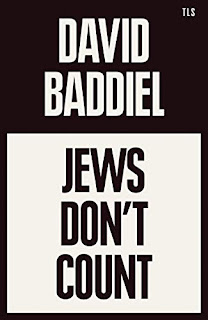
 Jews Don't Count, by David Baddiel I'd never heard of David Baddiel, but I came upon a strong recommendation for this book, and oh it was a good idea.  It's a short book, and it's kind of an angry polemic rather than a carefully constructed argument, and it's riveting reading. So, for my fellow Americans, who the heck is David Baddiel?  He's a British comedian/TV guy/writer who says he's one of the relatively few people in the UK who are famous as Jews.  And this is a very British book!  He talks a lot about famous Brits and events -- about half of the things mentioned were things I'd never heard of.  (Even I know about Jeremy Corbyn and the mural, though.  I'm still not too sure who Piers Morgan is but this week I learned that he is a TV person, not a politician.)  American issues sometimes get in, but this is mostly a very UK book, which means I learned a lot. The premise here is one that I think is completely true.  Baddiel argues that, ...

A Backpack, a Bear, and Eight Crates of Vodka

Image
 A Backpack, a Bear, and Eight Crates of Vodka: A Memoir, by Lev Golinkin Here's my last Russian title for 2020!  It paired very well with the book I read earlier this year, When They Come For Us, We'll Be Gone , which was about the effort to get persecuted Soviet Jews out of the USSR.  Lev Golinkin was a persecuted Soviet Jew who wanted desperately to get out, though he was only a child. So: back in the 1980s, as the USSR was teetering on the brink of collapse -- though no one realized it -- the Golinkin family lived in Kharkov, in the eastern end of Ukraine (it's now known as Kharkiv).  They were Jewish, and that meant that they were publicly despised: the USSR proclaimed the brotherhood of all men, but they still required that your ID card state your ethnicity, and having "Jewish" on that line meant that you were subject to random quota limits and routine persecution.  Lina, the elder daughter, wanted to get into medical school, but the most stellar achieveme...

The Life of Glückel of Hameln

Image
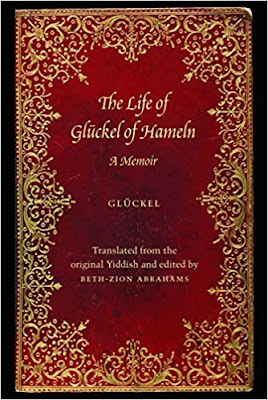
 The Life of Glückel of Hameln: A Memoir, by Glückel I am so glad I ran into this book!  It's truly one of a kind, I think.  I'm surprised I didn't run into it earlier.  It should be more widely known, outside of the world of Jewish history where it's long been a classic. Glückel (1646–1724) was a Jewish-German woman from a Hamburg family.  At fourteen, she was married to her husband and together they ran a successful business and had twelve children.  Her husband died when they were only in their early forties, and she worked hard to keep up the business and marry off her children well.  She was persuaded to marry again, to a wealthy banker, but he lost all their money before dying and she ended her life in poverty.  Glückel wrote her memoirs -- in an early form of Yiddish -- for her children, on nights when she couldn't sleep because she was so sad about losing her beloved first husband.  She wanted them to know where they came from, and wh...

When They Come for Us, We'll Be Gone

Image
When They Come for Us, We'll Be Gone: The Epic Struggle to Save Soviet Jewry, by Gal Beckerman Well, this title took me a little longer than I expected it to!  Embarrassing to relate, I started it in January and got bogged down a few times, especially when we started the lockdown.  For a while I couldn't concentrate well at all, and while it's a fascinating history, it's also a fairly heavy-duty book. This is the amazing history of the struggles of Soviet Jews, and outside efforts to help them.  The dilemma was that, while the USSR didn't really want Jews around, it wasn't willing to let them leave either.   In theory, the Soviets would band together as one; in practice, Jews were always treated as second-class citizens, which kept them out of jobs they were qualified for and made them feel unwelcome.  But if they applied to leave, they would just about always be denied...and would also lose their jobs and social circles.  This meant that even Jews...

Red Cavalry

Image
Red Cavalry, by Isaac Babel First off, I just have to say that visually speaking, this is one of the most awesome book covers in the history of the world and I love it.  Of course, what it actually depicts is terrible; it's a Soviet propaganda poster showing a map of Eastern Europe/Russia, with a giant Red soldier stomping on his neighbors -- specifically Poland -- and the neighbors are mostly depicted as bloated plutocrats and outdated military officers.  So it's not that I like the subject matter; it's just an amazing poster showing the official Soviet message -- an arresting primary source and window into this time. This time is 1919 -1920, when the newly-established Soviet Russia and Ukraine are involved in a war with Poland.  The whole thing is complicated enough that I'm just going to direct you to the Wikipedia page on the conflict , but the very short version is that Poland wanted to extend its territory east, and invaded Ukraine, and the Soviets wanted to...

Vasily Grossman and the Soviet Century

Image
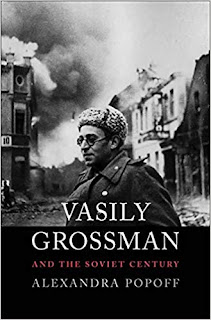
Vasily Grossman and the Soviet Century, by Alexandra Popoff Vasily Grossman isn't anywhere near as well-known as he ought to be.  My plan is to read some of his books, but they're heavy stuff so I thought I'd start with this biography so I could get situated. Grossman was born in 1905, in the Russian Empire, and was educated as a chemical engineer in the USSR.   He changed careers and became a writer and journalist in the 1930s -- he was always trying to tell the truth about what he saw, so his first novel was about the miners he'd known at his job.  He then worked as a journalist attached to the army during the war, and was present through nearly all of the battle of Stalingrad.  He was also one of the first people to witness what had happened Treblinka.  After the war, he had to deal with constant censorship and difficulty, as he spent just about the rest of his life trying to communicate what he knew and believed. He worked on the Black Book of Russia...

The Zelmenyaners

Image
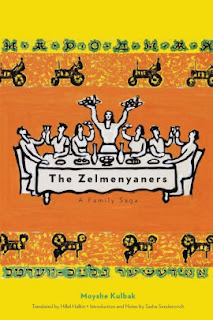
The Zelmenyaners, by Moyshe Kulbak A couple of years ago, I read Outwitting History, about saving Yiddish literature from the dumpster of history.  IT was one of my favorite books of the year, and it put some Yiddish titles on my wishlist.  This was one of them, and I finally picked it up! The Zelmenyaners appeared in a serial format in a Yiddish monthly magazine called Shtern (the Star), published in the Soviet Union.  It was actually two series; the first one ran in 1929 - 1930, and the second 1933 - 1935.  It became a comic family saga, about a Jewish family in Minsk. None of the Zelmanyaners are actually named that.  Their father, Reb Zelmele, has been dead for a while now, but it's still his courtyard, with his descendants all living around in a big house, and little houses, and stables.  Bubbe Bashe is their matriarch, and she's so old she's like a little hen.  The four sons now have children and grandchildren, and so there are Zelmenyan...

The Glatstein Chronicles -- Summer Book 18

Image
The Glatstein Chronicles, by Jacob Glatstein This book took me so much of the summer to read!  I enjoyed it a lot, but it's a long and complex read.  Definitely worth it, though! Jacob Glatstein was a Polish Jew who came to the US at twenty and made a career in journalism.  At forty, in 1934, he traveled back to Poland for the first time to see his dying mother.  The trip inspired two autobiographical stories written in Yiddish (he planned a third) and a determination to warn American Jews about the dangers Hitler posed in Europe.  He spent the next several years hammering away at his message in Jewish publications, frustrated by the lack of response.  The Chronicles contains both memoirs. Volume I, "Homeward Bound," is entirely about the trip to Poland.  Glatstein spends much of the trip spotting fellow Jewish people and sounding them out about Hitler, but he has plenty of time to talk about everybody else, too.  Volume II, "Homecoming ...

Post-summer riffle of reviews: part II

Image
Here is a whole set of books I've read from various countries in the last few weeks.  Most of them will show up in my Reading All Around the World list, and one I picked for August's Women in Translation event, which I nearly missed!  Most of these were also on my original 20 Books of Summer list (which currently stands at 17!  No way will I finish that list in the next week, but I read quite a few other books too). Lyrics Alley, by Leila Aboulela  (Sudan) : This novel of a wealthy and powerful family in 1950s Sudan is a tapestry of interwoven lives.  The patriarch, Mahmoud Bey, is a forward-looking man invested in bringing infrastructure and wealth to his country.  His son, Nur, is about to marry a cousin and they are very much in love, but a tragic accident leaves Nur paralyzed and depressed.  The family dynamics are complex and sometimes disastrous. Nur has to break through the weight of expectations and pity in order to forge a new life and id...

Stolen Words

Image
Stolen Words: The Nazi Plunder of Jewish Books , by Mark Glickman [Aside before this Very Serious Book Post: Last time I blogged, over a week ago, I was all pleased because I had actually cleared my desk of books to write about -- for the first time in at least a year.  Then I had a busy week that involved a whole lot of driving around.  I even went out of town for a few days, which was fun, especially since I really had nothing to do except deliver a kid and then listen to her perform two days later, so I went to a bookstore and generally goofed off.....and now I have six books on my desk and haven't posted a thing for days.  Summer is eating up my time in an even more odious manner than usual; I'm not working, there's no school, and yet I have less free time than before.  How does that work?  We haven't even gone swimming yet!  Well, anyway... ] We all know that the Nazis had every intention of destroying all vestiges of Jewish culture and influence, ...

Bovo-Buch

Image
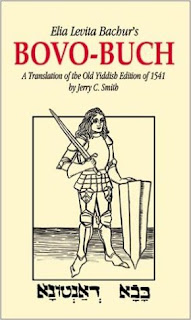
  Bovo-Buch (Bovo d'Antona) , by Elia Levita Bachur Oh, this was so much fun!  Back in the early 1500s, Yiddish-speaking folks liked tales of knightly adventure too.  Elia Bachur (properly, Elijah ha-Levi ben Asher Ashkenazi) was a famous grammarian and linguist in Hebrew, and he also wrote popular Yiddish works under the pen name of Elia Bachur.  He was born near Nuremburg in 1469, but spent most of his life in Italy, where he could more easily pursue his studies.  (Nuremburg expelled all of its Jews in 1499, just a few years after Bachur left.) Bovo-Buch was first written in verse in 1507, but did not see print until 1541, when Bachur's grandsons, Joseph and Elia, decided to print all of his Yiddish works.  Bovo-Buch was the first they printed, and the only one to survive to today.  It became hugely popular.  Two hundred years later it was still going strong, and was reshaped into prose.  By that time it was known as Bove-Mayse and...

Outwitting History

Image
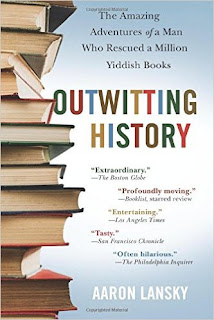
Outwitting History: The Amazing Adventures of a Man Who Rescued a Million Yiddish Books , by Aaron Lansky This is such a fabulous book and I had so much fun reading it!  It's been on my pile for a while now, and I'm only sorry I didn't get to it sooner.  OK, so... In 1980, the study of Yiddish and Yiddish literature was pretty well moribund.  Judaic scholars tended to focus on Hebrew and Jewish history, and considered Yiddish to be kind of an ugly half-language, not really worth preserving.  The Yiddish speakers of the world were elderly, and, having moved to new countries, had not passed on the language to their children.  Aaron Lansky and a couple of other grad students were interested in learning Yiddish, and pretty soon some other young grad student types were joining them, but they couldn't find the books to read.  Where were all the Yiddish books?  Libraries didn't have them any more.  Bookstores didn't carry them.  But they wer...