Posts

Showing posts with the label literary criticism

Four British Fantastists, Boneland, and Sir Gawain and the Green Knight: Some Chaotic Thoughts

Image
Four British Fantasists: Place and Culture in the Children's Fantasies of Penelope Lively, Alan Garner, Diana Wynne Jones, and Susan Cooper, by Charles Butler Boneland, by Alan Garner  Sir Gawain and the Green Knight, trans. by Simon Armitage I've been having one of those times when books criss-cross each other, and most of it was while I was taking a break.  But I really want to talk about them, so call it a themed riffle of reviews... I loved Four British Fantasists so much!  Obviously it's right up my alley, seeing that DWJ and Cooper are two of my favorites.  I've never read Penelope Lively, but this book convinced me to.  If, like me, you are really into at least two of these four writers, you'll enjoy this analysis.  There were lots of wonderful insights, but the part I'll talk about here concerns Alan Garner, who does get a large share of the book because he concerns himself so much with place -- to the point of obsession. The four aut...

Lectures on Russian Literature -- Summer Book 14

Image
Lectures on Russian Literature, by Vladimir Nabokov A few years ago, I read Nabokov's Lectures on Literature , which covers several English and French authors (Dickens, Proust, Austen...) and is a very enjoyable read, though Nabokov is weirdly anti-women authors and really doesn't like Jane Austen at all except for Mansfield Park , which he thinks is wonderful.  I also wanted to read this collection of lectures on Russian literature, but I felt like I ought to know more about Russian literature before I did.  Now that I've read a bit of all the authors he covers (though of course not as much as I would like), I felt like I could tackle this. We start with Gogol, and I got a lot out of that chapter.  I would like to re-read Dead Souls now, armed with some of the insights I got.  The Turgenev chapter is similar and I want to read more Turgenev.  (Odd fact: Turgenev admired Bazarov in Fathers and Sons , and was bewildered by the general reception of his cha...

The World Between Two Covers: Reading the Globe

Image
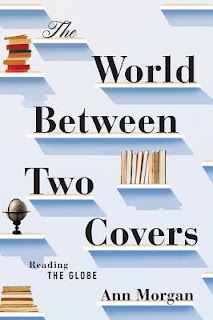
The World Between Two Covers: Reading the Globe , by Ann Morgan You all know I like to read books from all over the world, so I was interested in this title right away.  I thought it would consist of thoughts about literature from all over the world.  Then I was surprised to find that it is actually a blog-project book.  Then I was surprised again to find out that it's not really quite a blog-project book, since it isn't a description of the project; it's more thoughts on what 'world literature' is, what it means to read the globe, and issues pertaining thereunto, which developed as a result of the blog project. A few years ago, Morgan was doing a blog project where she read only women authors for a year, and then she realized that she hadn't read anything not written in English since college.  Her shelves were stuffed with Brits and Americans and a few other English-speakers, and that...was about it.  So she decided to read one book from each country in ...

Off the Beaten Track in the Classics

Image
Off the Beaten Track in the Classics , by Carl Kaeppel A couple of years ago, Dwight the Common Reader did a series of posts on this little book , and it sounded so fun that I put it on my wishlist.  I finally got around to ILLing a copy for myself and it came from all the way across the country, and very glad I am too.  I wish I had my own copy of this fun little book! Carl Kaeppel was a classical scholar from Melbourne who worked in the British Museum (does this therefore count as AusLiterature?), and the book was in fact printed in Australia in 1936, but in association with Oxford, so it happily received wider exposure.  It's a collection of short essays about slightly lesser-known classical works; in fact some of them are lost works that we only know through references and excerpts.  Nearly all of them are about travel or geography somehow. The first essay is on the work of one Gaius Julius Solinus, otherwise known as Polyhistor, who collected wonder-tales...

Spenser's Images of Life

Image
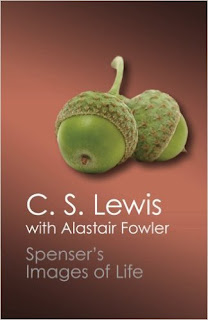
Spenser's Images of Life, by C. S. Lewis and Alastair Fowler This is my final preparation for the Faerie Queene Readalong next month!  Once upon a time, C. S. Lewis left Magdalen College at Oxford and took a chair in Medieval and Renaissance Literature at Magdalene College at Cambridge, where he lectured in English literature for the last years of his life.  (He commuted by train and went back to the Kilns on weekends.)  Lewis had meant to make a book out of his Cambridge lectures on Spenser, but died before he could do so.  His colleague Alastair Fowler took on the job of creating a book out of the lecture notes, and he succeeded well enough that Lewis' own voice still shows throughout.  I first read this book several years ago, before Cambridge brought it back into print, and it made me want to read the Faerie Queene and enjoy it.  I promptly failed, but this time I'm going to do it!  (With the help of o and Cleo and a lot of footnotes.) Lewis...

The Allegory of Love

Image
The Allegory of Love, by C. S. Lewis I first read this, Lewis' first book of literary criticism, at least 10 years ago.  Last year after reading that book about the Inklings I thought I'd like to read it again, but when I took my copy (really my mother's, which I stole) down from the shelf, it seemed practically unreadable; it had tiny type in a 60s era paperback.  So I splurged a little and bought a new copy.  Then when Cleo mentioned it in connection with the Faerie Queene , I realized I really ought to read it before the readalong, not after, so I got going.  It was really nice to revisit, especially since I have now actually read the Romance of the Rose and understand a lot more of what he's talking about. Lewis starts off by explaining that allegory was how early medieval people first started to express psychological ideas, especially conflict.  Much as a cartoon might show an inner moral conflict by means of an angel and a devil on each shoulder, th...

What Matters in Jane Austen?

Image
What Matters in Jane Austen?  Twenty Crucial Puzzles Solved, by John Mullan There is a whole Jane Austen industry, with sequels, prequels, biographies, craft books, novels whose authors realized that just putting the words "Jane Austen" in the title would guarantee a best-seller, zombie spinoffs, and meditations about life.  Amidst all this debris, how do we pick worthwhile Jane Austen-themed books without wading through a sea of junk?  I don't quite know, and so I have mostly not read them, or been disappointed when I did. But this book is different!  This is a truly insightful, valuable, and lovely book about Miss Austen's novels, and I promise that if you are a Janeite, you will adore this book.  John Mullan is an English professor of English, and here, in twenty essays, he asks questions and discusses each novel in that light.  He is quietly saying, "Here, try paying attention to this."  Some of the puzzles: Do sisters sleep in the same bed...

The Power of the Ring

Image
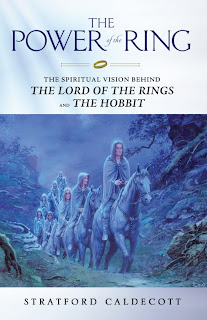
The new edition's cove--not as pretty as mine. The Power of the Ring: the Spiritual Vision Behind The Lord of the Rings and The Hobbit , by Stratford Caldecott InterLibrary Loan is my friend this month, and I've been reading 3 at once.  First to the finish line was this very lovely book by Stratford Caldecott--I am having a Caldecott party lately, since I just read his Beauty for Truth's Sake and just got Beauty in the Word a couple of days ago--and this is an older book, all about Tolkien and not education.  That sentence kind of got away from me there... If you're interested in how Tolkien's faith informed his work, and especially in how his Catholicism comes out in his books, this is the book to read.  There are several books like this actually; I've enjoyed one or two before, but Caldecott points out a lot of things I hadn't run into before.  It was really enjoyable to read, too (although the font used in the edition I read was a little annoying...

From Ritual to Romance

Image
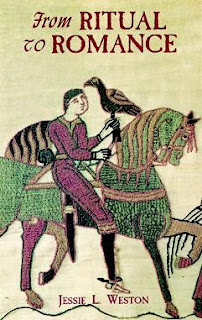
From Ritual to Romance , by Jessie L. Weston I blame T. S. Eliot for this.  References to "The Waste Land" constantly mentioned how the poem was partly inspired by Weston's landmark book about the legend of the Holy Grail, and put me in the mood to read it myself (and the same for Frazer's Golden Bough , which is now sitting by my bed).  I have an old paperback of this book, which I read partway through back in college when I was auditing a course on Arthurian literature because it was given by my favorite professor.  So when I opened the book again, I found a bookmark: a ticket to a 1995 performance of Rosencrantz and Guildenstern are Dead , which I remember enjoying very much.  I must have seen it just before meeting my now-husband. So.  In 1920, Jessie Weston published the result of her decades of study (she was 70 at the time): a sort of anthropological and folkloric study of the roots of the Grail legend, with special emphasis on the mysterious figure o...

Lectures on Literature

Image
Lectures on Literature , by Vladimir Nabokov In 1940, before launching on my academic career in America, I fortunately took the trouble of writing one hundred lectures--about 2,000 pages--on Russian literature, and later another hundred lectures on great novelists from Jane Austen to James Joyce.  This kept me happy at Wellesley and Cornell for twenty academic years. And here they are!  I read the first volume, which is the one not about Russian literature; unfortunately my library doesn't have the second volume, so I will have to get it from somewhere or other.  These are lectures on Austen, Dickens, Flaubert, Stevenson, Proust, Kafka, and Joyce.  Very often they've been sort of reconstituted from notes, and my volume includes reproductions of quite a few pages of those notes--drawings and diagrams as well as writing.  This is a nice addition, but it also makes the volume even heavier and more cumbersome than it already was, so I'm not sure how worthwhile i...