Posts

Showing posts with the label Middle Eastern literature

August Reading: Sprint to the End of Summer, part I

Image
I've got some good reading going on!  Here are the two latest, including my WIT title. Summerbook #15: The Story of Hong Gildong :  This is a Korean classic of literature, and the author is unknown.  For a long time, Koreans were taught that this was the first story written in Hangul, the Korean script, and that it dated from the 17th century, but our translator argues that modern Korean scholarship has found that it dates from the late 19th century.  Anyway, Hong Gildong occupies approximately the same spot in Korean literature that Robin Hood does in English, that of a delightfully tricky noble robber who steals from rich and advocates for the poor, but Gildong has another dimension -- he rebels and argues against Korean laws that, back then, discriminated against illegitimate children.  Hong Gildong's father had a beautiful prophetic vision of having a brilliant son, but this son is born to a lowly concubine, and so despite his intelligence, prowess, and mast...
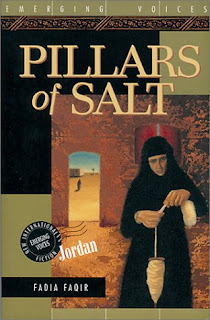
Summerbook #14: Pillars of Salt

Image
 Pillars of Salt, by Fadia Faqir I was saving this novel for August's Women in Translation event, and got halfway through before I looked at the copyright information and realized that Faqir, a Jordanian author, actually wrote this story in English.  So, oops.  Good thing I've got a Spanish mystery so I won't totally miss out on WIT! Two women are imprisoned in a mental asylum, and tell each other their stories.  Maha's life is told in the first person, in flashbacks.  Um Saad narrates her life to Maha each evening when the lights go out, since they aren't supposed to talk.  And a storyteller jumps in every so often to tell Maha's life through his own malicious and gossipy lens. Maha lives on a small farm with her father and no-good brother.  She is delighted to marry her husband, the Bedouin Harb, and they are deeply in love, but he spends most of the time off in the mountains, raiding English camps.  Despite this, the village is talking about Ma...

Tunnels

Image
Two sets of siblings, two ethnicities  Tunnels, by Ruth Modan, trans. by Ishai Mishory I was intrigued by the descriptions of this graphic novel, and I was not disappointed; it's a complex and fascinating read set on the fraught borders between Israel and Palestine. Nili is an unemployed archaeologist, single mom, resident of Jerusalem.  As a child, she helped her dad in his pursuit of his dream; he was convinced that he knew where the Ark of the Covenant was hidden, but the dig was canceled.  The spot is right under an Arab village, that village is behind a huge wall, and no Jewish archaeologists can get anywhere near it.  Now, with Nili's dad lost in dementia, and her brother working for a rival academic, she is determined to find a way to continue the project. Nili winds up with a strangely assorted crew of workers -- Jews, Palestinians, her brother, her son (whose name, inexplicably, is Doctor -- he's 6 or 7 and worryingly addicted to phone games).  As they ...

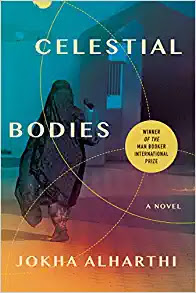
Celestial Bodies

Image
 Celestial Bodies, by Jokha Alharthi This novel has racked up the firsts.  Jokha Alharthi is the first Omani woman to have a novel translated into English, where it then won the Man Booker International Prize for 2019.  It's the first book translated from the Arabic to win that prize.  So, quite a book! This is a generational family novel, all taking place in one tiny Omani village.  And while my experience with multi-generational family sagas is pretty minimal, I think this one is a little different from the norm.  It bounces back and forth in time in a truly disconcerting manner; there are many short chapters focusing on various family members.  The thread that runs through it is a stream-of-consciousness narrative from Abdallah, the son, husband, and father who otherwise barely makes an appearance.  Yet he is a linchpin for the whole thing, right in the middle generation, a connection between families, and more openly emotionally raw than anyon...

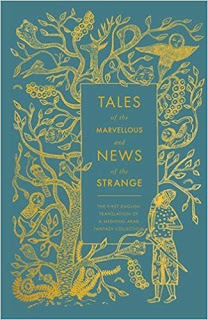
Tales of the Marvelous and News of the Strange

Image
Tales of the Marvelous and News of the Strange: The First English Translation of a Medieval Arab Fantasy Collection This is kind of a neat collection of tales.  They're not from the 1001 Nights , though they may not be a whole lot different.  These stories are from a medieval Arabic manuscript that has lost its original title, but contains the "tales of the marvelous and news of the strange" description on the first extant page.  Penguin made a very nice effort with the book, which is hardbound with a pretty gold stamped design on the cover and matching endpapers. In these stories, young warriors go on quests and kill lots of other warriors.  Beautiful maidens (who are also very well-educated) fall in love and either waste away or emerge triumphant.  Everybody recites poetry a lot.  People end up in prison, or are given lavish gifts, or meet magic animals. It did take me a long time to read this collection, because the stories do get a bit repetiti...

Women Without Men

Image
Women Without Men, by Shahrnush Parsipur It's 1953 in Iran, and it's dangerous out there.  But that's only the backdrop to the stories of five women from Tehran who all wind up in the same villa, in a pretty little town next to a river, where very unusual things happen.  This is a magical realism kind of novel, in fact.  And it also became a famous film. Mahdokht used to be a teacher, but now she just wants everything to be in harmony, so she plants herself in the villa's garden and waits to bloom. Fa'iza goes to see her friend Munis, who she doesn't actually like very much.  (She's hoping that Munis' brother will notice her.)  The two women's lives become intertwined, even though Munis has died a couple of times and can now hear the thoughts of others...they end up together at the villa. Farrokhlaqa, middle-aged housewife, is now a widow with ambitions in local politics.  She lets the others live with her in her new villa, and tries to write...

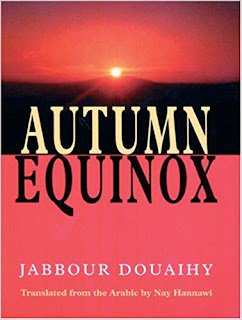
Autumn Equinox -- Summer Book 4

Image
Autumn Equinox, by Jabbour Douaihy In Lebanon, in the mid-80s, an unnamed young man writes in his diary.  He has studied in the US and sometimes writes to the girl he met there, but since he doesn't know her address and she can't write to him anyway, he's sending his letters into a void.  He has no job.  He's trying to improve his life -- he makes his mom and sister sit for three formal meals a day, throws out nearly all his books, and practices sitting so that he'll look confident.  All summer, as violence simmers under the village's ordinary life, he makes strange attempts at normalcy and writes about his life and his relatives, and his diary ends on the autumn equinox. This is kind of a quiet but odd little novel, and although it's set in the middle of the Lebanese civil war, that war only breaks in to the story a few times.  The diarist seems like an ordinary young man at first, but his actions get stranger as the summer goes on.  Various quotation...

The Conference of the Birds

Image
The Conference of the Birds, by Farid ud-Din Attar, with Rafiq Abdulla It was only after I read this book--introduction and all--that I figured out that it's really selections from a longer poem.  It's only mentioned in one spot that I nearly missed!  So now I feel kind of dumb, but I did enjoy the poetry and maybe someday I'll find the whole thing.  I have no idea how long it is. The Conference of the Birds is a Sufi poem, a sort of allegory of humanity's journey to God.  All the birds of the world meet together, and the hoopoe encourages them all to look for the Simurgh, the King of Birds--that is, God.  The hoopoe is their spiritual leader, wiser than the rest, and he tells them that the journey is long and difficult, but nothing else is worthwhile. The birds are at first happy enough to look for the Simurgh, but when they realize how arduous the quest will be, they start dropping out and giving excuses.  The sparrow is afraid, the owl doesn't h...

The Story of Layla and Majnun

Image
The Story of Layla and Majnun , by Nizami Layla and Majnun is one of the world's great love stories, akin to Romeo and Juliet or...Aeneas and Dido, maybe.  The story dates from around the 7th century AD, and various versions of it were floating around until Nizami, a Persian poet, collected and shaped the material into one long marrative poem in 1188.  After that, the story's popularity spread across a couple of continents and is still influential today.  The introduction in my copy speculates that the lovers may have been real people who became legendary. Layla and Qays know each other from childhood; both are Bedouin, though belonging to different tribes.  They fall in love as children, but when they grow older and Layla's parents realize that she is already attracting boys, they keep her sequestered in the family tent.  Layla, imprisoned, must act as though all is well.  Qays, however, starts reciting poetry in public and acting like a madman, whi...

Arabian Nights and Days

Image
Arabian Nights and Days , by Nahguib Mahfouz After Shahrzad succeeds in telling her story for three years, and gives birth to a son, and stops the sultan from killing a new bride every morning...what happens then? In chapter-long episodes, we follow the fortunes of the sultan's city and people, who frequently come under supernatural influence.  A pious man is beset by a genie, who orders him to kill the corrupt chief of police.  Two evil spirits produce a wedding night for a young couple and then separate them.  A man is given a cap of invisibility, but ordered not to obey his conscience in using it.  A man is beheaded for corruption, but deposited into a new body.  Finally the sultan himself sees amazing wonders. It's written in a style very much like the 1001 Nights , and many of the characters have a strong tendency to speak in aphorisms and proverbs--sometimes for entire conversations. I liked this quite a bit more than my previous Mahfouz attempt , ...

My Uncle Napoleon

Image
Fabulous cover! My Uncle Napoleon , by Iraj Pezeshkzad A large Iranian family lives in a compound of houses surrounding a garden, and they're ruled over by the patriarch, Dear Uncle.  He has so much admiration for Napoleon, and so much conviction that his own life mirrors that of the French general, that the kids call him Dear Uncle Napoleon.  In fact he is narrow, paranoid, and blustering; he's convinced himself that he was a great warrior against the English in his youth, and the whole family revolves around his tyrannical bad temper. And the narrator, a young boy who is never named, falls in love with Dear Uncle's daughter Layli. Unfortunately, the boy's father has a bit of a feud going with Dear Uncle, and spends most of the novel encouraging his paranoia about the English.  Boy's only confidant is his Uncle Asadollah, who is sympathetic, but also has a one-track mind.  His solution is always the same--"a little trip to San Francisco," which ...