Posts

Showing posts with the label medieval

Fall TBR Reading

Image
 Here are some titles from my official TBR list that I just haven't written about yet!  Mexican Gothic, by Silvia Moreno-Garcia : I saved this one for October, for an official RIP read.  And wow, this is a spooky story!  It's the 1950s, and Noem í is a debutante out for a good time in Mexico City.  Her father sends her down to the countryside to check on her cousin Catalina, who married last year in a romantic whirl.  Noem í arrives at a classic Gothic scene: a mouldering family mansion on a misty mountain, and....this is a strange place.  The silver mine that gave the Doyle family their wealth has been closed down for years, the house is festooned with mold, and everyone is very strange.  Catalina seems to be ill.  Her husband Virgil is creepy, but not as creepy as his elderly father is.  Just one family member, Francis, seems friendly, if shy and something of a weak character.  As Noemi unravels the dark family history and the se...
The Imitation of Christ

Image
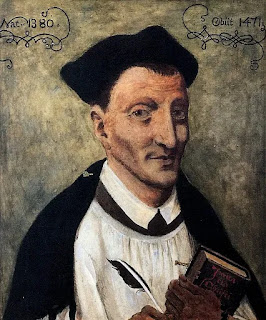
  The Imitation of Christ, by Thomas à Kempis This book has been on my Spin list so many times, but it never gets picked!  However, one of my classics challenges said to pick the title that has been on your TBR pile the longest, and I think this one is it. Thomas Hämerken (Haemmerlien), of Kempen, Germany, was born in 1380 and died in 1471 -- that's a pretty long run!  His devotional book was written in Latin and appeared in 1470.  It was translated into English just about 30 years later.  The translation I read in an old Oxford classics edition dates from 1613 -- at first I assumed it was written in KJV-style English as an affectation to sound Biblical, but no, it's actually written in the English of King James.  And as a fun aside, my copy contains an inscription from 1943 from the president of Trinity College in Texas.  It was given to a lady named Grace, and since she dated her highlights and notes, I know that she must have read it several times...

Summerbook #5: A Connecticut Yankee in King Arthur's Court

Image
  A Connecticut Yankee in King Arthur's Court, by Mark Twain Oh gosh, it is so long since I read this tall tale that I had forgotten everything except that Trina Schart Hyman did wonderful illustrations, and there's a lot about slavery.  So earlier this year I put it on my pile of books to read soon, and it was so much fun.   This story is a bit of a mish-mash, really.  It started as a send-up of romantic medievalist tales after Twain had a dream in which he was a knight-errant himself -- but how do you scratch an itch in armor, much less do your private business?  Where do you keep your hanky?  Don't you clank a lot in church?   So Twain took a downright, hard-headed, democratic-minded mechanical man, Hank Morgan, and imagined how he would modernize Camelot according to his desires.  Surely a man who knows how to manufacture gunpowder and telegraph wire would be able to get up to a lot of mischief!  But then, a modern man also has ...

Some pre-Shakespearean plays

Image
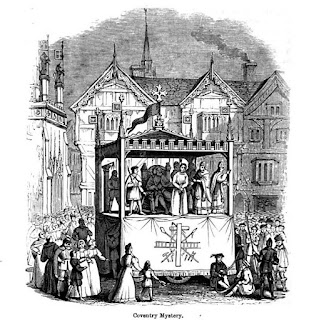
Selections from Specimens of the Pre-Shakespearean Drama , vol. I, ed. John M. Manly That 2020 TBR challenge that I'm not officially doing said that in March, I could take the TBR book that had been there the longest.  As far as I could figure, this was that book.  I bought it in about 1994 from the UC Berkeley Library, which had discarded it from the Moffitt Undergraduate Library (my least favorite library on campus, which is now a bunch of fancy group study rooms with no books at all).  It is a two-volume set, with a date of 1897 on it, and has a bookplate in it for one George Hubbard Savage, complete with family crest (on right!) and motto ("A te pro te"). This volume contains the fun stuff in the dual set: a whole bunch of medieval mystery plays, in which various guilds would depict a piece of the Bible;  some Robin Hood and St. George plays, and a sword play.  I wanted to read some of those, not the whole thing all in one go. I read the "Norwich Wh...

Tales of the Marvelous and News of the Strange

Image
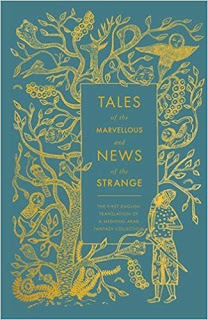
Tales of the Marvelous and News of the Strange: The First English Translation of a Medieval Arab Fantasy Collection This is kind of a neat collection of tales.  They're not from the 1001 Nights , though they may not be a whole lot different.  These stories are from a medieval Arabic manuscript that has lost its original title, but contains the "tales of the marvelous and news of the strange" description on the first extant page.  Penguin made a very nice effort with the book, which is hardbound with a pretty gold stamped design on the cover and matching endpapers. In these stories, young warriors go on quests and kill lots of other warriors.  Beautiful maidens (who are also very well-educated) fall in love and either waste away or emerge triumphant.  Everybody recites poetry a lot.  People end up in prison, or are given lavish gifts, or meet magic animals. It did take me a long time to read this collection, because the stories do get a bit repetiti...

Four British Fantastists, Boneland, and Sir Gawain and the Green Knight: Some Chaotic Thoughts

Image
Four British Fantasists: Place and Culture in the Children's Fantasies of Penelope Lively, Alan Garner, Diana Wynne Jones, and Susan Cooper, by Charles Butler Boneland, by Alan Garner  Sir Gawain and the Green Knight, trans. by Simon Armitage I've been having one of those times when books criss-cross each other, and most of it was while I was taking a break.  But I really want to talk about them, so call it a themed riffle of reviews... I loved Four British Fantasists so much!  Obviously it's right up my alley, seeing that DWJ and Cooper are two of my favorites.  I've never read Penelope Lively, but this book convinced me to.  If, like me, you are really into at least two of these four writers, you'll enjoy this analysis.  There were lots of wonderful insights, but the part I'll talk about here concerns Alan Garner, who does get a large share of the book because he concerns himself so much with place -- to the point of obsession. The four aut...

Summerbook #18: Lais of Marie de France

Image
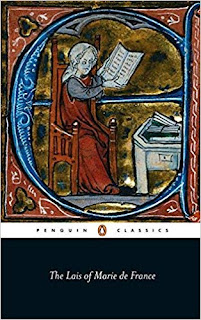
The Lais of Marie de France I didn't know anything about Marie de France, and I wanted to find out, so here we go.  Marie is the earliest French woman poet we know of, and she was writing in the late 1100s.  It seems that she was born in France and then moved to England, and we do not know her real name.  She just said (in Old French) "My name is Marie, and I am from France," and that's what we've got.  Scholars have looked at several Maries of the day, but there is no certain identification.   She was almost certainly known at the court of Henry II and Eleanor of Aquitaine, and her poems were popular in  aristocratic social circles. Marie wrote "lays," that is, narrative poems of a few hundred lines each, and they were based on Breton tales.  We have twelve of these stories.  The majority of them are about knights who fall in love with ladies, or vice-versa, and how they evade one or more spouses in order to carry on affairs.  One lay ...

Summerbook #16: Hartmann von Aue

Image
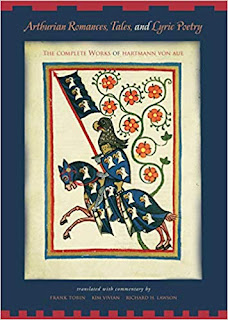
Arthurian Romances, Tales, and Lyric Poetry: the Complete Works of Hartmann von Aue This is a long-held goal of mine, to read the complete works of Hartmann von Aue!  I did, some time ago, get hold of a (terrible) copy of Poor Heinrich, which is how I found out about this medieval German knight and poet.  I shall now quote my own blog post for background: If you were here for my Arthurian literature project of 2014, you know that the mania for knightly romances and Arthurian tales spread through Western Europe in the 1100s.  I read French and German tales as well as English ones.  There were three great German poets of the courtly romance: Wolfram von Eschenbach wrote Parziva l , and Gottfried von Strassburg wrote Tristan , but before them came Hartmann von Aue, who introduced the idea into Germany in the first place in the 1190s.  He has not become nearly as well-known in English as the two later poets... This volume contains Hartmann's four narr...

Memoirs of the Crusades

Image
Memoirs of the Crusades, by Geoffroy de Villehardouin and Jean de Joinville I've had this kind of ancient Everyman paperback book on my shelves forever, and it's high time I got around to reading it.  The trouble is, while I love medieval literature, I find war stories -- that is, accounts of battles -- to be fairly boring, so it was hard to pick up.  But really, these memoirs were pretty fun to read and contained some entertaining moments amid the incredible misery of Crusader life.  Neither Villehardouin nor de Joinville are all that interested in recounting miseries; they skim over a lot of that.  Being in charge probably helped that part too. Both of these men were French (Franks, in their terms), and highly placed in their homelands and in the crusading hierarchies.  They served in different crusades and went to completely different locations, and neither of their crusades accomplished the stated goal of conquering Jerusalem (again). Villehardouin wa...

The Macclesfield Alphabet

Image
The Macclesfield Alphabet Book: a Facsimile , ed. Christopher de Hamel and Patricia Lovett After reading Meetings With Remarkable Manuscripts , I wondered what else de Hamel might have produced, and I found this neat book!  With the magic of InterLibrary Loan, it was soon in my hands. This is a facsimile of an unusual manuscript.  It's not very long, and it dates from the late 1400s.  It's a sort of design or idea book for the fancy initials in illuminated manuscripts!  It contains fourteen different kinds of decorative letters: a sort of blackletter type, several with leaves, and some very whimsical alphabets made of human and animal figures.  Most aren't colored in or anything; they're diagrams. It's a lot of fun to look at and full of great design ideas.  I'm very tempted to use some of them in embroidery, and maybe someday I will (I've got plenty to do right now).  If you're interested in lettering, this is a great resource!

Meetings With Remarkable Manuscripts

Image
Meetings With Remarkable Manuscripts: Twelve Journeys Into the Medieval World , by Christopher de Hamel I had such a wonderful time with this book!  I actually started it in late 2017 and decided it would have to be my favorite book of the year, but then I was reading it so slowly (to make it last, and to absorb it properly) that I didn't finish until a couple of weeks ago, by which time I was so busy and frazzled that blogging sort of fell off the map for a while.  But now I can tell you about it!  Hooboy, this was such a fabulous book. Christopher de Hamel is one of the bigger names in the world of medieval books (or so I gather), and he's written several things for a lay audience.  In this very long book, he travels around to twelve really neat manuscripts and does an in-depth...interview...with each one, describing the history of the book, how it got where it is now, what's in it, lots of information about the writing and art, and plenty of yummy details....

Merlin and the Grail

Image
Merlin and the Grail: Joseph of Arimathea, Merlin, Perceval , by Robert de Boron It's Witch Week!  The focus this year is on Arthurian literature, a favorite of mine, and so I read Merlin and the Grail , which I've been saving up for a treat.  This one was new to me, and I found out that it's an important piece in the Arthurian jigsaw puzzle, so read on. We don't know much about Robert de Boron, but he was writing right after Chretien de Troyes, around the 1180s, and he was the first writer to write the Arthurian cycle -- the whole story from beginning to end.  He managed to smush the important elements into just three tales (two, really), and he added a whole lot as well with Joseph of Arimathea .  He also converted the Grail into an overtly Christian relic. Chretien had a Grail that was a kind of platter, which served a host, and there was a spear dripping blood; these were obviously Christian allusions.  Chretien's audience would have immediately thoug...

The Treasure of the City of Ladies

Image
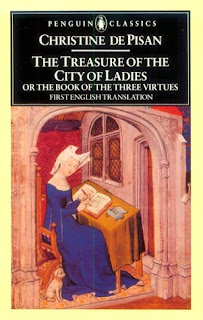
The Treasure of the City of Ladies , by Christine de Pisan I love Christine de Pisan so much, I cannot even tell you.  I discovered her Book of the City of Ladies several years ago, and it's a must-read if you like medieval literature.  Widowed at 25 with three children, a mother, and a niece to support, she became a professional writer to pay the bills, but she did it in about 1390.  She started with lyrics -- your standard love ballads and so on -- and then moved into longer poetic and historical works.  The popularity of the Romance of the Rose inspired her to argue with the misogynistic portrayal of women in Jean de Meun's part of the poem and she took a large part in "the debate of the Romance of the Rose," a literary and scholarly correspondence with various other writers.  In 1404 she wrote the Book of the City of Ladies as her public answer to the whole question of women.  In the next year, she wrote this 'sequel,'  of which more anon....

Eneas

Image
Eneas: a Twelfth-Century Romance , translated by John Yunck Storytime: way back in college when I was taking literature classes, one of my favorite classes was on medieval literature, and it was taught by one of my favorite professors, who had a newly-minted Oxford PhD and probably not much familiarity (yet) with Berkeley students.  She threw a mass of really weird stuff at us, which in retrospect was probably not the usual kind of fare for an average introduction to medieval literature -- though of course I had no idea at the time.  We started with the Aeneid , because it was so admired and emulated, and then at some point we read Eneas , a medieval re-telling of the Aeneid that is also really the first of the French romances.  The author took the old-fashioned chansons de geste about heroes (like The Song of Roland ) and combined them with the new fashion for romantic love and psychological evaluation.  So this story features Sir Eneas, the prince and knight, a...

The History of the Franks

Image
  The History of the Franks , by Gregory of Tours I was pretty scared of this book, which is a solid 600 pages of early medieval history.  I should not have been nervous at all, because this history is crammed full of gripping stuff!  Feuds, intrigues, miracles, and weird stories spill out all over the place.  I had about as much fun with this as it is possible to have with 600 pages of early medieval history. Gregory was the bishop of Tours in the late 6th century, during the Merovingian dynasty of Frankish kings.  He served through four reigns.  His history is in ten books, and starts with the creation of the world, moving to Frankish history, and then to the history he personally witnessed.  Of course he wrote in Latin. Book I is a summary of Biblical history, pretty much, except that Gregory continues through early Christian history up to the death of St. Martin of Tours in 397.  I will admit to skimming this one, since I am already pr...