Posts

Showing posts with the label drama

A sudden pile of books

Image
 Hey everybody!  I disappeared for a while there, and I'm not quite sure what I am going to do, but I'll tell you about it.  My reading mojo disappeared; I mean, it took a long vacation and I wondered if it was coming back.  I think it had mostly to do with my husband's layoff back in January; worry took up most of my brainspace and there was not much left over.  I could read the fluffiest mysteries, and Diana Wynne Jones.  I read something like eight of Anne McCaffrey's Pern novels, would you believe -- I liked those when I was around 13.  But I couldn't seem to keep up with blogging, or anyone else's blogs, or read anything new or in the least challenging.  I saw the CC Spin and I just couldn't do it!  Instead I embroidered things and played too much on my phone. A couple of weeks ago, my husband got a nice contracting gig, and I instantly felt much better.  Pretty soon my reading came back, and with renewed energy -- I read two Shakes...
Some pre-Shakespearean plays

Image
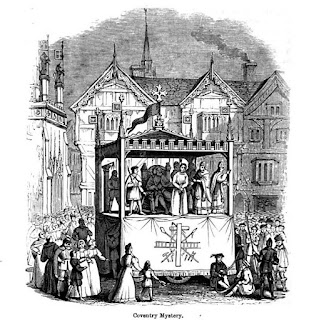
Selections from Specimens of the Pre-Shakespearean Drama , vol. I, ed. John M. Manly That 2020 TBR challenge that I'm not officially doing said that in March, I could take the TBR book that had been there the longest.  As far as I could figure, this was that book.  I bought it in about 1994 from the UC Berkeley Library, which had discarded it from the Moffitt Undergraduate Library (my least favorite library on campus, which is now a bunch of fancy group study rooms with no books at all).  It is a two-volume set, with a date of 1897 on it, and has a bookplate in it for one George Hubbard Savage, complete with family crest (on right!) and motto ("A te pro te"). This volume contains the fun stuff in the dual set: a whole bunch of medieval mystery plays, in which various guilds would depict a piece of the Bible;  some Robin Hood and St. George plays, and a sword play.  I wanted to read some of those, not the whole thing all in one go. I read the "Norwich Wh...

A Tempest

Image
A Tempest, by Aimé Césaire  Aimé Césaire, born 1913 in Martinique (which is still officially French), became a world-renowned dramatist and poet; he, along with his friend the poet Damas, established the idea of "Negritude," that black people did not need to assimilate into European culture, but had valuable cultures of their own to contribute to the world.  Leopold Senghor was the leader of this movement; I read some of his poetry in 2014 .  This was an anti-colonialism black pride movement, largely in the areas that had been colonized by France, in the 1930s - 1950s.  A Tempest was published in 1969. Césaire's play is an adaptation of Shakespeare's Tempest which casts Ariel as mulatto, and Caliban as black, both enslaved by Prospero, who has arrived on their island and taken illegitimate possession of it.  Ariel works hard for Prospero, always hoping for his long-promised freedom and trying to appeal to Prospero's conscience, while Caliban has given up wa...

Othello

Image
Othello, by William Shakespeare Erica at The Broken Spine has been hosting the tragedy part of the Year of Shakespeare, and so I thought I'd sign up for a couple titles.  I decided to read Othello , and hope to read Antony and Cleopatra too, before the end of the year. (The trouble I always have with writing blog posts about famous classics is...what do I say?   It's not like I'm going to tell you something you don't know.) Othello is a newish and excellent general in Venice, and he's a Moor.  He's been winning battles and impressing everybody, and he's just secretly married the lovely Desdemona, daughter of one of Venice's senators.  His ensign, Iago, hates Othello because the general promoted a younger man, Cassio, above him, and vows to have his revenge upon all of them with the help of the dissolute Roderigo, who wanted to marry Desdemona. Iago plays upon Othello's jealousy, implying that he knows that Desdemona is having an affair wi...

RIP XIII #2: The White Devil

Image
The White Devil, by John Webster I'd been meaning to read this play for some time, for reasons which shall be explained hereafter.  Then I needed a classic with a color in the title for the Back to the Classics Challenge, and soon a really nice copy came across the donation table, and so I put it at the top of the pile.  Seemed appropriate for RIP... This is a Jacobean revenge play, performed in 1612, and was a complete flop at the first performance.  Webster blamed this on the audience, which made me raise an eyebrow, but it did in fact do better in 1630.  I found it pretty difficult to read, though; Shakespeare is easier.  This may possibly be because Shakespeare is already familiar..but Webster is hard!   There are a zillion double entendres, the language is extremely tricky, and everybody has Italian names that are too similar.  Keeping everybody straight was part of the problem. The story is based on an actual event in Italy that happened ab...

Jim Henson

Image
Jim Henson: The Biography, by Brian Jay Jones A couple of weeks ago, I took my 15 year old to see Labyrinth playing at the movie theater.  It' s one of my favorite movies and we had a great time.  That put me in the mood to read the Jim Henson biography I've been meaning to read for a couple of years now, so I brought it home from work and wound up enthralled, more so than I'd expected.  I'm a big Jim Henson fan. It's a solid, thorough biography that chronicles Henson's family background and childhood, but really gets detailed when he hit college.  Henson's ambition was to work in television, and in the mid-50s, of course there was no such thing as college coursework aimed at a career in TV.  He wound up a home economics major because that was where a lot of the hands-on stuff was happening, and he fell into puppeteering as a way to get started in TV.  Henson had no intention of being a puppeteer forever; that was just what happened. Jones takes the...

Isis

Image
Isis: a play by Nawal El Saadawi Nawal El Saadawi is an Egyptian writer (and physician too) who has been fairly prolific over her long career.  She has focused a lot on women's issues -- FGM in particular -- and has been imprisoned and exiled for her anti-religious and feminist writing.  Until I started writing this post just now, I was under the impression that I had read one of her novels in the early days of this blog, but it seems our library did not own her works at that time and I didn't read it after all....so I'm a newcomer. Isis is the earliest of El Saadawi's seven plays and was written in 1986 in Egypt.  El Saadawi seems to identify a good deal with the ancient Egyptian goddess; she titled her memoir A Daughter of Isis (as in, she considered her actual mother to be Isis-like), and calls her a "personal muse." In the play, Ra has taken over all of creation and thrown out Geb (god of earth) and Nut (the sky goddess).  Ra insists that he is t...

Spin title: Henry IV, Part 1

Image
Henry IV, Part 1 , by William Shakespeare My Spin title!  It wasn't exactly a 'scary' one, but I wasn't too excited either; I'm more looking forward to Part 2.  But here we go...this play is second in a line of four, after Richard II and before Part 2 and Henry V. Henry IV is king of England, but the story is really more about his son, Prince Hal -- the future Henry V.  It's set in 1402-03, and we have a couple of major plot lines that converge.  The king won't do as the powerful Percys wish, and he threatens young Hotspur (Henry Percy, and about the 4th Henry in the play), who decides to foment a rebellion.  Meanwhile, Prince Hal is spending all his time hanging around inns, drinking with commoners, and generally causing consternation at court.  He's always with Sir John Falstaff, a corrupt old knight who prefers carousing to all else, and everybody is wondering if the Prince is going to be able to do his job.  The Prince's plan is to quit this...

Ajax

Image
Ajax , by Sophocles I really needed just one more classic for a challenge, and it was a tricky one -- an award-winner, published before 1967.  But I wasn't in the mood for a Pulitzer or a Newbery, and prizes weren't being given out in most of my favorite historical periods.  What to do?  O gave me the answer: a Greek play!  Sophocles never got less than second place.  So I picked a play I'd never read before, and voila!  An award-winning classic. Poor Ajax.  He's the strongest and most mighty warrior around, but his pride has been hurt.  Achilles has just been killed, and Odysseus and Ajax both claimed his armor.  In the argument, the wily and smooth-tongued Odysseus naturally managed to convince all of the Greeks that the armor should be his.  The play opens after this; Ajax feels he's been dishonored, and he has every intention of killing not just Odysseus, but the leaders of the expedition who allowed the whole thing to happen....

Boris Godounov

Image
Boris Godounov , by Alexander Pushkin A year or so ago, I was browsing in the used bookstore and found this great edition of Boris Godounov by Pushkin, illustrated by Zvorykin.  But it was kind of on the pricey side, so I thought I might get it later...and then of course it wasn't there any more, and I regretted everything.  But!  Then I started this volunteer job sorting used books for the library, and the very first thing that happened was that the same book came across the table!  So I finally got to read it, and for free too.  It turns out to have a companion volume of fairy tales, so I'd like to get that as well. Boris Godounov is a play written in blank verse, but I think more people are familiar with it in the Mussorgsky opera based upon the play.  (Comment and tell me!)  It's a historical play, and I had to learn some Russian history before I could make head or tail of the story.  The quick version: Ivan IV (the Terrible) murdered...

The Glass Menagerie

Image
The Glass Menagerie , by Tennessee Williams It's my second Tennessee Williams play!  Next thing you know, I'll be reading Cat on a Hot Tin Roof . This is an intense family play that makes you feel shut in.  It has only four characters and takes place entirely in the family apartment, and is narrated by the brother Tom from years later.  Amanda, the mother, is a former belle who loves to reminisce about her beaus, because now she works hard to make ends meet and worries all the time about what will become of her children.  Tom, an aspiring poet, works in a warehouse to support the family but is dying to get out and get free.  He spends all his time out 'at the movies.'  Laura is very fragile and cripplingly shy; she dropped out of high school and then secretarial school, hardly ever goes out, and spends much of her time polishing her collection of glass animals. Amanda hounds Tom into bringing home a coworker, Jim, in hopes that Laura will find a bea...

The Threepenny Opera

Image
The Threepenny Opera , by Bertold Brecht When I first put my Classics Club list together, I pulled from a lot of pretty random sources and I put some things on the list that I'd vaguely heard of, but didn't know anything about.  That way, I'd learn new things!  (This is kind of how I operate in a lot of areas.)  Somehow, I wound up with two Brecht plays on my list, and what I've mainly learned from that is that I do not like Bertold Brecht.  So now I've learned some new things, yep. The Threepenny Opera is a musical play that was based on the 18th century Beggar's Opera by John Gay.  Although it was originally written in German (during the inter-war period), it's set in Victorian London.  It's supposed to be a savage commentary on capitalist bourgeois society from a Socialist standpoint.  It was a big hit in Germany.  Critics in the baby USSR loved it.  Americans liked the music, but not a lot else; one critic called it "a dreary enigma...

Our Town

Image
Our Town, by Thornton Wilder The introduction to Our Town says that a lot of students read, or see, the play when they're younger--in junior high--and they tend to think it's schmaltzy.  I was lucky, I guess; I've never seen or read Our Town at all, and so only got to read it as an adult.  It made me think of that song from Fiddler on the Roof , "Sunrise, Sunset."  When I was a kid I thought that was the dumbest, sappiest song on earth.  Now I cry every time I hear it, because some things you only get when you've been around for a little while. Our Town is a simple, stripped-down play, set in a small town in around 1900.  The three acts take place years apart.  A narrator comments on events, pointing out the daily routines in the background, and the events going on all the time.  Emily, who emerges as the main character, appears as a child, a teen, and a young bride.  In the third act, she has died, and she meets all the other dead folks i...

Three Plays by Karel ÄŒapek

Image
Three Plays by Karel ÄŒ apek I read R. U. R. a while back, and I wanted to read the other three plays in the book, but I didn't get around to it for quite a while.  Silly, because they are pretty neat. The Insect Pla y: an entomologist observes several different kinds of insects, who illustrate types of humanity.  Butterflies are flirtatious Bright Young Things with just one thing on their minds; dung-beetles only think about gathering wealth, while crickets are all about family, and ants have a fascist war-machine going. The Makropulos Case : a lovely singer captivates everyone she meets.  Men all want her; women all want to be her, but she is incredibly cold and unfeeling.  It's about mortality and the necessity of death. The White Plague : a new illness, which looks like leprosy but only attacks those over fifty, is becoming an epidemic.  No-one can escape, and it's always fatal.  A young slum-clinic doctor develops a cure, but he will only gi...

Galileo

Image
Galileo, by Bertolt Brecht Hey, everybody--I've been reading a good bit, but blogging has been just about impossible lately.  Still, I've got plenty to tell you and I'm determined to have my say for Elizabeth Goudge Week (starts today!) and Trollope's birthday month (go enter the giveaway!) before it's over. And now, to Bertolt Brecht's famous play, Galileo ... I've figured it out.  It's all Brecht's fault.  I blame him.  Or at least partly.  It's Brecht's fault that everybody thinks that medieval people were anti-science and all that.  Because he wrote this play, which shows Galileo kind of knuckling under to the evil Catholic Church because of cowardice, and we've all seen that scene acted out....  But!  Brecht wasn't the least bit interested in showing a historically accurate Galileo.  In fact, he happily gets a whole lot about Galileo's actual life quite wrong.  What Brecht was interested in was using the Galilean ...

R. U. R.

Image
R. U. R. by Karel Capek I was really looking forward to reading this play.  I have a collection of four Capek plays here and plan to read them all; they sound intriguing.  I first got hooked by R. U. R. , when I found out that not only did it introduce the word and concept of robot* to the world, it also invented the robot apocalypse! The story is that Reason's Universal Robots is a successful company that produces robots--mostly-organic workers with limited intellect and no will or emotion who are grown and constructed.  The owner dreams of a day when there will be such abundance in the world that there will be no poor and no-one will have to work hard for a living--the robots will do it all. Lady Helen, young and elegant, comes to visit on an ideological crusade to educate the robots; she feels certain that if they are treated well and taught, they will be people.  She is disappointed to find that the robots are totally unresponsive to emotional persuasion a...

Faust (Part I)

Image
Faust (Part I), by Johann Wolfgang von Goethe Goethe seems to have made his play about Faust the great work of his life.  He started writing pieces of it in the early 1770s, when he was in his early to mid-20s, published a preliminary version in 1808, and continued revising it until 1828 or so, when he published a final version.  That's Part I, which is what I read.  Part II took up most of Goethe's attention during his later years and was finished in 1831. Goethe's version is very different from Marlowe's, which I read several months ago.  It starts with a framing device that echoes the book of Job; the devil makes a bet with God that he can lead the virtuous scholar Faust astray.  When Mephistopheles arrives on scene in the form of a large black dog, Faust is already complaining that earthly knowledge is not enough and that he wishes to delve into the deeper knowledge afforded by black magic.  Mephistopheles has no trouble convincing him to agree t...

Henry V

Image
Henry V , by William Shakespeare  I've been wanting to read Henry V for a long time; I never have before, so I wanted to fill in that gap.  Everybody knows what happens--I don't like writing posts about Shakespeare plays because I feel like whatever I say, it's kind of pointless.  However, just in case, this is a "historical" play about the young Henry V, his claim to own all of France, and his campaign to win it.  In a surprise fluke, the English actually defeated the numerically superior French at the battle of Agincourt, for God, Harry and St. George. Even though I knew what to expect in the plot of Henry V , I had a really hard time getting into it.  My daughter and I got out the DVD of the movie--the 1989 one with Kenneth Branagh as Henry--and watched it together, and that really helped a lot (I got it for schooly purposes but we hadn't watched it yet).  What I mostly noticed about the film, which is beautifully produced with lots of setting a...

King Lear

Image
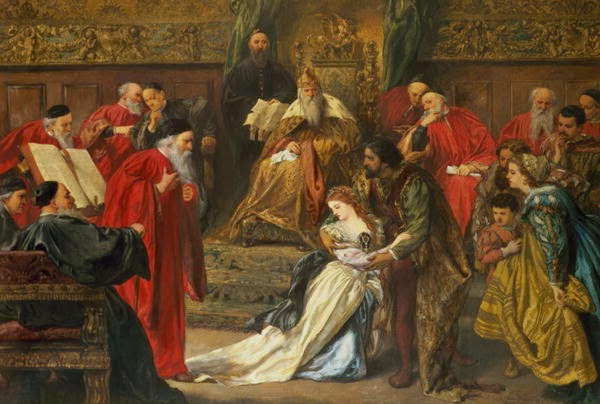
King Lear , by William Shakespeare  For the Literary Movement Challenge, Fanda asked readers to focus on drama.  Before I figured that out, I was considering reading Tyndale's Obedience of a Christian Man and worrying that I would never be able to read it in the time.  I still plan to read Tyndale but it was somewhat easier to read a couple of Shakespeare plays for February.  Cordelia in the court of King Lear, by Ford Madox Brown King Lear is a fairy tale cast as a historical event and tragedy.  Lear was a legendary pre-Roman king in Britain; he appears (spelled Leir) in Geoffrey of Monmouth's History of the Kings of Britain , and in Holinshed, where Shakespeare got the story.   Lear, a rather silly king, decides to divide his kingdom between his three daughters based on how fervently they declare their love for him.  The two older sisters walk off with the swag, and youngest Cordelia, who honestly loves her father but refuses to flatt...

Love's Labour's Lost

Image
Love's Labour's Lost , by William Shakespeare I wanted to hit 90/150 on my Classics Club list by the end of the year (I decided this right before Christmas) so I figured a Shakespeare play would be about right.  I wanted a comedy that I hadn't read before, so I chose Love's Labour's Lost (it was a competition between that and The Merry Wives of Windsor ).  After all, I just read a fun mystery that featured a newly-discovered script of Love's Labour's Won (Love Lies Bleeding , by Edmund Crispin, in case you're dying to know). The plot: Ferdinand, King of Navarre, talks his three best buddies into entering a three-year pact to study hard and practice virtue.  They will eat only plain food, fast once a week, sleep little, and...never talk to any women at all ever.  The impracticality of this silly plan is promptly revealed when the Princess of France shows up--with three of her best friends--to conduct some diplomatic business.  Naturally, each man f...